

On this page
If you have dyslexia, a page of physics can feel like two problems stacked together: decoding the words, then understanding the idea. AI tools can take some weight off the first problem, so more of your energy goes to the second. The catch is that a tool which rewrites science in simpler words can quietly change what it means.
Does text-to-speech help students with dyslexia?
The evidence points to a modest benefit. Dyslexia is a common learning difficulty that does not affect intelligence, as the NHS explains. Hearing text while you read can ease some of the decoding load.
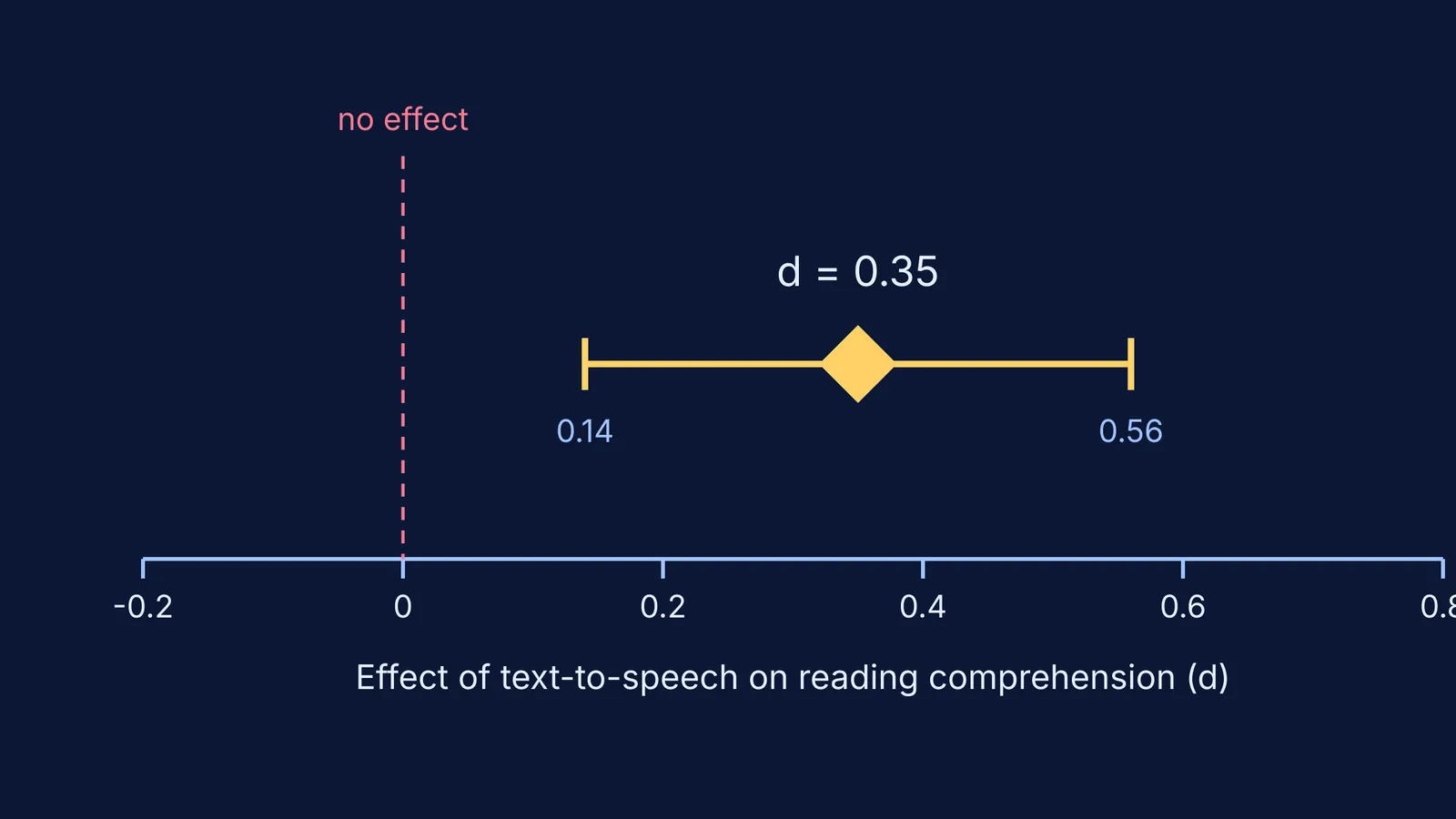
A meta-analysis by Sarah Wood and colleagues at Florida State University, published in the Journal of Learning Disabilities, pooled studies of text-to-speech and read-aloud tools for students with reading difficulties. The average effect on reading comprehension was d = 0.35, with a 95% confidence interval of 0.14 to 0.56. The authors conclude these tools may help, and say more studies are needed to understand when they work best.
In practice, listen and read along rather than only listening. Slow the voice down for dense paragraphs, and replay a sentence when it contains a definition or a condition such as "only if".
Can AI simplify science text without changing the meaning?
Sometimes, but not reliably. Simplification means rewriting text so it is easier to read while keeping the same information.
A study presented at ACL 2022 on factuality in automatic text simplification found errors were common in simplified texts, such as added statements the original did not support or missing key information. The authors warn that a more readable but inaccurate version may in many cases be worse than none at all.
A later study by Sweta Agrawal and Marine Carpuat, in Transactions of the ACL, tested simplified texts with reading comprehension questions. Even the best supervised system left readers unable to answer at least 14% of the questions from the simplified text alone.
In science, the small words carry the meaning: "net", "per", "directly proportional", "at constant temperature". Those are exactly the words a simplifier is tempted to drop.
How do you check an AI explanation keeps the meaning?
Take a Class 11 physics example.
Original: "The acceleration of a body is directly proportional to the net force acting on it and inversely proportional to its mass."
A poor simplification: "Pushing something harder makes it go faster, and heavy things are slow." This swaps acceleration for speed, drops "net" and turns a relationship into a vague rule.
A good simplification: "Acceleration is how quickly velocity changes. If the total (net) force on an object doubles, its acceleration doubles. If the mass doubles and the force stays the same, the acceleration halves. In symbols, a = F/m."
Run this five-point check on any simplified passage:
Terms kept: every technical word in the original still appears, with a plain meaning beside it.
Equations unchanged: symbols, powers and signs match the textbook exactly.
Numbers and units match: every value keeps its exact digits and unit, with no rounding to "about".
Conditions survive: words like "net", "constant", "only if" and "in a vacuum" are still there.
Teach it back: close the AI text and say the idea aloud in one or two sentences, then compare with the original.
For more ways to test yourself, see five quick ways to check you understood an AI explanation. In maths, AI can also slip on calculations, so use the steps in why AI chatbots get maths wrong.
What should you ask an AI tool to do?
A clear request gets a safer answer. Copy this script:
"Rewrite this paragraph in short sentences. Keep every technical term and add a plain meaning in brackets."
"Do not change any equation, number or unit."
"After the rewrite, list anything you left out or changed."
"Give me one everyday example and one question to check I understood."
That third line matters most. It makes the tool show you its own edits, so you know where to look in the textbook.
Some ideas are easier to see than to read. Fermi's AI tutor decides whether to explain, ask or show, and can draw the figure as it teaches, which takes some of the load off reading. If a single term keeps tripping you up, the Fermi Concept Library gives every concept in physics, chemistry, biology and mathematics its own lesson.
Where do parents and schools fit in?
AI tools support a student; they do not diagnose or replace formal help. If you suspect dyslexia, our guide to dyslexia and dyscalculia signs and how assessment works explains the next steps. Ask your school about the support available in class and in exams.
Start small this week: pick one textbook section, listen while you read, simplify one paragraph with the script above, and run the five-point check.


