

On this page
When you face an equation like x² - x - 6 = 0, your first hurdle is not doing the maths—it is choosing how to do it. Should you factorise, complete the square, or jump straight to the quadratic formula?
A 2024 study of 46 Grade 9 students found that mishandling signs and computational mistakes during factoring or completing the square are common errors in quadratic equations (Baybayon & Lapinid, 2024). Choosing the wrong method wastes time and invites these very mistakes.
Instead of hunting for the final answer, you can use an AI tutor to practice choosing the best method before you calculate a single number. This active decision-making strengthens your algebraic instincts.
Why is choosing the method the hardest part?
Every quadratic equation can be solved using the quadratic formula, so why not use it every time? The formula involves squaring numbers, subtracting them, and taking square roots, which leaves plenty of room for those common sign errors.
Factorisation is much faster and less prone to calculation errors, but it only works if the roots are rational numbers. You have to hunt for two numbers that multiply to your constant and add to your middle coefficient. Completing the square is elegant and forms the basis of many higher-level math topics, but if the middle term is an odd number, you end up wrestling with messy fractions that often lead to arithmetic mistakes. Getting the right method makes the rest of the problem flow naturally. If you want to dive deeper into why roots behave the way they do, read our guide on Quadratic equations for JEE: nature and location of roots.
Ask AI: factorise or use the quadratic formula?
This is exactly where Fermi's AI tutor helps. When you bring a problem set, the tutor builds a plan for the session and teaches through it. It holds a line of reasoning across the session, deciding whether to explain, ask, or show, and checking understanding as it goes. If you choose factorisation for an equation that doesn't factorise cleanly, the tutor will write on a board to show you why it fails before guiding you to the formula.
To pick the right method on your own, use this four-step decision framework:
Is the constant missing?
If your equation looks like ax² + bx = 0, always factor out x. This gives x(ax + b) = 0. One root is zero, and the other is -b/a. This takes only seconds.
Can you spot the factors instantly?
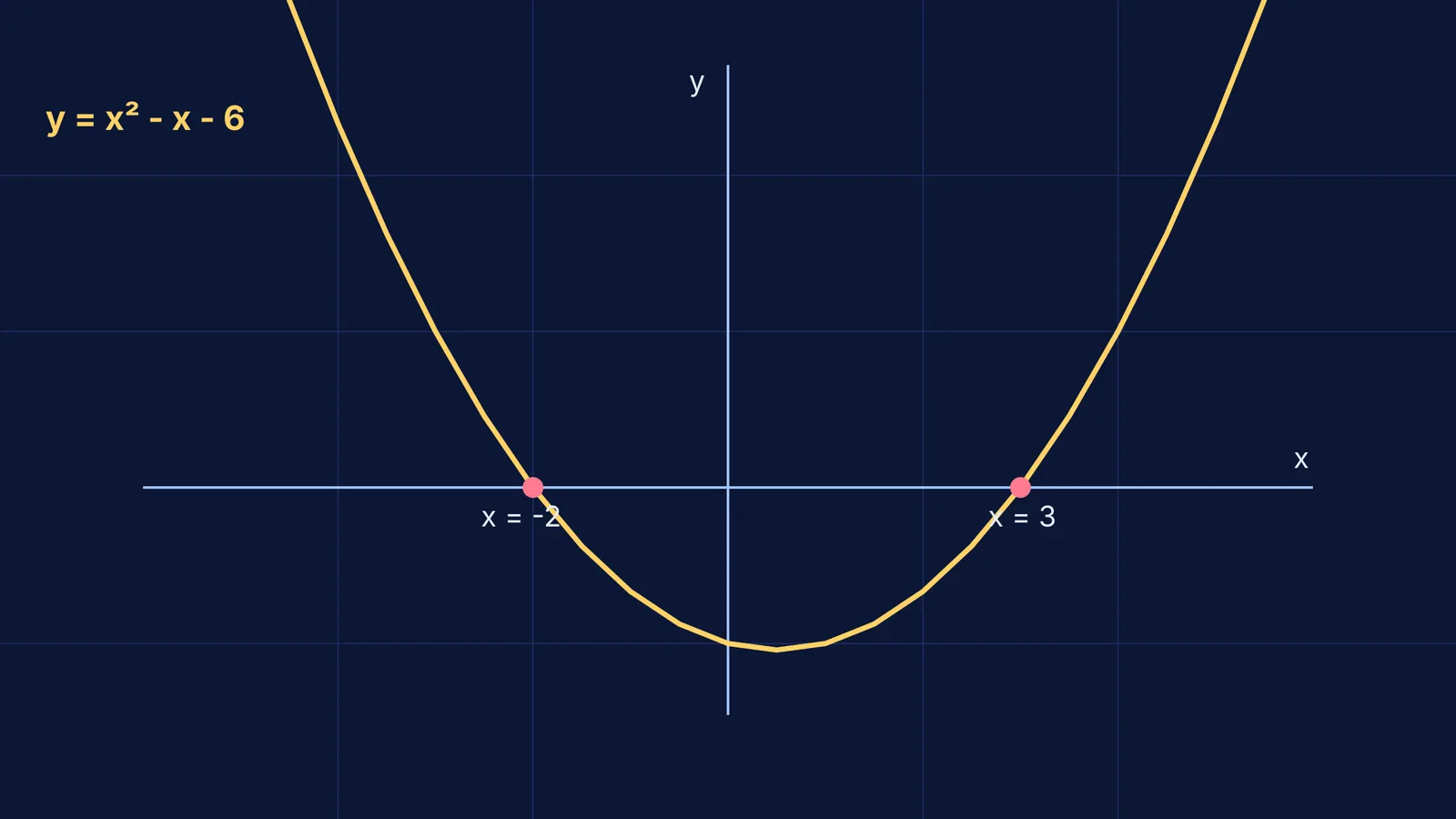
If a = 1, look for two numbers that multiply to c and add to b. In x² - x - 6 = 0, the numbers -3 and 2 multiply to -6 and add to -1. If they jump out at you, factorise.
Is the middle term even?
If a = 1 and b is an even number, completing the square is extremely fast and avoids large numbers. For x² + 6x - 7 = 0, halving the 6 to get 3, squaring it to 9, and adding it to both sides is far simpler than plugging numbers into the quadratic formula.
Are the numbers messy?
If a is not 1, or if you cannot see the factors within ten seconds, use the quadratic formula. It is reliable for difficult fractions and irrational roots.
You can read more about checking this value in our article on When is ax² + bx + c positive for all x? The discriminant test.
How to check your roots by substituting?
Once you have your answers, how do you know you avoided the common sign errors highlighted by researchers? You must check your roots by substituting them back into the original equation.
If your equation is x² - x - 6 = 0 and you found x = 3, substitute 3 for x: (3)² - 3 - 6 equals 9 - 9, which is 0. Since both sides equal zero, your root is correct. Then, check your second root, x = -2: (-2)² - (-2) - 6 equals 4 + 2 - 6, which is also 0.
If it does not equal zero, you have dropped a negative sign somewhere. This is a crucial habit for exam preparation because it gives you immediate feedback on your accuracy. When working through complex assignments, the Fermi Problem Library offers worked problems with a step-by-step solver that explains the reasoning rather than printing an answer, helping you spot exactly where your substitution went wrong.


