

On this page
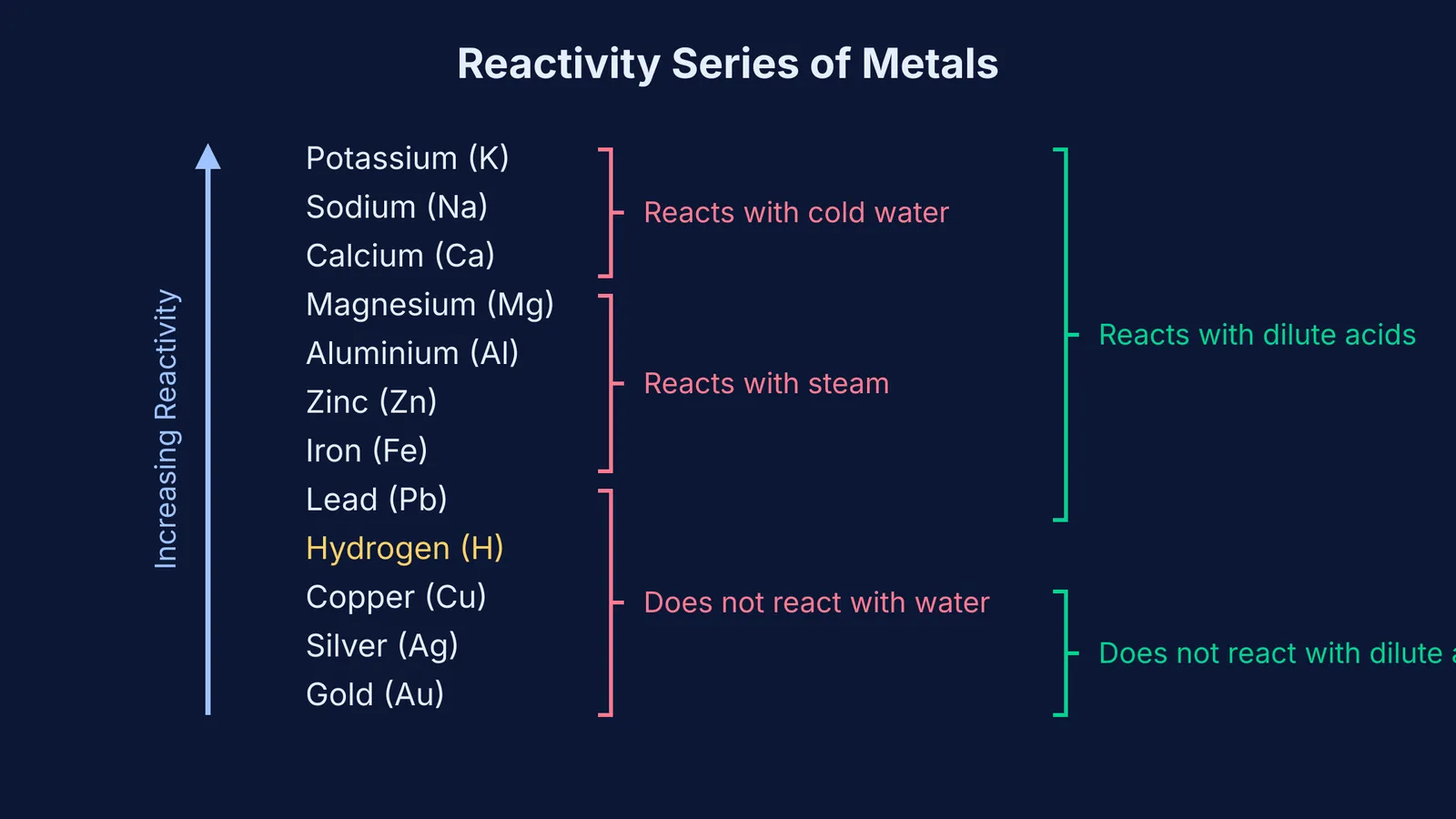
The reactivity series helps us predict the outcome of a chemical reaction. By listing metals from the most reactive down to the least reactive, we can see exactly which metal will react with water, which will react with a dilute acid, and which can displace another metal from a salt solution.
How do we predict if a metal reacts with water, acid, or salt?
In chemistry, a reactivity series is an empirical, calculated progression of metals arranged by their reactivity from highest to lowest. The order places highly reactive metals like potassium and sodium at the top, and unreactive metals like gold and silver at the bottom. Hydrogen is also included in this series as a baseline reference, even though it is a non-metal.
When you know a metal's position in this series, you can confidently predict its chemical behaviour. A metal higher in the series will always displace a metal lower in the series from its salt solution. Similarly, metals above hydrogen can displace hydrogen from dilute acids and water, while those below it cannot. If you need a refresher on the basics of these elements, you can review Metals and non-metals in Class 10: reactivity series and ionic bonds.
What happens when a metal reacts with water?
Not all metals react with water in the same way. The speed and products of the reaction depend entirely on how reactive the metal is:
Cold water: The most reactive metals—potassium, sodium, and calcium—react vigorously with cold water to form metal hydroxides and hydrogen gas. The reaction with potassium is so exothermic that the hydrogen gas immediately catches fire.
Steam: Metals like magnesium, aluminium, zinc, and iron do not react with cold water. Instead, they react with steam to form metal oxides and hydrogen gas. Magnesium, for instance, reacts vigorously with steam to produce magnesium oxide and hydrogen.
No reaction: Metals below iron in the series, such as lead, copper, silver, and gold, do not react with water or steam at all under normal conditions.
Will a metal react with a dilute acid?
When a metal reacts with a dilute acid, such as hydrochloric acid (HCl) or sulphuric acid (H₂SO₄), it produces a metal salt and hydrogen gas. However, this only happens if the metal is more reactive than hydrogen.
Metals like zinc and iron, which sit above hydrogen, will readily bubble and release hydrogen gas when dropped into a dilute acid. For example, zinc reacts with hydrochloric acid to form zinc chloride and hydrogen gas: Zn + 2HCl → ZnCl₂ + H₂.
Metals below hydrogen, such as copper, silver, and gold, will not react with dilute acids. This is why copper is often used for plumbing and roofing—it simply does not corrode when exposed to acidic rainwater. If you find it hard to picture what is happening at the atomic level during these reactions, the Fermi Simulation Lab provides interactive simulations for the ideas that are easier to see than to read, allowing you to observe these energetic reactions safely.
How do metals react with salt solutions?
A single displacement reaction occurs when a more reactive metal takes the place of a less reactive metal in a compound.
If you dip an iron nail into a blue copper sulphate solution, the iron (which is higher in the series) will displace the copper. The solution will turn pale green as iron sulphate forms, and a brown layer of solid copper will coat the nail: Fe + CuSO₄ → FeSO₄ + Cu.
If you tried the reverse—dipping a copper wire into an iron sulphate solution—there would be no reaction, because copper cannot push iron out of its compound. You can read more about foundational tests in Metals and non-metals for Class 7 and 8: properties and tests.
Using Fermi to test metal reactions
Memorising the reactivity series is one thing, but applying it to predict novel chemical reactions during an exam is another. If you have concept gaps when balancing displacement equations or predicting products, the Fermi Concept Library contains every concept in physics, chemistry, biology, mathematics and computing, each with its own lesson.
When you bring a tricky chemistry assignment to Fermi, the AI tutor works out what you already know and builds a plan for the session. It teaches through the problem—writing on a board, drawing the figure, and checking your understanding as it goes—rather than just printing an answer. This one-to-one guidance helps you understand exactly why a reaction happens, ensuring you are ready to predict the next one on your own.


