

On this page
Why ask AI to compare cell organelles?
When preparing for competitive examinations like NEET-UG, cytology presents a dense volume of structural dimensions, membrane configurations, and catalytic functions. In NCERT Class 11 Biology, Chapter 8 ("Cell: The Unit of Life") describes over a dozen organelles across descriptive prose. Memorising these sequentially often leads to confusion during exams that test subtle distinctions between similar structures. For a structured overview of organelle roles, see our guide on Cell: the unit of life for NEET, with organelles compared.
Prompting an artificial intelligence model to arrange organelles into a comparative matrix provides an immediate structural skeleton. A well-designed comparison aligns organelles across shared parameters: membrane boundary count, internal lumen architecture, nucleic acids, and metabolic specialisation. Instead of confronting isolated blocks of text, you see cellular architecture as an interconnected system.
Where do generic AI comparison tables fail NCERT standards?
Artificial intelligence models are trained on massive corpora of general biology papers. While their high-level descriptions are broadly accurate, competitive entrance exams in India evaluate students against the exact definitions in the official NCERT textbook. When an AI generates an organelle table without strict guardrails, it routinely introduces errors that can cost marks.
The most frequent discrepancies appear in four areas:
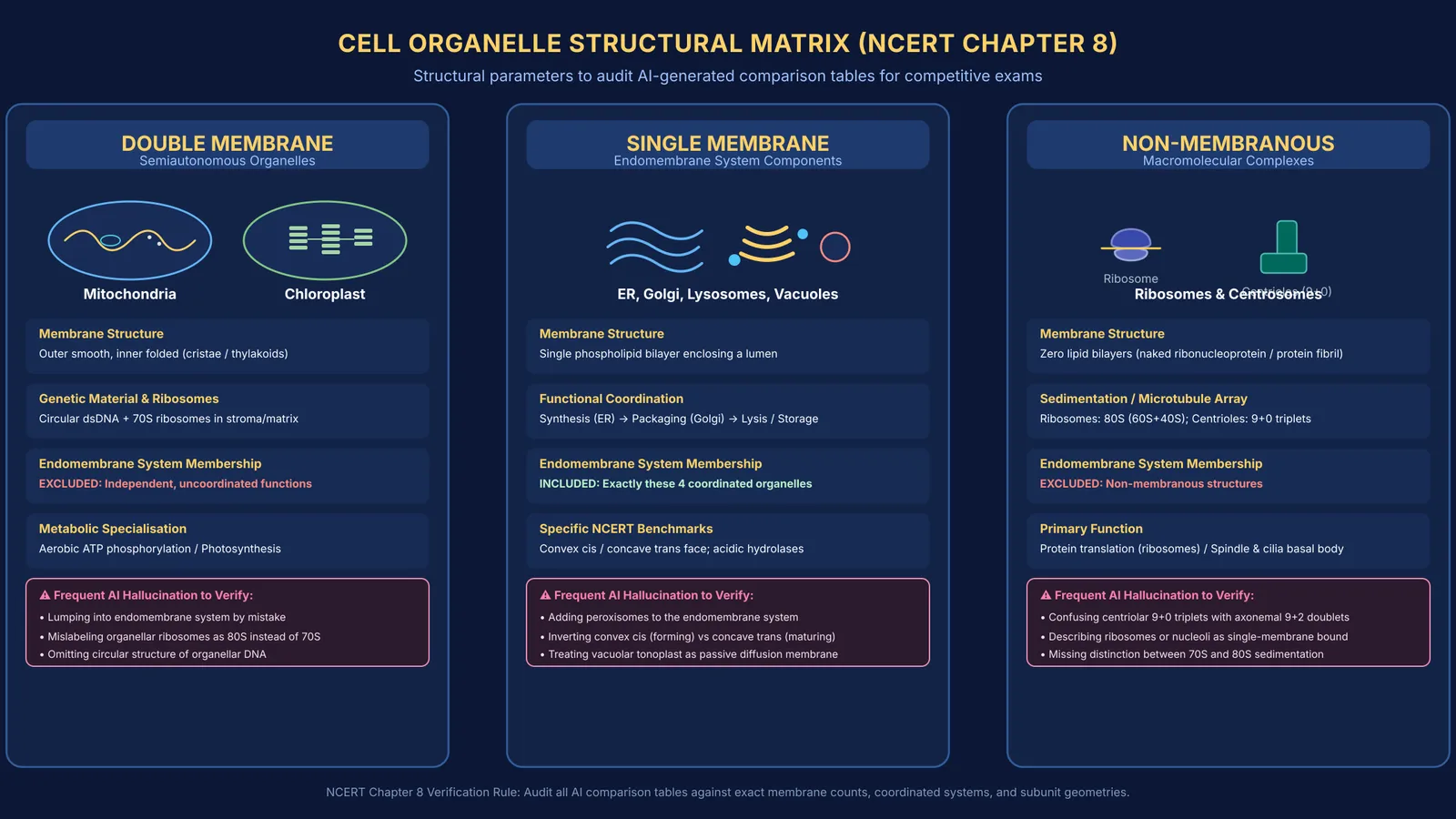
The endomembrane system: NCERT includes only organelles whose functions are coordinated: endoplasmic reticulum, Golgi complex, lysosomes, and vacuoles. Generic AI models frequently add peroxisomes, chloroplasts, or mitochondria simply because they are membrane-bound.
Polarity of the Golgi apparatus: NCERT specifies that Golgi cisternae have a convex cis (forming) face toward the nucleus and a concave trans (maturing) face toward the plasma membrane. Generic AI responses often omit the terms 'convex' and 'concave' or reverse their packaging roles.
Organellar ribosomes and DNA: Mitochondria and chloroplasts contain circular double-stranded DNA and 70S ribosomes in their matrices, whereas eukaryotic cytoplasm contains 80S ribosomes. AI summaries often omit sedimentation coefficients or mislabel organellar ribosomes as 80S.
Solute gradients across the tonoplast: The vacuolar tonoplast actively transports ions against concentration gradients, keeping solute levels significantly higher inside the vacuole than in the cytoplasm. Generic AI tables routinely describe the vacuole merely as a passive storage sac.
Line-by-line fidelity matters; read our analysis on using NCERT lines for NEET biology to understand how examiners construct questions from textbook sentences.
How does the verification habit build deeper retention?
The true value of generating an AI comparison table is not the output itself, but the act of auditing it. When you scan an AI-generated summary passively, you fall prey to the 'illusion of explanatory depth.' Cognitive scientists Leonid Rozenblit and Frank Keil (2002) demonstrated that people consistently overestimate their grasp of complex systems until required to explain every mechanism in detail. Passive reading feels effortless, creating false confidence that collapses during exams.
Verification turns passive reading into active cognitive work. In their landmark 2014 paper on the ICAP framework, Michelene Chi and Ruth Wylie (2014) classified learning into four modes: passive, active, constructive, and interactive. Passive consumption yields the weakest retention. By auditing AI outputs against your textbook, you enter the constructive mode: generating justifications, comparing rival statements, and correcting errors.
This active evaluation produces measurable learning gains. A meta-analysis of 225 STEM studies by Scott Freeman and colleagues (2014) found that active learning reduced average course failure rates from 33.8% to 21.8% and increased student exam scores by 0.47 standard deviations. For more active revision strategies, see our guide on how to read a science textbook actively.
What is the step-by-step verification protocol?
To make verification a reliable study habit, apply this three-phase protocol to dense descriptive chapters:
Prompt for structured contrast: Use a prompt that demands specific parameters rather than open summaries. For example: 'Generate a comparative table for Mitochondria, Chloroplast, Endoplasmic Reticulum, Golgi Apparatus, Lysosome, Vacuole, Ribosome, and Centrosome with columns: Membrane Count, Structural Features, Primary Function, Ribosome or DNA Type, and Endomembrane System Membership.'
Run the five-point NCERT audit: Verify each row against Chapter 8 using this checklist:
Membrane count: Confirm double-membrane, single-membrane, or non-membranous status (ribosomes and centrioles have no membrane).
Endomembrane coordination: Ensure only ER, Golgi, lysosomes, and vacuoles are listed as members; confirm peroxisomes and mitochondria are excluded.
Subunit geometry: Check that mitochondrial cristae, thylakoid grana, and centriolar 9+0 triplets use exact textbook terms.
Matrix components: Ensure organellar DNA is circular and ribosomes are 70S.
Functional conditions: Confirm lysosomal hydrolases require acidic pH and vacuolar transport moves ions against concentration gradients.
Annotate discrepancies: Mark every cell where the AI omitted an NCERT fact or used non-syllabus terms. Writing corrections into your notes cements the concept.
When you need curriculum-aligned concept maps rather than generic text summaries, the Fermi Concept Library maps every concept in physics, chemistry, biology, mathematics and computing, each with its own lesson and its place in the map. If you want interactive guidance while resolving discrepancies, Fermi's AI tutor can work out what you already know, build a plan for your study session, and teach through the concepts step by step.


