

On this page
Why should you turn Class 10 Life Processes into flowcharts?
When preparing for board examinations, Class 10 biology presents a heavy cognitive challenge. In the CBSE Class 10 Science curriculum, Unit II ("World of Living") carries 25 marks out of the 80-mark theory paper, with "Life Processes" serving as its core foundation. The chapter requires students to remember intricate biological sequences: how food moves along the digestive tract, how glucose breaks down under different oxygen conditions, and how blood circulates through cardiac chambers and vascular circuits.
Reading dense paragraphs repeatedly creates an illusion of competence. In a meta-analysis examining 55 studies with 5,818 participants across 67 effect sizes, researchers John C. Nesbit and Olusola O. Adesope showed that learning through node-link diagrams and concept maps produces substantial retention gains compared to reading standard text (Review of Educational Research). Flowcharts externalise memory: they transform continuous prose into discrete nodes, directional arrows, and regulatory checkpoints. When revising Class 10 life processes, structuring physiological pathways into clear sequences helps you recall every enzyme and organ in its exact functional order. Pair these flowcharts with standard CBSE Class 10 science diagrams to master both descriptive sequences and spatial labelling.
How do you prompt an AI tutor for Class 10 biology?
Standard conversational AI tools tend to over-explain. If you ask a general chatbot to describe respiration or digestion, it frequently outputs college-level terminology—such as Krebs cycle intermediates, acetyl-CoA, or specific electron transport cofactors—that are outside the Class 10 syllabus and distract from the marking scheme.
To keep the output tightly aligned with your board requirements, use a constrained prompt:
"Act as an NCERT Class 10 biology tutor. Create a sequential text flowchart for [Topic: Human Digestion / Breakdown of Glucose / Double Circulation]. Use only the organs, enzymes, substrates, and physical conditions explicitly described in the NCERT Class 10 Science textbook. Structure each stage as: Location -> Secretion or Enzyme -> Substrate -> Product -> Biological mechanism."
This structured framing forces the AI to output crisp, linear steps rather than paragraphs. Instead of simply generating answers to copy down, Fermi's AI tutor holds a line of reasoning across a session, noticing where a student is stuck and deciding whether to explain, ask, or show. This conversational guidance helps students unpack complex multi-step processes without losing the big picture.
Which NCERT errors and hallucinations must you audit?
Generative models assemble text based on statistical likelihood rather than verified physiology. Because AI models are trained on vast web corpora containing university physiology and simplified trivia, they regularly introduce subtle factual errors. You must audit every generated node against the NCERT Science textbook across the three core systems:
Nutrition and digestion:
The mouth: Confirm that salivary glands secrete saliva containing salivary amylase, which breaks down starch into simple sugars.
The stomach: Check that gastric glands release hydrochloric acid (creating an acidic medium), pepsin (digesting proteins), and mucus (protecting the inner stomach lining).
The small intestine: Verify that bile juice from the liver contains bile salts that emulsify large fat globules into smaller globules and make the medium alkaline, but does not contain digestive enzymes. Ensure pancreatic juice provides trypsin (digesting proteins) and lipase (breaking down emulsified fats), while intestinal enzymes complete digestion into glucose, amino acids, fatty acids, and glycerol.
Respiration pathways:
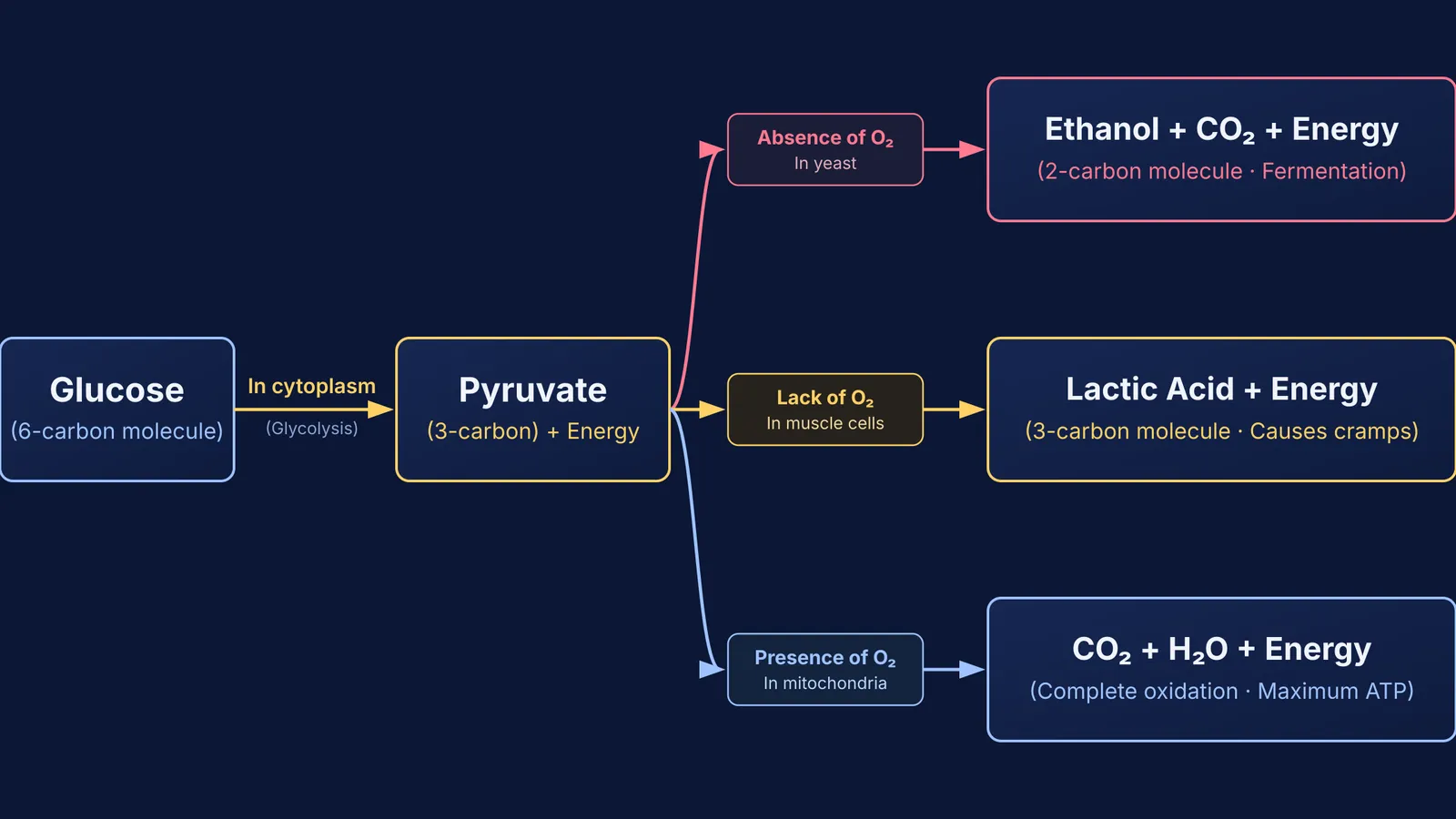
Cytoplasm breakdown: Confirm that 6-carbon glucose is first converted into 3-carbon pyruvate plus energy in the cell cytoplasm.
The three terminal fates: Audit the three branches carefully. In yeast (absence of oxygen), pyruvate converts to ethanol (2-carbon), carbon dioxide, and energy. In human muscle cells (lack of oxygen), pyruvate converts to lactic acid (3-carbon) and energy, causing cramps. In mitochondria (presence of oxygen), pyruvate breaks down into carbon dioxide, water, and energy.
Transport mechanisms:
Human circulation: Check the path of double circulation. Deoxygenated blood from the body enters the right atrium via the vena cava, flows into the right ventricle, and travels via the pulmonary artery to the lungs. Oxygenated blood from the lungs returns via pulmonary veins to the left atrium, moves into the left ventricle, and is pumped via the aorta to the body.
Plant transport: Confirm that xylem moves water and minerals upward unidirectionally through tracheids and vessels driven by root pressure and transpiration pull. Phloem translocates soluble products of photosynthesis (sucrose) and amino acids bidirectionally using ATP to create an osmotic pressure gradient.
How does textbook verification strengthen board exam prep?
The highest learning value of generative AI does not lie in the speed with which it drafts a flowchart; it lies in the cognitive effort of auditing that flowchart. When you examine each node to catch whether an AI mistakenly placed trypsin in the stomach or called the pulmonary vein deoxygenated, you engage in active error detection and discriminative recall.
To make this routine a core part of your revision:
Generate the draft flowchart using the constrained prompt.
Cross-check every single arrow, substrate, and condition with your NCERT textbook open beside you.
Highlight any missing details—such as the role of intestinal villi in absorption or the rings of cartilage in the trachea that prevent respiratory collapse.
Redraw the verified flowchart from memory into your revision notes.
Integrating this audit method into a structured Class 10 science revision plan ensures complete mastery before exam day. For students seeking to understand the deeper structural logic behind biological and physical phenomena, the Fermi Concept Library maps every concept in physics, chemistry, biology, mathematics and computing, each with its own lesson and its place in the map.


