

On this page
The Mendelian monohybrid cross is one of the most important concepts in the Class 10 science syllabus. While drawing the grid might seem like a simple game of matching letters, getting the biological mechanism right is harder than it looks. According to a 2016 study published in *Transactions on Science and Technology* by Awang-Kanak et al., 47.4% of foundation science students struggled with basic Mendelian inheritance problems. A major stumbling block was simply figuring out how gametes separate from a parent's genotype.
Rather than just memorising the classic 3:1 ratio, working with an AI tutor can help you connect the dots between the letters on the page and the real biology of how traits are passed down.
What is a monohybrid cross in Class 10?
A monohybrid cross tracks the inheritance of a single contrasting trait—for example, plant height (tall versus dwarf) or seed shape. When Gregor Mendel cross-pollinated a pure tall pea plant (homozygous dominant, TT) with a pure dwarf plant (homozygous recessive, tt), he discovered that all the offspring in the first generation (F1) were tall.
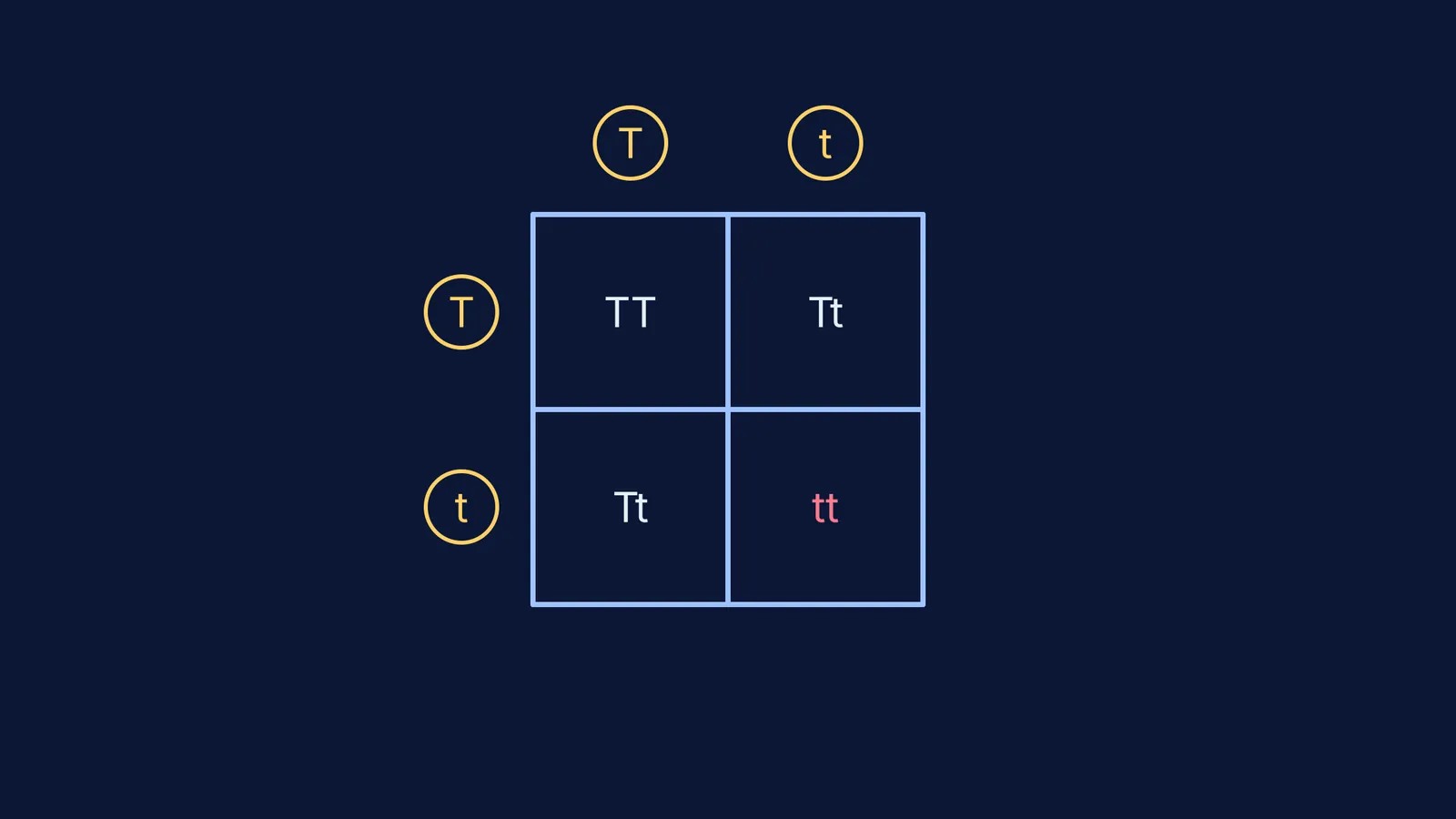
To map this out, you use a Punnett square. The alleles (versions of the gene) from each parent separate during gamete formation. The grid then shows all the possible ways these gametes can combine during fertilisation.
It is easy to view the Punnett square as just a multiplication table. However, it actually represents biological probability. Each box inside the grid represents a 25% chance for a single offspring's genotype. Every time a new seed is formed, the probability resets.
If you are trying to work backward from an offspring's phenotype to determine the parents' exact genetics, you might need to perform a specific type of test. For a deeper dive into finding unknown parent genotypes, see our guide on the Test cross vs back cross: identifying an unknown genotype.
Why do traits skip a generation?
When Mendel allowed his F1 generation of tall plants (all carrying the mixed Tt genotype) to self-pollinate, the dwarf trait suddenly reappeared in the next generation (F2).
This phenomenon explains why traits can seem to skip a generation. The recessive allele (t) was never lost or destroyed in the F1 plants; it was simply hidden by the dominant allele (T). When two heterozygous plants (Tt) are crossed, there is a one-in-four chance that an offspring will inherit the recessive allele from both parents (tt), allowing the hidden trait to express itself visibly.
This mechanism is codified in Mendel's Law of Segregation and Law of Dominance. It isn't just a rule for pea plants; it governs many human genetic conditions where perfectly unaffected carrier parents can pass on a trait to their children. You can read more about how this works in humans in our article on Mendelian disorders: sickle-cell anaemia, thalassemia and PKU.
How can an AI tutor help with heredity?
When practising these crosses at home, many students make algorithmic errors. A common mistake is putting two alleles into a single gamete circle, or assuming that if one child has a recessive trait, the next three will definitely have the dominant one.
Fermi's AI tutor teaches rather than answers: it holds a line of reasoning across a session, notices where a student is stuck, and decides whether to explain, ask, or show. If you place the wrong alleles on the outside of your grid, the tutor works out what you already know and builds a plan for the session, stepping back to write on a board and explain the physical process of meiosis that separates the genes.
A script to check your work
Instead of typing a question from your textbook and just copying down the answer, use your AI tutor to actively verify your logic. Here is a practical script you can use to check your own Punnett squares step-by-step:
State the parent cross: "I am crossing a heterozygous tall plant (Tt) with a homozygous dwarf plant (tt)."
State your gametes: "I think the gametes for the first plant are T and t, and for the second plant they are only t."
State your result: "My Punnett square gives me 50% Tt offspring and 50% tt offspring. Is this phenotypic ratio correct?"
Ask the underlying 'why': "Can you explain why the Law of Segregation makes these gametes split this way during meiosis?"
By asking the AI to review your steps, you ensure that your foundational understanding is sound.
When you are ready to tackle more complex exam questions, such as dihybrid crosses or working out probabilities, the Fermi Problem Library has worked problems with a step-by-step solver that explains the reasoning rather than printing an answer.


