

On this page
In Class 7 science, one of the most common hurdles for students is telling heat and temperature apart. In everyday conversation, we use them interchangeably. You might say, "Turn up the heat" when you mean "Increase the temperature," or describe a hot day as having "a lot of heat." But in physics, these two words describe completely different properties of matter.
When a student gets stuck on these definitions, textbook explanations can sometimes feel dry or confusing. A highly effective way to clear up this confusion is to ask an AI tutor to explain the difference using everyday cases, and then test the AI with a tricky problem. This active learning approach builds a much deeper understanding than simply memorizing definitions.
What is the difference between heat and temperature?
To get started, ask your AI: "Explain the difference between heat and temperature using a simple analogy."
The AI should tell you that heat is the total energy of all the molecular motion within an object, representing the energy transferred due to a temperature difference (BYJU'S). Because heat is a form of energy, we measure it in Joules (J). The more molecules an object has, and the faster they move, the more heat energy it contains.
Temperature, on the other hand, is a measure of the average kinetic energy of those molecules, indicating the exact degree of hotness or coldness (BYJU'S). We measure temperature using a thermometer, usually in degrees Celsius (°C). Temperature does not depend on the size of the object or how many molecules are in it; it only depends on how fast they are vibrating on average.
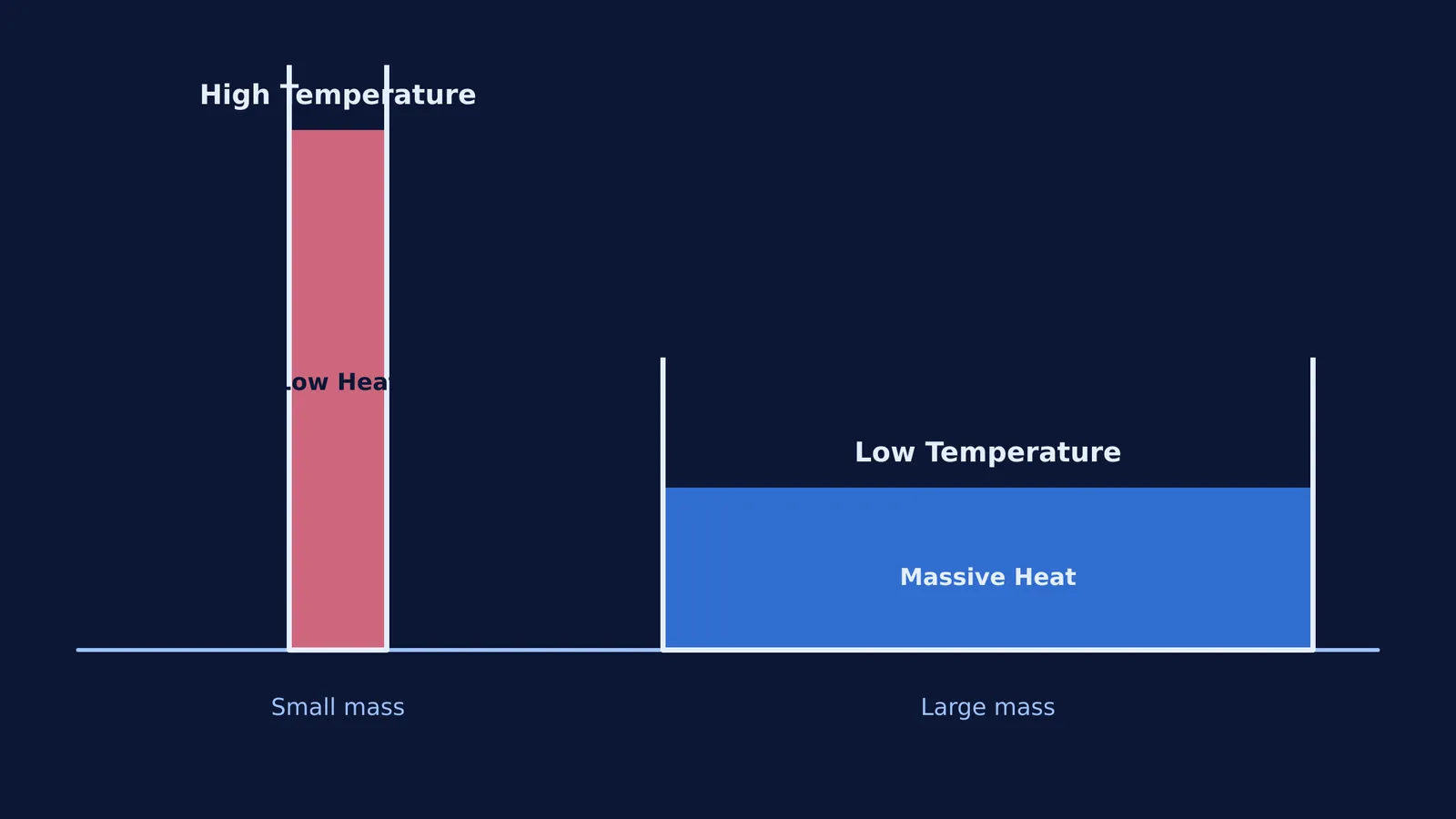
Think of temperature as the water level in a tank, and heat as the total volume of water. A very narrow tube can have a high water level but hold very little water in total. A wide swimming pool might have a low water level but hold a massive volume of water.
Why doesn't a spark from a sparkler burn you?
To really see if the AI can reason—and to test your own understanding—give it a puzzle that relies on the mass of the object. A typical sparkler burns at temperatures between 1,000 °C and 1,600 °C (Wikipedia). Try this prompt:
"A sparkler reaches temperatures over 1,000 °C, but a single flying spark doesn't usually cause a severe burn if it lands on your hand. Meanwhile, a bucket of warm water has a much lower temperature, but falling into it would instantly warm up your whole body. Why is that?"
A capable AI tutor, like Fermi, will explain that this is exactly where mass matters. The individual spark is incredibly hot, which means the average kinetic energy of its particles is exceptionally high.
However, the spark is just a microscopic piece of burning metal. Because its mass is so small, its total thermal energy (heat) is very low. When it hits your skin, it transfers that tiny amount of heat and reaches thermal equilibrium with your hand almost instantly, usually cooling down before it can cause real damage.
The bucket of water has a much lower temperature. But because there are vastly more water molecules, the total heat energy stored inside it is massive. It can transfer a huge amount of heat to your body without its own temperature dropping very much.
How do icebergs and boiling water compare?
If you want to push the concept further, you can ask the AI to compare an iceberg to a cup of boiling water. This is a classic physics thought experiment.
The boiling water has a high temperature, and the iceberg has a very low temperature. But which one contains more heat energy?
Because the iceberg is a massive block of ice, the total energy of all its slow-moving molecules combined is vastly greater than the energy in a single cup of fast-moving hot water. Asking an AI to break down this scenario helps cement the idea that heat is extensive (it depends on mass) while temperature is intensive (it does not).
How do you apply this to exam problems?
When you use an AI tutor, active learning means putting the concept to use rather than passively reading the screen. Do not just read the answer; ask the tutor how this definition connects to other topics you will study later.
For instance, when studying heat in isobaric and isochoric processes, the distinction between total energy added to a system and the resulting rise in temperature is what makes the thermodynamic equations work. The law of specific heat by Dulong and Petit is also entirely based on how atomic structure and mass dictate a material's ability to store that heat energy.
Next time you hit a confusing definition, do not settle for a basic textbook summary. Ask for a puzzle, test the edges of the idea with extreme examples like a spark or an iceberg, and let the AI guide you to a deeper understanding.


