

On this page
Most physics chapters end with a box of formulas, and many students try to learn the box. Learned as separate facts, they blur under exam pressure. Learned as a family, where each one comes from another, most of them stop needing to be memorised, because you can rebuild them in a few lines.
An AI chatbot is quick at drafting that family tree, but not reliable enough to trust unchecked. So the AI drafts the map, and you verify every link by deriving it yourself.
Why connect formulas instead of memorising them?
In a classic study, Chi, Feltovich and Glaser (1981) asked physics experts and novices to sort and represent problems. The experts started from the physics principle behind a problem; the novices started from its literal features. Building a formula tree is one way to practise that expert habit of tracing each equation back to its principle.
Deriving the links is also a form of self-explanation. In a 1989 study of students learning mechanics from worked examples, Chi and colleagues found that the stronger students explained steps to themselves and related them to principles in the text, while weaker students explained less and later leaned heavily on the examples. A review of 10 learning techniques by Dunlosky and colleagues (2013) rated self-explanation as moderate utility: promising, but not yet adequately tested in real classrooms.
How do you ask AI to map a chapter's formulas?
Type out the formula list from your textbook chapter, then use a prompt like this one.
Asking for conditions matters: v = u + at stops holding the moment the acceleration changes. If you have never drawn a map like this, our guide to building a concept map for science covers the layout.
Worked example: the kinematics family tree
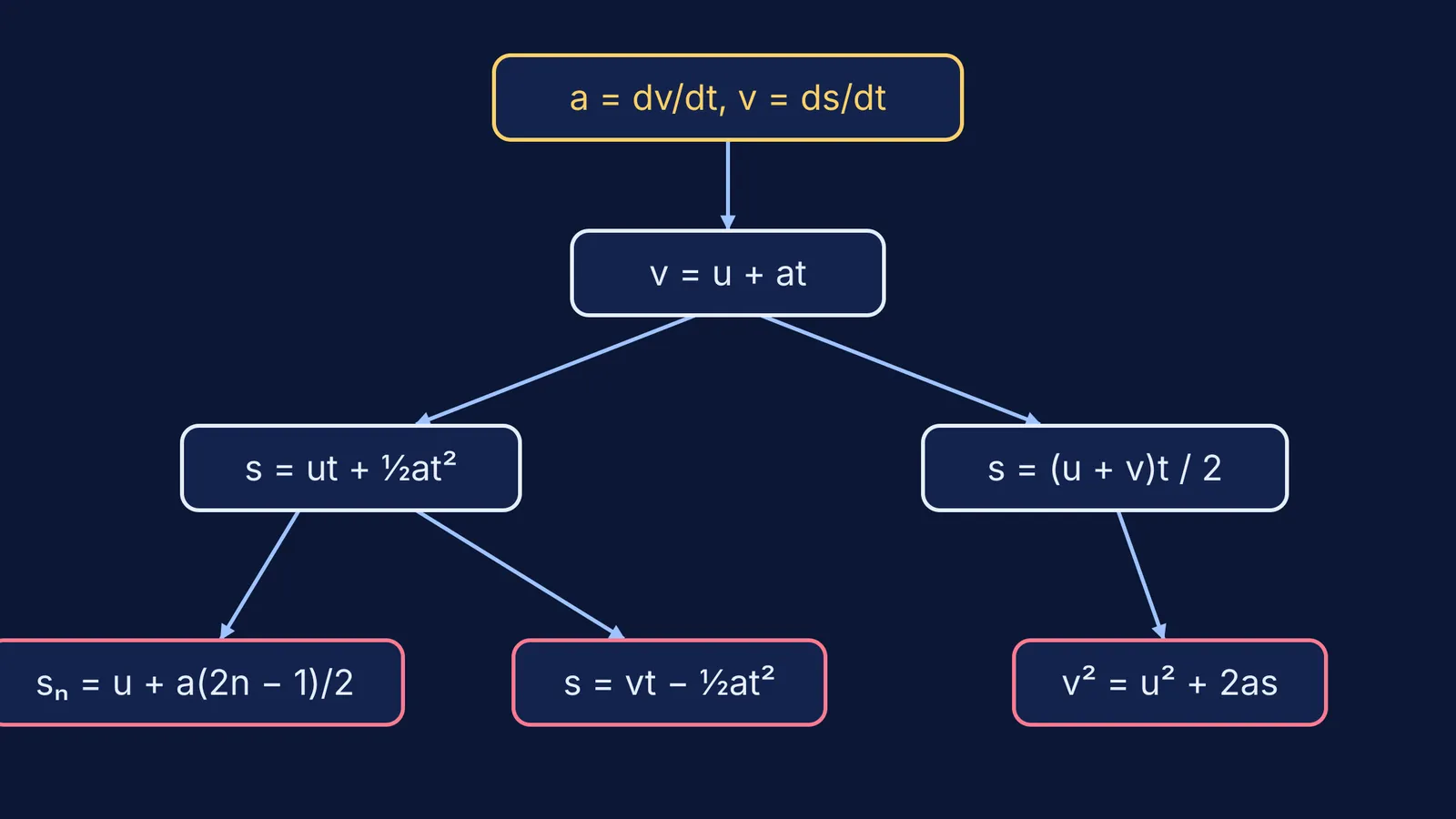
Here is a correct map for motion in a straight line with constant acceleration, the same tree shown in the diagram above.
Root: the definitions a = dv/dt and v = ds/dt, with a held constant.
Integrate a once: v = u + at.
The v–t graph is now a straight line, so the area under it is a trapezium: s = (u + v)t/2.
Integrate v = u + at, or substitute it into step 3: s = ut + ½at².
Eliminate t between steps 2 and 3. From step 2, t = (v − u)/a, so s = (v + u)(v − u)/2a, which rearranges to v² = u² + 2as.
Replace u with v − at in step 4: s = vt − ½at².
Subtract the distance covered in (n − 1) seconds from the distance covered in n seconds: sₙ = u + a(2n − 1)/2.
Six formulas, one root. You need to remember the two definitions and the condition that a is constant; the rest is a few lines of algebra away.
How do you check each link the AI gives you?
Chatbots can produce algebra that looks right and is not; here is why AI chatbots get maths wrong, with a five-step way to check. Check your tree like this:
Cover the AI's step and derive the link yourself on paper.
If you get stuck, read only the AI's one-line step, then try again.
Check units on both sides. If sₙ looks dimensionally odd, you have found the hidden 1 second in it.
Check a limit: set a = 0, and every formula should reduce to v = u or s = ut.
Cross out any link you cannot derive and ask the AI to justify it step by step. If it still fails, go back to your textbook.
If a derivation keeps stalling, Fermi's AI tutor holds a line of reasoning across a session and decides whether to explain, ask or show, writing on a board as it goes, so you can work through the stuck step instead of copying an answer. The Fermi Concept Library gives each concept its own lesson and its place in the map, which helps when a link depends on an idea from an earlier chapter.
What should you still memorise?
You will not derive everything in the exam hall. Sort each formula into one of three groups:
Roots: definitions and laws. Memorise these exactly.
Fast leaves: formulas you use in nearly every problem, like v² = u² + 2as. Memorise these for speed, but know where they come from.
Slow leaves: formulas you need rarely. Keep the derivation, not the formula.
For CBSE boards, where derivations often appear as questions, the tree doubles as a revision list; see how to structure a physics derivation that earns marks.
A few days later, redraw the tree from memory. Any arrow you cannot rebuild is your next study session. Start with one chapter this week.


