

On this page
Why do students forget the middle steps in biological sequences?
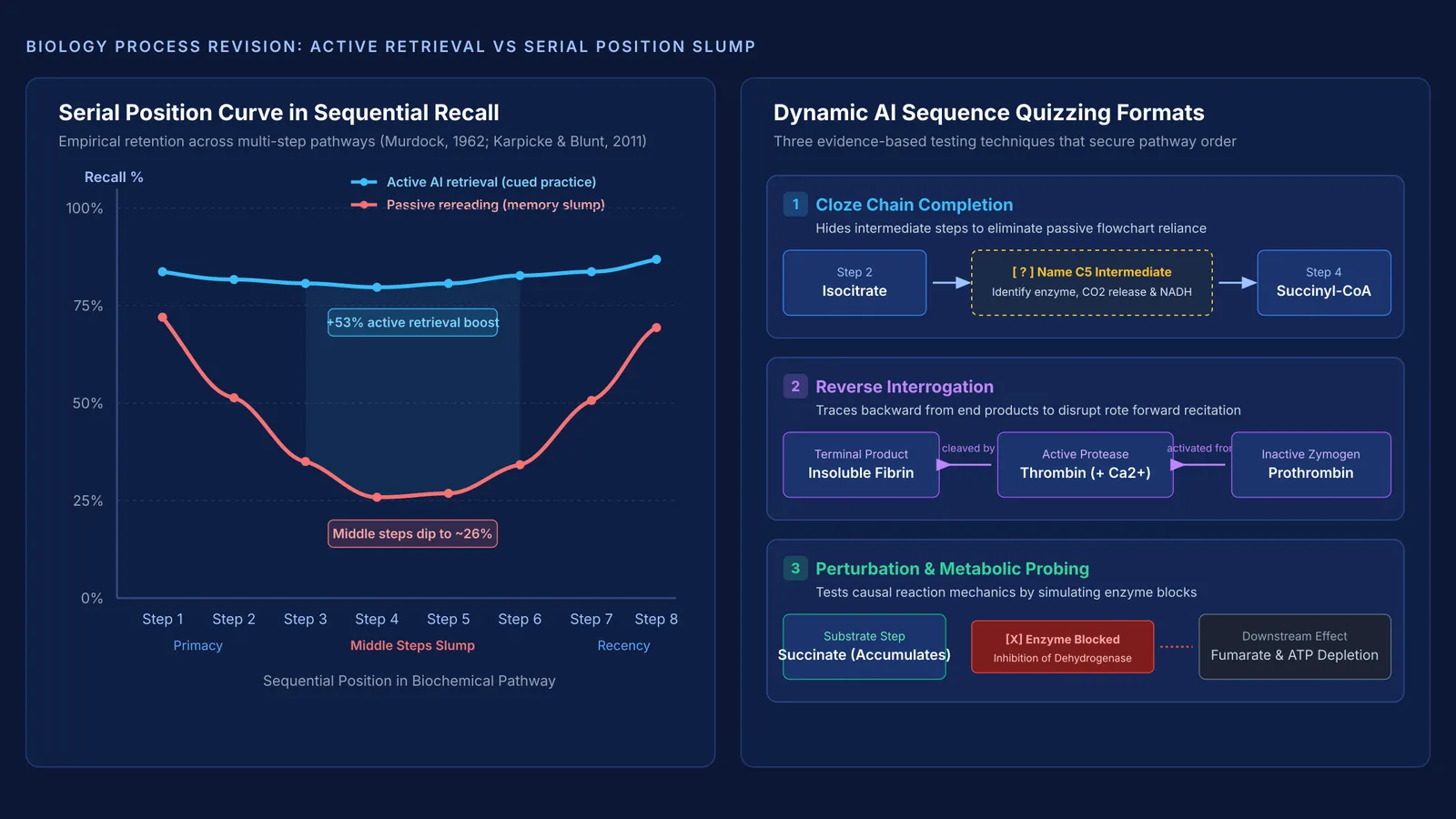
When you revise a multi-step pathway like the citric acid cycle or the blood coagulation cascade, memory fades unevenly. In the *Journal of Experimental Psychology*, psychologist Bennet Murdock established the serial position effect, demonstrating that people recall items at the beginning and end of a list far better than items in the middle. In biology revision, students readily remember that glycolysis begins with glucose and ends with pyruvate, or that the Krebs cycle starts with citrate. The breakdown almost always occurs in the middle, such as confusing the order of α-ketoglutarate, succinyl-CoA, and succinate, or forgetting where substrate-level phosphorylation yields GTP.
Passive review makes this illusion worse. When you reread a pathway diagram or trace flowcharts with a highlighter, familiar names create false confidence. In *Science*, Jeffrey Karpicke and Janell Blunt compared passive concept mapping against active retrieval practice for science texts doi:10.1126/science.1199327. One week later, students using retrieval practice scored an average of 67% on a comprehensive test, compared to 45% for those who used concept mapping. Similarly, Henry Roediger and Jeffrey Karpicke found in *Psychological Science* that testing produced 61% recall after one week, whereas repeated reading produced only 40% doi:10.1111/j.1467-9280.2006.01693.x. Rereading sequential diagrams leaves intermediate transitions fragile under exam pressure.
How can AI quiz you on the order of steps?
Standard revision apps rely on isolated multiple-choice questions that ask you to name a single enzyme. But biological pathways are directional chains where each intermediate depends on the previous reaction. An AI assistant can test these connections dynamically through three sequence-focused formats:
Cloze chain completion: Providing two surrounding steps and asking you to name the missing intermediate, enzyme, and cofactors.
Reverse interrogation: Presenting a terminal product—such as fibrin in the clotting cascade—and asking you to trace backward through active enzymes to initial tissue injury.
Perturbation probing: Asking what happens to downstream metabolites if a specific intermediate enzyme is blocked.
This dynamic probing aligns with findings on whether AI tutors teach better than chatbots that give answers. Rather than generating a completed chart, an AI tutor prompts you step-by-step, noticing where you hesitate and reinforcing the exact links where recall dips.
What do sequence quizzes look like for Krebs and clotting?
To see how this works, consider two pathways tested in Class 11 Biology: the Krebs cycle and the blood clotting cascade. You can prompt an AI model to act as an examiner:
"Act as an oral examiner for Class 11 biology. Give me step 3 of the citric acid cycle (isocitrate to α-ketoglutarate). Ask me to name the enzyme, by-product gas, and reduced coenzyme formed. Do not reveal the answers until I respond, then ask what follows next."
Evaluating your recall of this oxidative decarboxylation step anchors energetic stoichiometry into the sequence, helping you connect respiration as an amphibolic pathway.
For blood clotting, test the cascade triggers and inactive precursors:
"Quiz me on blood clotting under the NCERT syllabus. Ask what inactive plasma protein thrombokinase acts on in the presence of calcium ions (Ca²⁺). Wait for my answer before asking about the conversion to insoluble fibrin."
Isolating each step—tissue trauma releasing thromboplastin, thrombokinase activating prothrombin to thrombin, and thrombin cleaving fibrinogen into fibrin threads—prevents confusing enzymes with inactive zymogens. If you hesitate on cofactor roles, the AI provides scaffolded support following evidence-based principles of hints versus immediate answers.
How should you structure your sequence revision sessions?
To maximize retention, structure your revision routine systematically:
Write out the pathway from memory on a blank page.
Paste your attempt into the AI and ask it to flag missing intermediates without naming them.
Have the AI quiz you on the transitions into and out of those gaps until you answer unprompted.
Redraw the full sequence from memory the following day.
When you need structured, step-by-step practice across your syllabus, Fermi's AI tutor works out what you already know and builds a plan for the session, deciding whether to explain, ask, or show as you work through complex pathways. To review reactions and physiological mechanisms in their wider context, the Fermi Concept Library covers every concept in physics, chemistry, biology, mathematics, and computing, giving every topic its place in the learning map.


