

On this page
The strongest AI systems now score at medal level on the hardest school olympiads, yet a general chatbot can still bluff its way through a proof. If you are preparing for IOQM, INMO or the physics olympiad, the useful question is “which part of the work should I let AI do?”
Can AI solve olympiad maths and physics problems?
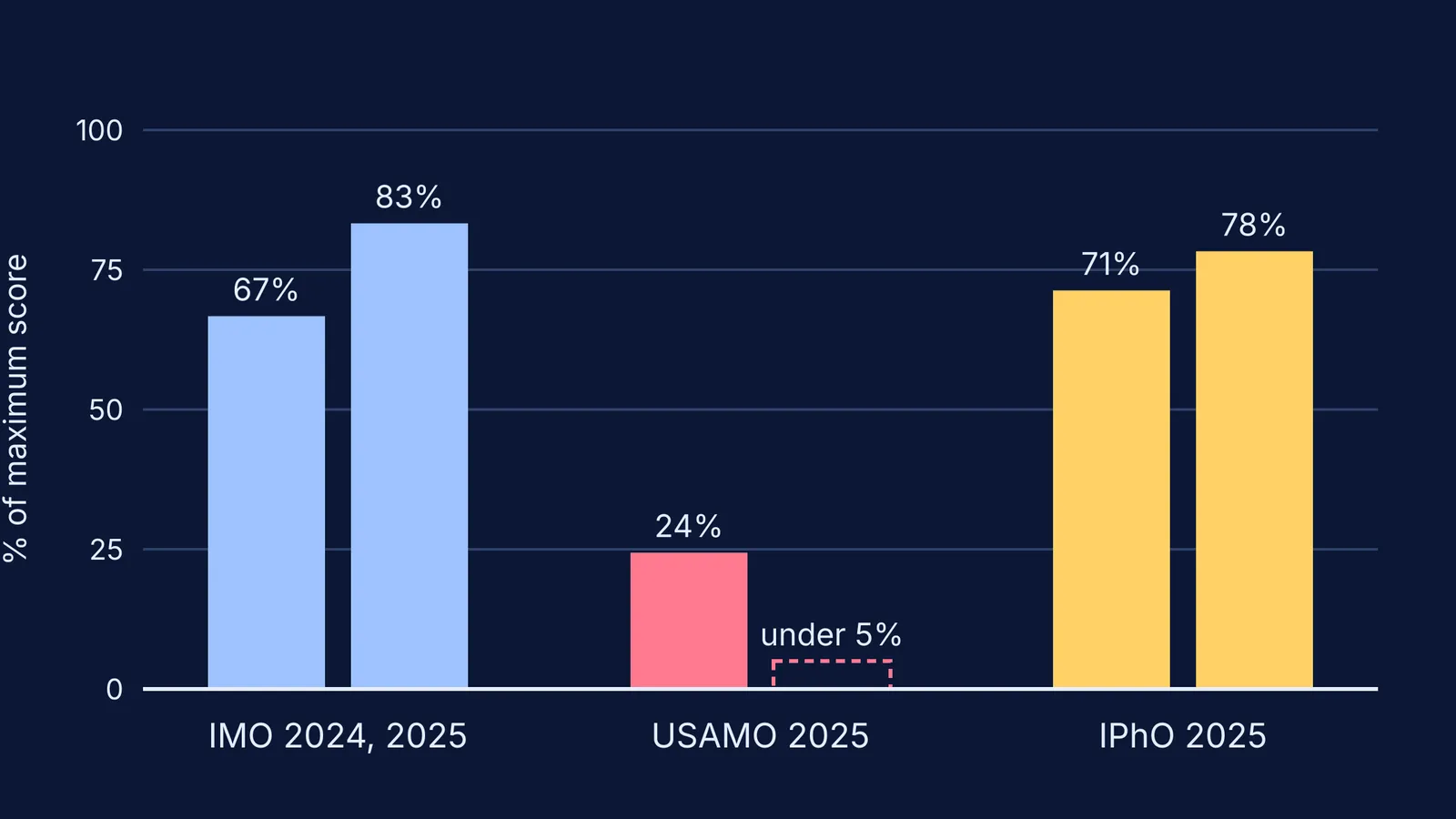
Research systems can, under test conditions. At IMO 2025, an advanced version of Gemini Deep Think solved 5 of the 6 problems for 35 of 42 points, a gold-medal score, writing natural-language proofs within the 4.5-hour limit (Google DeepMind). IMO coordinators graded them with the criteria used for students. A year earlier, AlphaProof and AlphaGeometry 2 scored 28 points, silver standard, but only after experts translated the problems into formal languages such as Lean, and with two to three days of computation.
Physics has followed. An AI agent called Physics Supernova scored 23.5 out of 30 on the IPhO 2025 theory problems, which would have ranked 14th of 406 contestants (Qiu et al., arXiv). A later preprint reported a Gemini 3.1 Pro Preview agent getting full marks on the same problems in each of five runs, but its author warns that the model came out after the competition, so it may have seen them (Huang, arXiv).
Where do AI proofs break?
The clearest test of general chatbots is “Proof or Bluff?”, in which expert judges graded full written solutions to the six USAMO 2025 problems (Petrov et al., arXiv). It tested reasoning models from early 2025, so newer ones may do better. Gemini 2.5 Pro scored about 25%, and every other model scored under 5%. The judges found:
Logic errors, the most common: unjustified leaps, sometimes waved through as “trivial”.
Assumption errors: unproven or false assumptions slipped in.
Creativity errors: a fundamentally wrong strategy.
Algebra and arithmetic errors: a critical miscalculation.
Overgeneralising: checking small cases, then claiming the pattern always holds.
False confidence: every model claimed to have solved the problems, even when it had not.
The last one matters most. A confident wrong proof looks like a right one unless you check each line, and in an olympiad a missing step costs marks. Our guide to how INMO proofs are marked explains why.
Where do AI physics solutions and estimates break?
The Physics Supernova paper shows the weak spots (Qiu et al.). The language model alone, Gemini 2.5 Pro, scored 21.4 of 30. An image-analysis tool cut its average error when reading values off a figure from 0.015 to 0.004, and a final review step added about a point. Scores varied most on the hardest problem.
So expect trouble with numbers read off a figure, with hard problems where one run succeeds and the next fails, and with estimates that hide a wrong power of ten. A plain chatbot may have no measuring or review step, so re-read every value it takes from a diagram and check units yourself. Our post on why AI chatbots get maths wrong covers the arithmetic side.
How should you use AI for olympiad practice?
Use it as a hint ladder, not an answer key. Write your own attempt first, then paste this:
“I'm working on this problem: prove that n^5 − n is divisible by 30 for every integer n. Don't solve it. Give me the smallest useful hint, then stop until I ask for the next one.”
A good ladder looks like this:
Hint 1: factor the expression completely.
Hint 2: n^5 − n = (n − 1)n(n + 1)(n^2 + 1). What do three consecutive integers give you?
Hint 3: that covers 2 and 3. For 5, try each remainder n can leave on division by 5.
Watch for the bluff: “n = 1, 2, 3, 4, 5 all work, so it is always true.” That is the overgeneralising error. The real proof needs the last step: if n leaves remainder 2 or 3, then n^2 + 1 is a multiple of 5.
If you want help that works this way by default, Fermi's AI tutor is built to teach rather than answer: it notices where you are stuck and decides whether to explain, ask or show.
How do you check an AI's olympiad solution?
Check a full AI solution like a strict marker:
Ask it to list every step it calls obvious, then prove each one.
Test edge cases yourself: n = 0, negative numbers, a degenerate triangle.
For physics, check units and limiting cases, such as a mass going to zero.
Re-read any number it took from a figure.
Ask for a second, different method. If the two disagree, at least one is wrong.
Close the chat and write the proof yourself from memory.
The Fermi Problem Library has worked problems with a step-by-step solver that explains the reasoning rather than printing an answer, so you can compare it with your own line of argument.
For more on when a hint helps more than an answer, read what tutoring research says about hints and answers.


