

On this page
NCERT Exemplar questions are built to stretch you past the chapter examples, which is why pasting one into a chatbot is so tempting. For where Exemplar fits in your week, see how to use NCERT Exemplar well.
Why should AI give hints, not answers, on Exemplar questions?
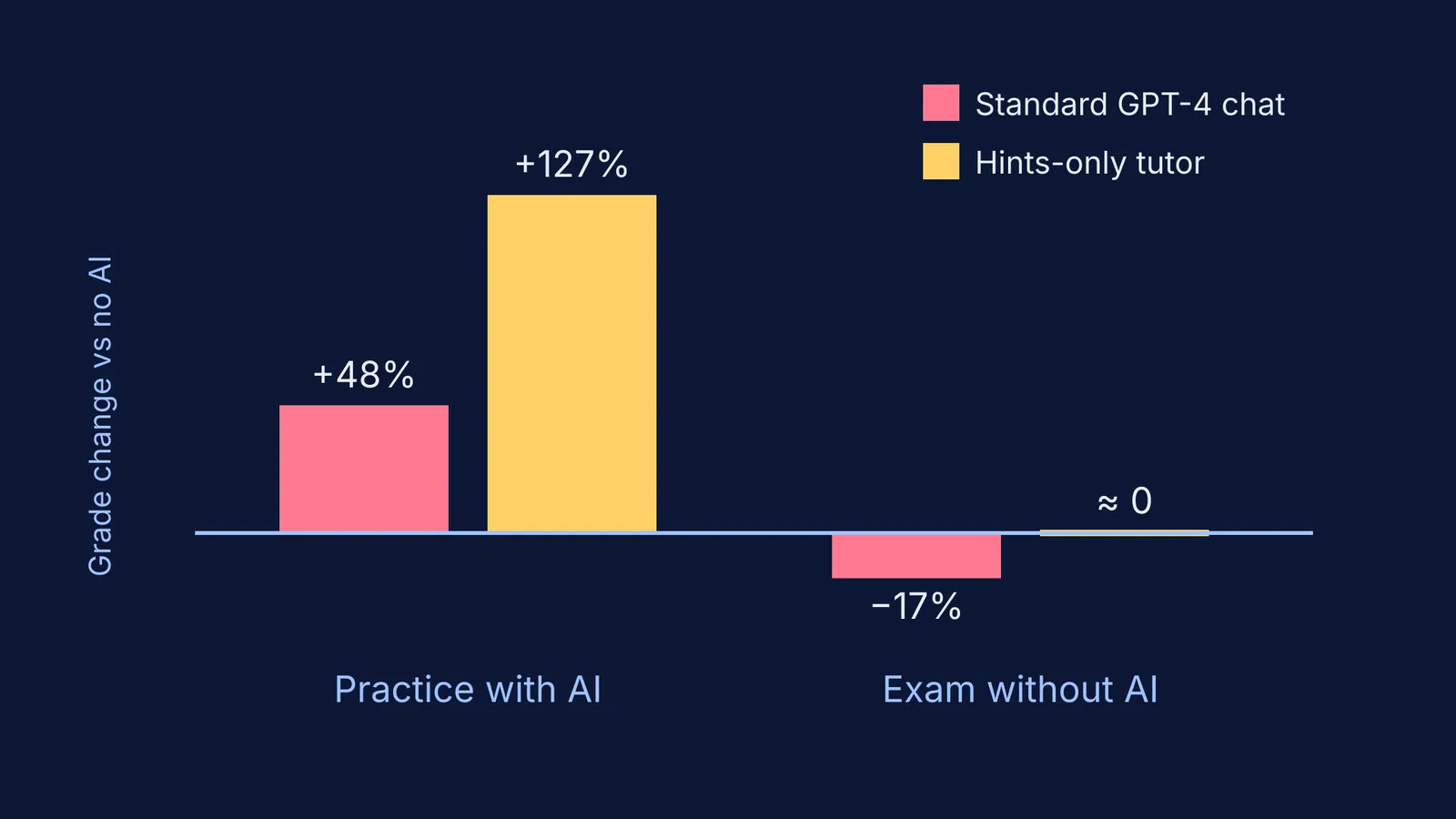
The clearest evidence comes from a field experiment with nearly 1,000 high-school maths students in Turkey, published in PNAS in 2025. One group practised with a plain GPT-4 chat ("GPT Base"); another used a version prompted to give hints without giving the answer ("GPT Tutor").
With the AI open, practice grades rose 48% for GPT Base and 127% for GPT Tutor. On a later exam without AI, the GPT Base group scored 17% lower than students who never had access, while the hint-only group was statistically indistinguishable from the control group. The researchers found that most GPT Base students used it to get solutions.
Struggling first is not wasted time. A meta-analysis of 53 studies by Tanmay Sinha and Manu Kapur in Review of Educational Research found a moderate advantage (Hedges' g of 0.36) for solving problems before being taught, though results for younger pupils (grades 2 to 5) favoured teaching first.
What are the three hint levels?
Climb one rung at a time, and only after a real attempt.
Level 1, the nudge: a question that points at what to look at, with no method. "What stays the same for both objects?"
Level 2, the key idea: the principle that cracks the question, still with no working. "Both have the same acceleration, so think about relative motion."
Level 3, the first line: only the opening step of working. You write the rest.
Paste this before your question so the AI keeps to the ladder:
"Do not give me the answer or a full solution to this NCERT Exemplar question. Give me a Level 1 hint, a question that tells me where to look, then wait for my attempt. If I am still stuck, give Level 2, the key idea with no working, then Level 3, only the first line. Show the full solution only if I type SHOW SOLUTION."
Chatbots drift back into giving answers, so remind them; our piece on AI tutor hints vs answers explains why. Fermi's AI tutor is built to teach rather than answer: it notices where you are stuck and decides whether to explain, ask or show.
What does the ladder look like on a real question?
An Exemplar-style question (our wording): two stones are dropped from a tall tower, the second a second after the first. Ignoring air resistance, does the gap between them stay the same, grow or shrink?
Your attempt: "Both fall with g, so the gap stays the same." It feels wrong.
Level 1: "Same acceleration, yes. Do they ever have the same velocity?"
Level 2: "Relative acceleration is zero, so relative velocity stays fixed at its value when the second stone was let go."
Level 3: "With t from the first drop, write s1 = ½gt² and s2 = ½g(t − 1)², then subtract."
Your finish: s1 − s2 = gt − g/2, so the gap grows steadily.
When should you accept the full solution?
Take it, without guilt, when:
You have used all three levels and made two honest attempts after the last one.
After Level 2 you still cannot say what the key idea means. That is a concept gap, not a problem gap: learn the concept, then come back.
It is revision week and time is short. Read it, but add it to your redo list.
Read actively: cover each step and predict the next before you look. When a worked solution is what you need, the Fermi Problem Library has a step-by-step solver that explains the reasoning rather than printing an answer. Check any AI working against your book's answers, because chatbots make errors.
How do you redo a solved question later without help?
Reading a solution is not the same as producing one. In experiments published in Psychological Science, Henry Roediger and Jeffrey Karpicke found that students who took recall tests on prose passages remembered more on tests 2 days and 1 week later than students who restudied them, even though restudying made them more confident. A redo is a self-test:
Close the solution and write the key move in your own words: "Same acceleration means constant relative velocity."
Later the same day, redo it on a blank page with no notes.
Redo it after 2 days, then after a week, ticking each in a redo list.
If a redo fails, go back to Level 2, not the full solution.
Once you can do it cold, try a similar question from the same chapter.
Tonight, pick one Exemplar question you skipped, paste the hint prompt, and climb only as far as you need.


