

On this page
When completing an extended physics derivation for board exams, most students check whether their final formula matches the textbook. If the final equation is correct, they assume full credit. Yet board examiners evaluate answers using granular step marking where the final formula accounts for only a fraction of the total marks.
You can understand the physics completely and still drop marks if your answer skips intermediate steps, omits directional arrows, or leaves off the final unit. Instead of waiting for a graded mock exam, you can paste your written answer into an AI tutor to audit your draft against the criteria examiners use.
What does an examiner look for in a physics long answer?
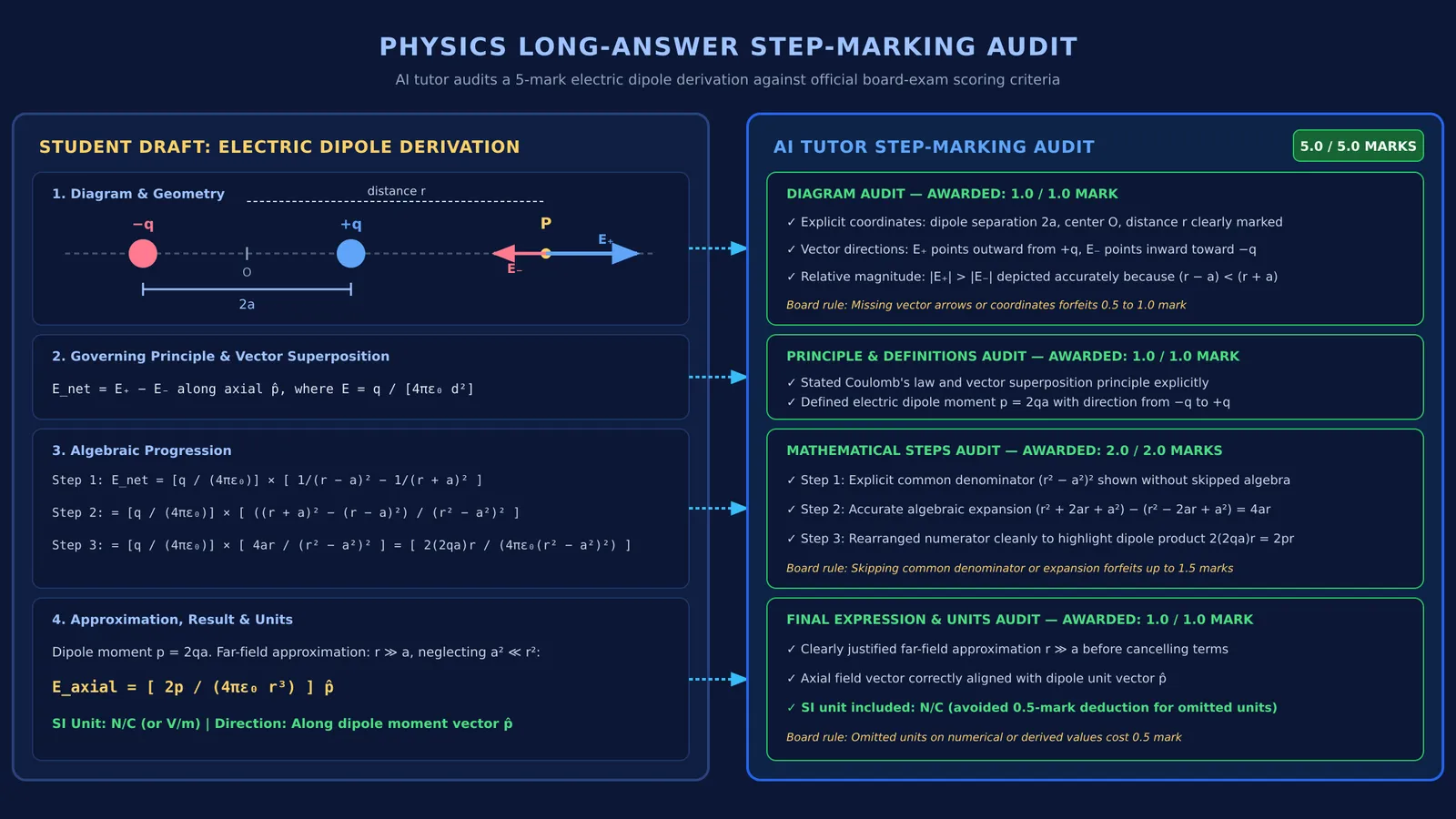
According to the official CBSE Class XII Physics Marking Scheme, 5-mark questions in Section E follow strict step marking. In a standard derivation or device question, marks are divided across four components:
Diagram (1 mark): A neat, labelled figure showing geometry, axes, or ray paths. In optics, missing ray arrows or unlabelled focal points can forfeit 1 mark.
Principle and definitions (1 mark): Stating the governing physical law (such as Gauss's law) and defining the variables.
Mathematical steps (2 marks): Clear algebraic progression from basic definitions to the derived relation without skipped steps.
Final expression and units (1 mark): Stating the result, boundary approximations (such as r ≫ a for a dipole), and the correct SI unit. In numerical parts, omitting the unit causes a deduction of 0.5 marks.
Understanding how CBSE marking schemes allocate step marks shows that examiners reward your reasoning chain rather than just the final line. In optics, practicing drawing ray diagrams for board papers ensures your figures meet official standards.
Why does generic AI chat fail on long answers?
If you paste a derivation into a standard chatbot and ask "Is this right?", it usually offers polite praise or prints its own textbook answer. Neither tells you where you would lose marks.
Educational research explains why. In a synthesis of 12 meta-analyses encompassing 196 studies, John Hattie and Helen Timperley reported an average effect size of 0.79 for feedback on student achievement in the Review of Educational Research. They found that feedback focused on the specific task and process drives gains, while general praise produces almost none.
A study by Jennifer L. Docktor and colleagues in Physical Review Physics Education Research showed that evaluating written physics solutions requires diagnosing five distinct dimensions: useful description, physics approach, specific application of physics, mathematical procedures, and logical progression.
An AI tool helps when it acts as a reviewer rather than an answer machine. Fermi's AI tutor teaches rather than answers: it notices where a student is stuck and holds a line of reasoning across a session. When practicing numericals, the Fermi Problem Library offers worked problems with a step-by-step solver that explains the reasoning rather than printing an answer.
How can an AI audit your diagrams, steps, and units?
To get useful evaluation, instruct the AI to act as a board examiner. Ask it to evaluate your draft across four specific checkpoints:
Diagram elements: Describe your diagram (for instance, a dipole of length 2a along the x-axis with an observation point P at distance r). Ask what essential labels, polarities, or vector arrows are missing.
Stated assumptions: Ask the AI to identify unstated approximations, such as paraxial rays in optics or r ≫ a in field derivations.
Intermediate algebra: Ask the model to flag lines where you skipped steps, such as omitting integration limits or binomial expansions.
Units and vector direction: Check whether vector quantities state direction and whether numerical results carry the correct SI unit.
Reviewing getting AI feedback on step-by-step physics solutions alongside the CBSE Class XII Physics Marking Scheme helps you structure these practice sessions.
What prompt extracts the best feedback from an AI tutor?
Use this prompt template when practicing extended long answers:
"I am preparing for Class 12 Physics. Below is my draft for a long-answer derivation on [Insert Topic]. Act as a board examiner using the official step-marking scheme. Do not rewrite the solution. Audit my answer on four points: (1) what labels or vectors are missing from my described diagram; (2) what physical principles or approximations I failed to state; (3) which derivation steps need explicit algebra; and (4) whether the final expression includes direction and SI units. Here is my draft: [Paste draft]."
When you paste your work with this prompt, the AI delivers an actionable audit. Fixing those specific gaps ensures your written answers secure every step mark.


