

On this page
An AI chatbot will comment on your geometry proof in seconds. The risk is the steps it says yes to: a reason that sounds right but doesn't follow from your figure. Here is how to give the AI what it needs, and how to test each reason it accepts, using one theorem from the Class 10 Triangles chapter.
Can AI check my geometry proof reliably?
Not on its own. In a 2025 study, expert judges marked AI-written proofs for the 2025 USA Mathematical Olympiad, and the most common failure was logic: unjustified steps and wrong reasons (Petrov et al., 2025).
When AI models were asked to grade those same proofs, they “frequently awarded points for incorrect or unjustified reasoning, inflating the scores by a factor of up to 20” (Petrov et al., 2025). Olympiad problems are much harder than Class 10 ones, but the weakness is the same: an AI may accept a step because it sounds right.
Figures are a second weak spot. The MathVerse benchmark found that most multimodal models rely more on the words of a problem than on the diagram, and most scored better when the diagram was taken away and only the text was given (Zhang et al., 2024). Tools built only for geometry work differently. AlphaGeometry uses a language model to guide a symbolic deduction engine that works by formal rules, and it solved 25 of 30 olympiad-level geometry problems in its test set (Trinh et al., Nature, 2024). A general chatbot has no such engine, so the checking is your job.
How do I give the AI my figure and statements?
Describe the figure in words, even if you also upload a photo: every point, which line it lies on, what is parallel or perpendicular, and what is given.
Number your statements, with each reason in brackets after it.
Ask for reasons, not a verdict.
Here is a prompt you can copy: “Here is my figure and proof. For each numbered step, say which earlier step or given fact it uses, and whether every condition of the reason is met. Don't rewrite my proof. If a reason is incomplete, ask me a question instead of fixing it.”
If you're photographing handwritten work, our guide to getting the figure right when you ask AI about a photographed problem covers lighting, cropping and labels.
A worked example: the basic proportionality theorem
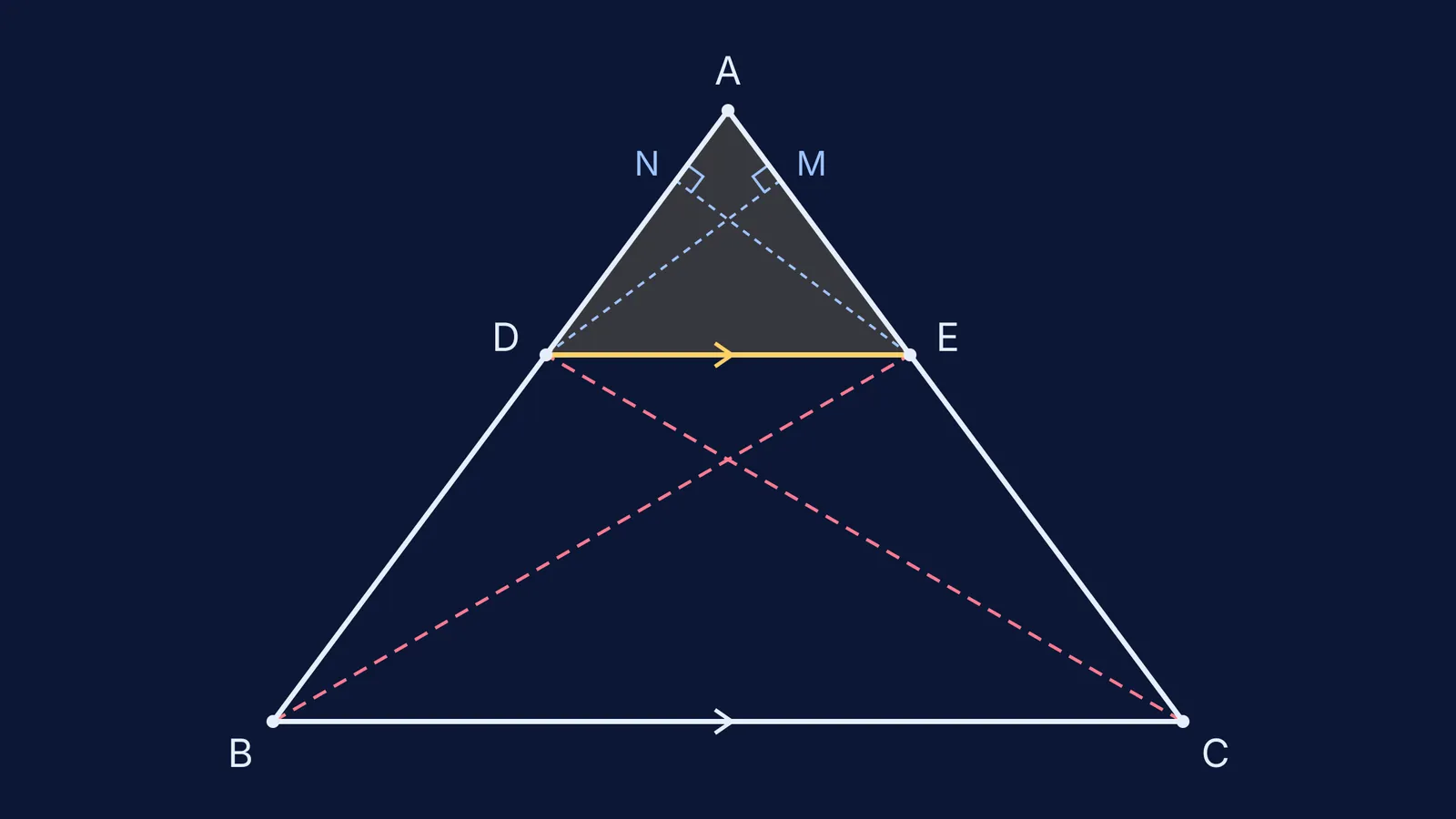
Figure, typed out: In triangle ABC, D lies on AB and E lies on AC, with DE parallel to BC. Prove AD/DB = AE/EC. Construction: join BE and CD; draw EN perpendicular to AB and DM perpendicular to AC.
ar(ADE)/ar(BDE) = AD/DB (both triangles have height EN).
ar(ADE)/ar(DEC) = AE/EC (both triangles have height DM).
ar(BDE) = ar(DEC) (same base DE).
So AD/DB = AE/EC (from 1, 2 and 3).
A chatbot may well accept all four lines. Step 3 is the problem. Two triangles on the same base can have any areas. The full reason is “on the same base DE and between the same parallels DE and BC”, because only then do B and C sit at the same height above DE. The parallel lines are the whole point of the theorem, and this version of step 3 never uses them.
A second version you might write: “Triangle ADE is similar to triangle ABC (AA), so AD/AB = AE/AC.” The AA criterion is real and its conditions hold here. But check where your textbook proves the similarity criteria. If they come after this theorem, or are proved using it, AA can't be used to prove it.
Our post on similar triangles and the basic proportionality theorem has the full theorem and the exercises that follow it.
How do I test whether each reason really follows?
Put each reason the AI accepts through three questions:
Name: is this a real theorem, property or given fact, stated in full? “Same base” is half of a result.
Conditions: is every condition true in your figure because of the given facts or an earlier step, not because the drawing looks that way?
Order: was this result proved before the theorem you're proving? If not, the proof goes in a circle.
If a reason fails any of the three, rewrite that line yourself before asking the AI again. You learn far more from fixing one line than from reading a corrected proof. Chatbots also make plain arithmetic and logic slips, and our five-step way to check an AI's maths works alongside this one.
This kind of back-and-forth is how Fermi's AI tutor is built to teach: it draws the figure, decides whether to explain, ask or show, and checks your understanding as it goes, so it can ask you about a weak reason rather than just accepting it.
Tonight, take one proof from your notebook, type the figure and steps, and run the three questions on every reason.


