

On this page
When preparing for competitive exams like JEE and NEET, most students review multiple-choice questions (MCQs) in a predictable way: they verify the answer key, glance at the solution if they made an error, and move on. This habit ignores three-quarters of the learning material. In well-designed exams, incorrect options—known in psychometrics as distractors—are not random filler. They are deliberate traps engineered around common misconceptions and predictable calculation errors.
Why are wrong options in MCQs designed as traps?
Test makers do not invent wrong options at random. In a comprehensive review of multiple-choice guidelines published in *Applied Measurement in Education*, Haladyna, Downing, and Rodriguez (2002) showed that high-quality distractors must represent authentic student misunderstandings. In STEM exams, every distractor reflects a standard misstep: a reversed sign, an inverted ratio, or a forgotten conservation condition.
Examining why each distractor exists reveals what examiners anticipated. If you only study why the correct option works, you learn how to solve problems under ideal conditions. Investigating why wrong options fail turns distractors into diagnostic tools, reinforcing why making mistakes helps you learn.
What does cognitive science say about studying distractors?
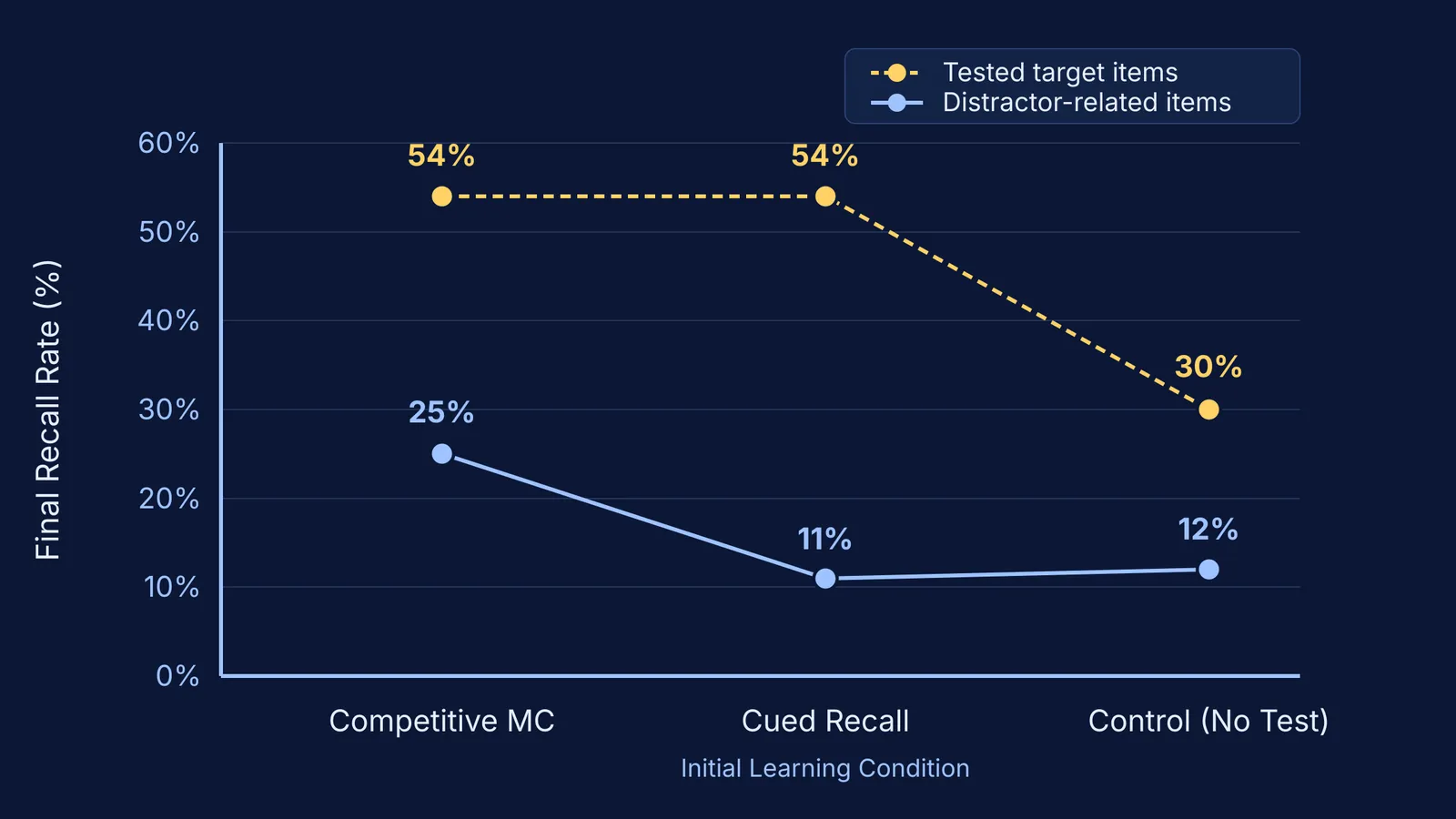
Cognitive research shows that evaluating plausible distractors deepens long-term retention. In a study published in *Psychological Science*, Little, Bjork, Bjork, and Angello (2012) found that taking a multiple-choice test with competitive distractors increased recall of distractor-related information to 25%, compared to only 11% for cued recall and 12% for non-tested controls. Rejecting plausible alternatives forces "productive retrieval," strengthening related concepts across memory.
However, studying distractors requires corrective feedback. Research in *Memory & Cognition* by Butler and Roediger (2008) revealed that without clear feedback, exposure to plausible lures can reinforce false beliefs. Explanatory feedback removes this risk and cements the correct concept.
Furthermore, passive reading does not fix misconceptions. In *Cognitive Science*, Chi, De Leeuw, Chiu, and LaVancher (1994) demonstrated that prompting students to self-explain yielded a 22.6% gain on difficult inference questions compared to 12.5% for unprompted reading. Combining AI feedback with active self-explanation delivers both accuracy and depth.
How can you ask AI to explain why each option fails?
Instead of asking a chatbot "What is the answer?", use a diagnostic prompt that forces it to unpack every option:
"For this MCQ, state why the correct option holds. For every incorrect option, explain: (1) what specific calculation or conceptual mistake produces that choice, and (2) what misunderstanding makes it tempting."
Consider an electrostatics problem: Two point charges +q and −q are separated by distance r. When distance increases to 2r, what is the work done by the electrostatic force?
Option A: +kq² / (2r)
Option B: −kq² / (2r) (Correct)
Option C: +kq² / (4r)
Option D: −kq² / r
The AI identifies the specific trap in each choice:
Option B is correct because conservative work equals the negative change in potential energy: W = −ΔU = −[−kq²/(2r) − (−kq²/r)] = −kq²/(2r).
Option A preys on the sign trap: it computes ΔU correctly as +kq²/(2r) but forgets that internal field work requires a negative sign.
Option C confuses the 1/r potential energy formula with the 1/r² force law.
Option D computes the initial potential energy magnitude but omits the displacement.
When tackling tricky numerical problems, Fermi's AI tutor teaches rather than answers: it holds a line of reasoning across a session, notices where you are stuck, and explains why an intermediate step fails. You can also explore worked examples in the Fermi Problem Library, which explains the reasoning behind each step instead of printing a raw answer.
How should you rewrite AI explanations to spot your own traps?
Reading an AI explanation creates an illusion of mastery unless you reprocess it. After the AI analyzes the distractors, rewrite each failure mode in your notes as a personal "If-Then" rule:
State the trigger: "If I compute ΔU and forget that field work is −ΔU, I will pick Option A."
Match your history: Ask whether this sign slip is your frequent mistake under exam pressure.
Write a counter-rule: "Write W_field = −ΔU before calculating numbers."
Using these ways to check your understanding after an AI explanation strengthens your strategy for eliminating options systematically in timed mocks.
What mistakes should you avoid when using AI for MCQs?
Never prompt the AI before committing to your own answer. An unassisted first attempt provides the retrieval struggle that makes feedback stick.
Never settle for generic explanations. If an AI claims an option is "just mathematically incorrect," push it to specify which false premise yields that exact number.
Never skip rewriting in your own words. If you cannot summarize why a distractor fails in one clear sentence, the misconception is still active.
Start your next practice session by asking an AI tutor to dissect the wrong options on five questions, then log each trap in your own words before moving on.


