

On this page
If you open an organic chemistry textbook, you will find numerous chemical equations. Above almost every reaction arrow sits a symbol: a triangle for heat (Δ), hν for light, or a chemical formula like H₂SO₄ for an acid catalyst.
Faced with this volume of information, many students resort to treating these conditions as arbitrary rules. A 2012 study published in *Chemistry Education Research and Practice* found that organic chemistry students frequently default to rote memorisation, creating a barrier that stops them from applying concepts to new, unfamiliar reactions.
But chemistry is not a list of random rules; it is a logical system. Every condition over the arrow is there to solve a specific physical or thermodynamic problem. Instead of memorising flashcards, you can ask an AI tutor to explain *why* those conditions are necessary.
Why does this reaction need heat?
A classic point of confusion for students is the competition between substitution and elimination reactions. If you mix an alkyl halide with a strong base, two things can happen. A substitution reaction swaps the halogen for a new group. An elimination reaction strips away the halogen and a hydrogen to form a double bond.
Textbooks often provide a simple rule: "Substitution happens at room temperature; elimination requires heat." But why?
The answer lies in thermodynamics. In an elimination reaction, two molecules (the substrate and the base) react to form three molecules (an alkene, a conjugate acid, and a leaving group). Because the products contain more molecules than the reactants, the system becomes more disordered, meaning the change in entropy (ΔS) is positive.
The spontaneity of a reaction is governed by the Gibbs free energy equation: ΔG = ΔH − TΔS. Because the entropy change (ΔS) is positive, increasing the temperature (T) makes the entire −TΔS term much more negative. This drives the Gibbs free energy down, pushing the reaction forward. Heat does not just make the molecules move faster; it fundamentally shifts the thermodynamic balance in favour of disorder.
How does a catalyst actually work?
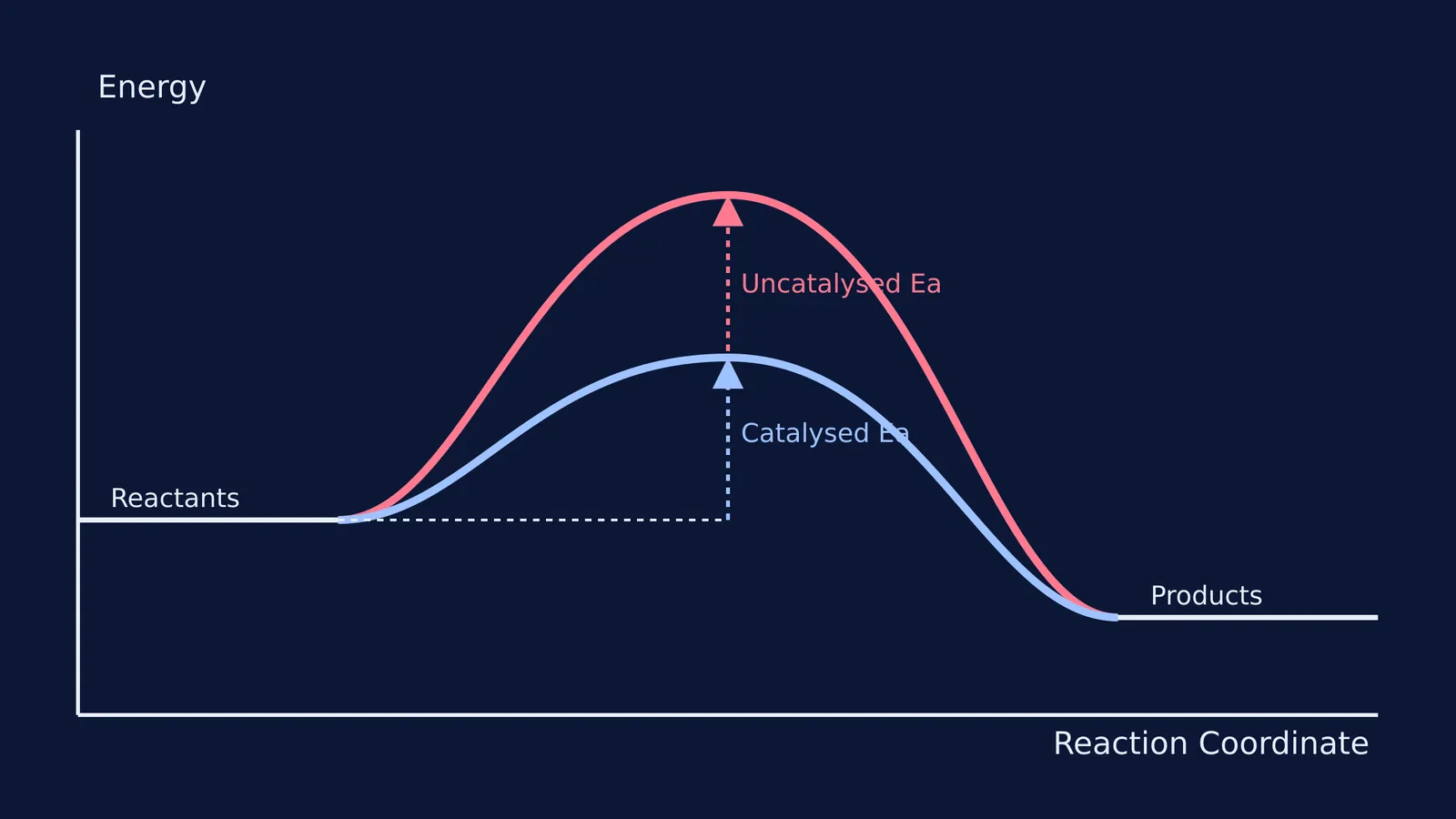
Another rote rule is that a catalyst "speeds up a reaction without being consumed by lowering the activation energy." While true, this definition obscures what the catalyst is actually doing to the molecules. As the chemist Elizabeth Fulhame first proposed, a catalyst actively participates in the reaction.
A catalyst does not merely lower the barrier on the existing pathway. Instead, it provides an entirely different mechanism. For example, if you want to create an ester from a carboxylic acid and an alcohol, you usually add a few drops of sulphuric acid. The acid donates a proton to the oxygen atom of the carboxylic acid, pulling electron density away from the carbon below it. This makes that carbon highly attractive to the incoming alcohol.
A 2015 study in the *Journal of Chemical Education* showed that teaching organic chemistry through these "patterns of electron flow"—rather than listing functional group reactions to memorise—significantly improves a student's ability to predict chemical behaviour.
What role does light play in a reaction?
Beyond heat and catalysts, you will frequently see hν written over an arrow, representing light energy. This condition is most common in free radical reactions, such as the chlorination of methane. A textbook might simply state that sunlight is required to start the reaction. However, memorising this fact does not help you understand the underlying quantum mechanics.
Light is made of photons, and each photon carries a specific amount of energy, which can be calculated using the 1240/λ formula. Ultraviolet light happens to carry the exact quantum of energy required to break the bond between two chlorine atoms evenly. One electron goes to each atom, creating highly reactive free radicals that drive the rest of the mechanism. Understanding this energy transfer is far more powerful than memorising a rule about sunlight.
How can an AI tutor uncover the logic?
If you are stuck staring at a reaction condition, Fermi's AI tutor can bridge the gap between a memorised rule and genuine understanding. If you bring a confusing reaction to the tutor, it works out what you already know, builds a plan for the session, and teaches through it — writing on a board, drawing the figure, running the simulation, and checking your understanding as it goes.
For instance, you might understand the temperature coefficient of a reaction rate but struggle to see the interplay between kinetics and thermodynamics in a specific pathway. The AI tutor holds a line of reasoning across a whole session, noticing where you are stuck and deciding whether to explain, ask, or show the concept.
When you stop treating reaction conditions as symbols to be memorised and start treating them as physical problems to be solved, organic chemistry transforms. It stops being a test of memory and becomes a test of logic—one that is much easier to pass.


