

On this page
NCERT chemistry tables are high-yield resources for competitive exams in India. Examiners know that students often skip tables to focus on the bold text. Therefore, they frequently lift data directly from these summaries to frame their questions. For example, you might be asked to arrange the basic strength of different amines, or to identify which transition metal has an irregular ionisation enthalpy.
While the main text of the chapter explains a general trend, the numerical values in the table provide the proof. They also expose where the trend breaks down. An element's atomic radius might suddenly expand when it was expected to shrink, or a boiling point might spike because of molecular geometry. Spotting these anomalies is crucial for scoring well in the inorganic and physical chemistry sections of the exam, where exceptions are tested more often than the rules. Memorising every single data point is impossible, but understanding the underlying physical reasons makes the data predictable.
How do you ask AI to explain NCERT chemistry summary and tables?
When faced with a dense block of data, the worst strategy is to stare at it until it sticks. Rote memorisation might get you through a school unit test, but it falls apart under the pressure of a three-hour competitive exam. A more effective method is to have a tutor walk you through the logic of why each value differs from the one above it.
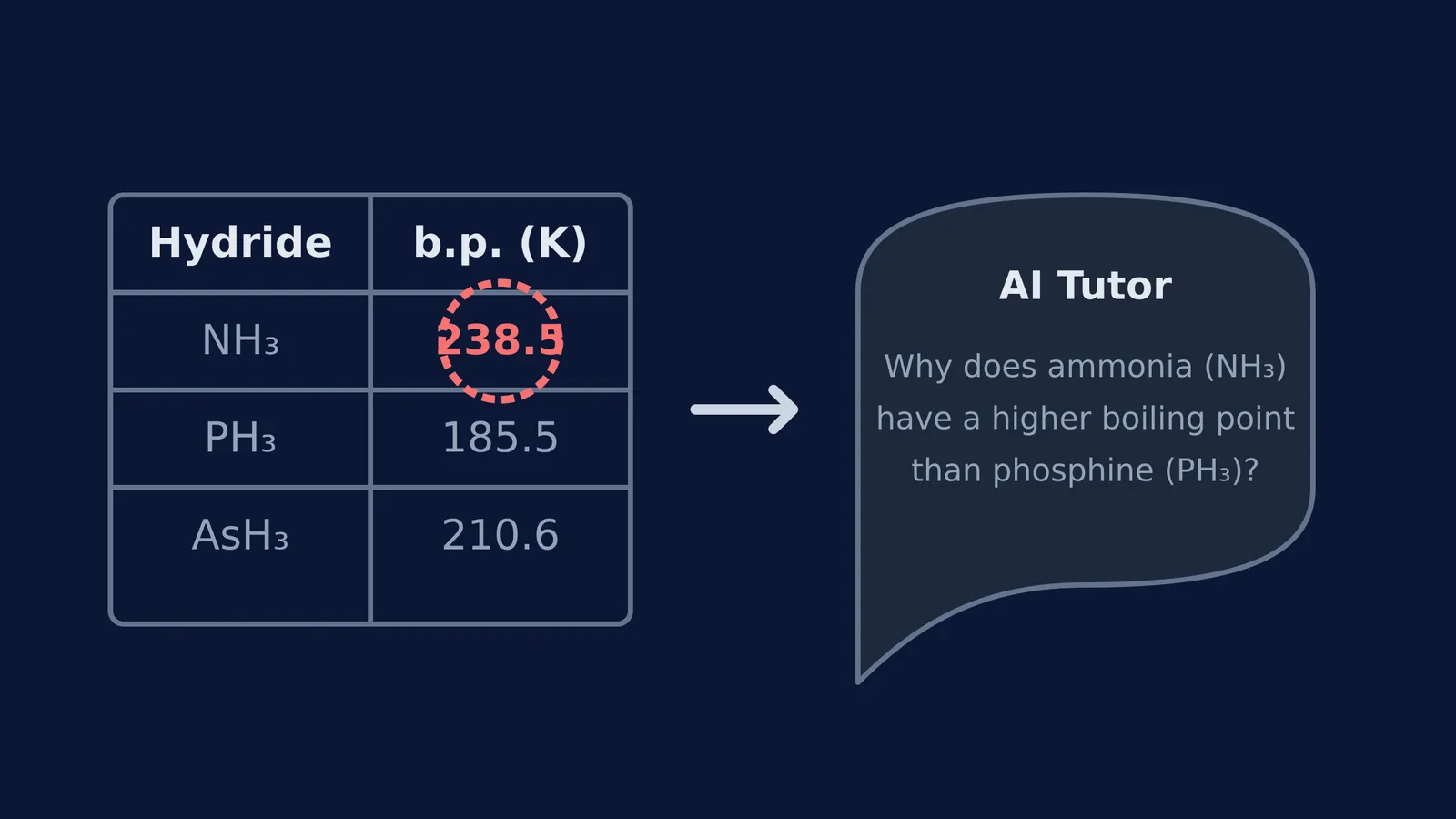
You can upload a photo of a page to Fermi's AI tutor and ask it to explain the chemistry behind the numbers. Because the tutor is designed to hold a line of reasoning, it can look at the values for Group 16 hydrides and point out why water has an unusually high boiling point compared to hydrogen sulphide. It can also help you understand the conditions, such as temperature and pressure, listed in industrial process tables like the Haber or Contact processes. Instead of just answering a single question, the AI works out what you know and builds a plan to check your understanding of the underlying concept.
For instance, rather than blindly memorising that the Haber process requires 773 K and 20 MPa, you can ask the tutor why those specific numbers were chosen. It will guide you through Le Chatelier's principle, explaining the trade-off between the yield of ammonia at lower temperatures and the faster reaction rate achieved by adding a catalyst and raising the temperature. This contextual understanding turns abstract numbers into a logical narrative.
How do you prompt an AI to test you on exceptions?
The best way to lock in this knowledge is to be quizzed on it immediately. Here is a script you can use to turn a static table into an active study session:
"I am preparing for JEE Main. Here is a photo of an NCERT table showing the properties of Group 15 elements. Please do not just give me the answers. First, explain the general trend going down the columns. Then, point out any exceptions or anomalies in the data. Finally, ask me one question at a time to test if I understand why those exceptions happen, and wait for my reply before moving on."
By asking the AI to withhold the answers and quiz you step by step, you are forced to retrieve the information from your own memory. You have to recall concepts like shielding effects or hydrogen bonding to justify the data. This shifts your study habit from passive reading to active problem-solving, much like how active practice helps when you understand physics theory but still fail numericals.
Why does active recall beat re-reading?
Testing yourself is not just a way to check what you have learned; it is the actual mechanism that builds long-term memory. Every time you struggle to recall an answer, you strengthen the neural pathways associated with that information.
Students who took a delayed test a week later retained substantially more material than those who only re-read it, according to a 2006 study in *Psychological Science*. The researchers divided students into groups: some simply studied the material multiple times, while others studied it once and then took immediate free-recall tests.
The study found that while re-reading gave students a false sense of confidence in the short term, retrieving the information through testing dramatically slowed the rate of forgetting. The students who re-read the text performed slightly better when tested five minutes later, but the testing group showed far greater retention within a week. Spacing out your testing over several days further solidifies these memories, ensuring that the chemistry trends you learn today will still be accessible on exam day.
This is why turning an NCERT table into a quiz with an AI tutor is so effective. It forces you to construct the answer from scratch without looking at the book. If you find yourself slipping into passive reading and simply highlighting sentences, you can find more strategies on how to read a science textbook actively to keep your brain engaged throughout your study session.


