

On this page
Most chapters have a few traps that catch students year after year: a sign, a unit, a force drawn the wrong way. An AI chatbot can list them in seconds, but the list alone does little. What helps is turning each item into a question, answering it yourself, and keeping only the mistakes you actually make.
Why test yourself instead of just reading the list?
Reading a list of mistakes is closer to rereading than to practice. In a review of 10 common study techniques, Dunlosky and colleagues (2013) rated practice testing and distributed practice as high utility, because they helped learners of different ages and abilities. The same review rated rereading and highlighting as low utility.
Getting a question wrong is part of how this works. In her review Learning from Errors, Columbia University psychologist Janet Metcalfe reports that errors followed by corrective feedback are beneficial to learning, and that errors made with high confidence are corrected more readily than low-confidence ones.
There is a warning too. In a field experiment with nearly a thousand high school maths students, Bastani and colleagues (2025) found that students who practised with an unrestricted GPT-4 chat interface got grades 17% lower, once access was taken away, than students who never had it. A version with prompts designed to protect learning largely avoided that harm. So let the AI write the test, not take it.
How do you ask AI for common mistakes in a chapter?
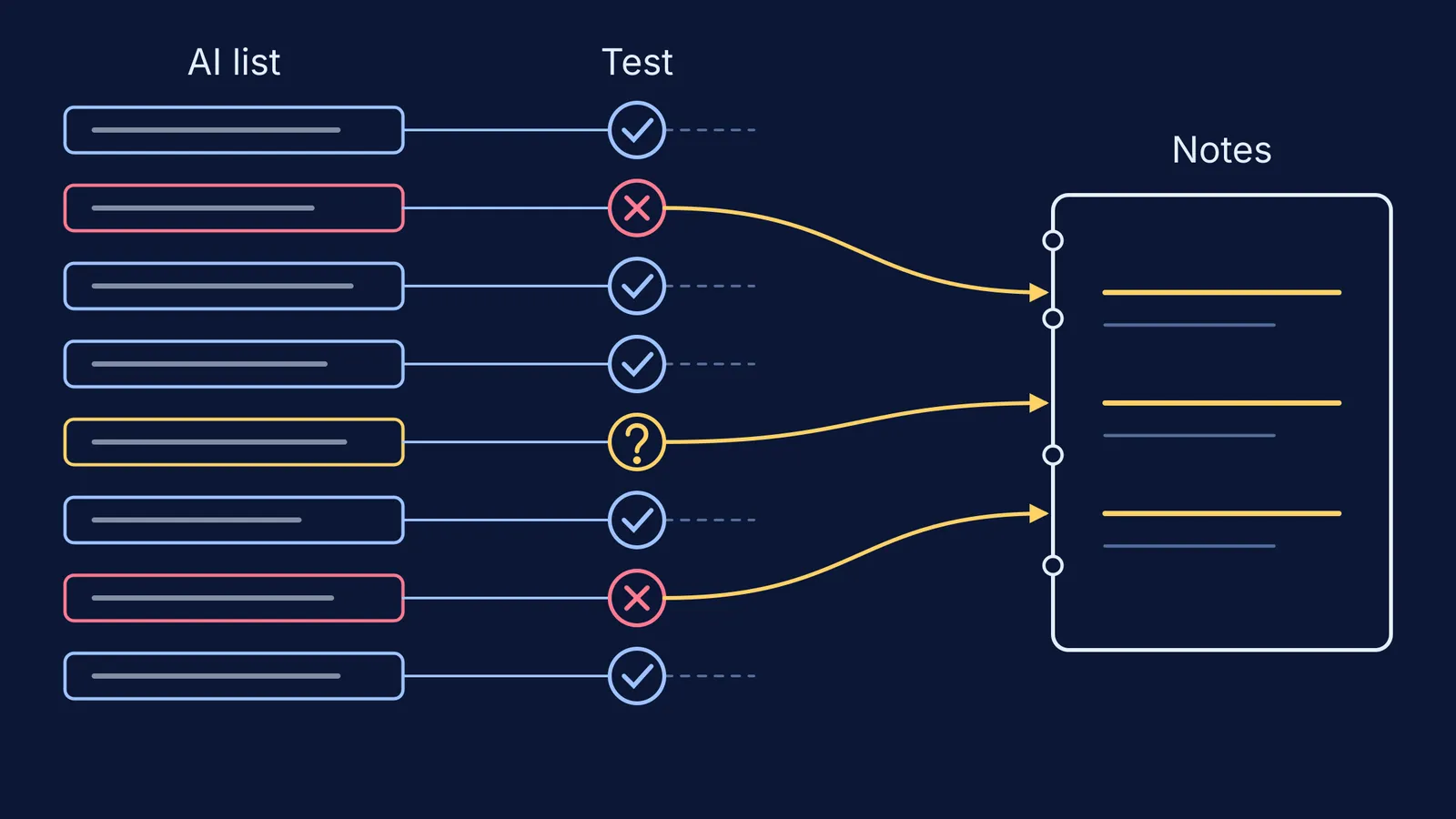
Ask for the list. Paste: "I'm in Class 11, studying Laws of Motion from NCERT. List eight mistakes students commonly make in this chapter, one line each. No explanations yet."
Ask for one question per mistake: "For each mistake, write one short question that a student who makes it would get wrong. Don't give the answers."
Answer on paper, book closed. Next to each answer, write sure, unsure or guess.
Check: "Here are my answers. Mark each right or wrong. For wrong ones, give me a hint first, not the full solution." Try again after the hint.
Sort. Right and sure: cross it off. Wrong, or right but guessed: it goes in your notes.
A few days later, ask for fresh questions on the kept mistakes only.
Check the AI's list against your NCERT textbook or teacher, because chatbots can state wrong things confidently (see how AI makes up sources). For more prompts, read how to make AI quiz you.
What does this look like for one chapter?
Here are four of the eight traps for Laws of Motion (g = 9.8 m/s²), each with its test:
Normal force is always mg. A 2 kg block rests on a 30° incline: normal force? Answer: mg cos 30°, about 17 N. You wrote 19.6 N, sure. Keep.
Static friction is always μN. A 5 kg block on a floor (μ = 0.5) is pushed with 10 N and stays put: friction? Answer: 10 N, not 24.5 N. You got it, sure. Drop.
Apparent weight in a lift. A 50 kg student on a scale, lift accelerating up at 2 m/s²: reading? Answer: m(g + a) = 590 N. Right, but guessed. Keep.
Contact force. 2 kg and 3 kg blocks touch on a smooth floor; 10 N pushes the 2 kg one: force between them? Answer: acceleration 2 m/s², so 6 N. You wrote 10 N. Keep.
If the other four were right and sure, your notes hold three lines instead of eight: the mistake, what sets it off, and the check that catches it. For example: "Wrote N = mg on an incline. Trigger: any slope or lift. Check: resolve forces perpendicular to the surface first."
What should go in a mistakes notebook?
Your own mistakes, in your own words.
The trigger and a one-line check you can run in the exam hall.
The date you last got it wrong. Cross the line out once you pass two later retests.
For full papers, our guide to analysing a mock test sorts errors by cause before you decide what to revise.
If a kept mistake is about the method rather than a slip, the Fermi Problem Library has worked problems with a step-by-step solver that explains the reasoning rather than printing an answer. If you are not sure which chapter to start with, Fermi's AI tutor can work out what you already know and build a plan for the session.
How can parents help without knowing the subject?
You do not need to know physics. Once a week, look at the kept list and ask: "Which of these did you get right this time?" A shorter list is progress; a line that keeps coming back is worth a word with the teacher. If study pressure is affecting sleep or mood, talk to a school counsellor or doctor, or call the Tele MANAS helpline on 14416.
Pick tonight's chapter, run the six steps, and see how short your list gets.


