

On this page
Paste a Class 12 conversion into a chatbot and you get a neat product with a confident explanation. Whether it is right is another question.
How accurate is AI at predicting reaction products?
It depends which kind of AI you mean. Specialist models are trained only on reactions: the Molecular Transformer (Schwaller and colleagues, ACS Central Science, 2019) reported top-1 accuracy above 90% on a common benchmark of patent reactions, and could estimate how likely each of its own predictions was to be correct.
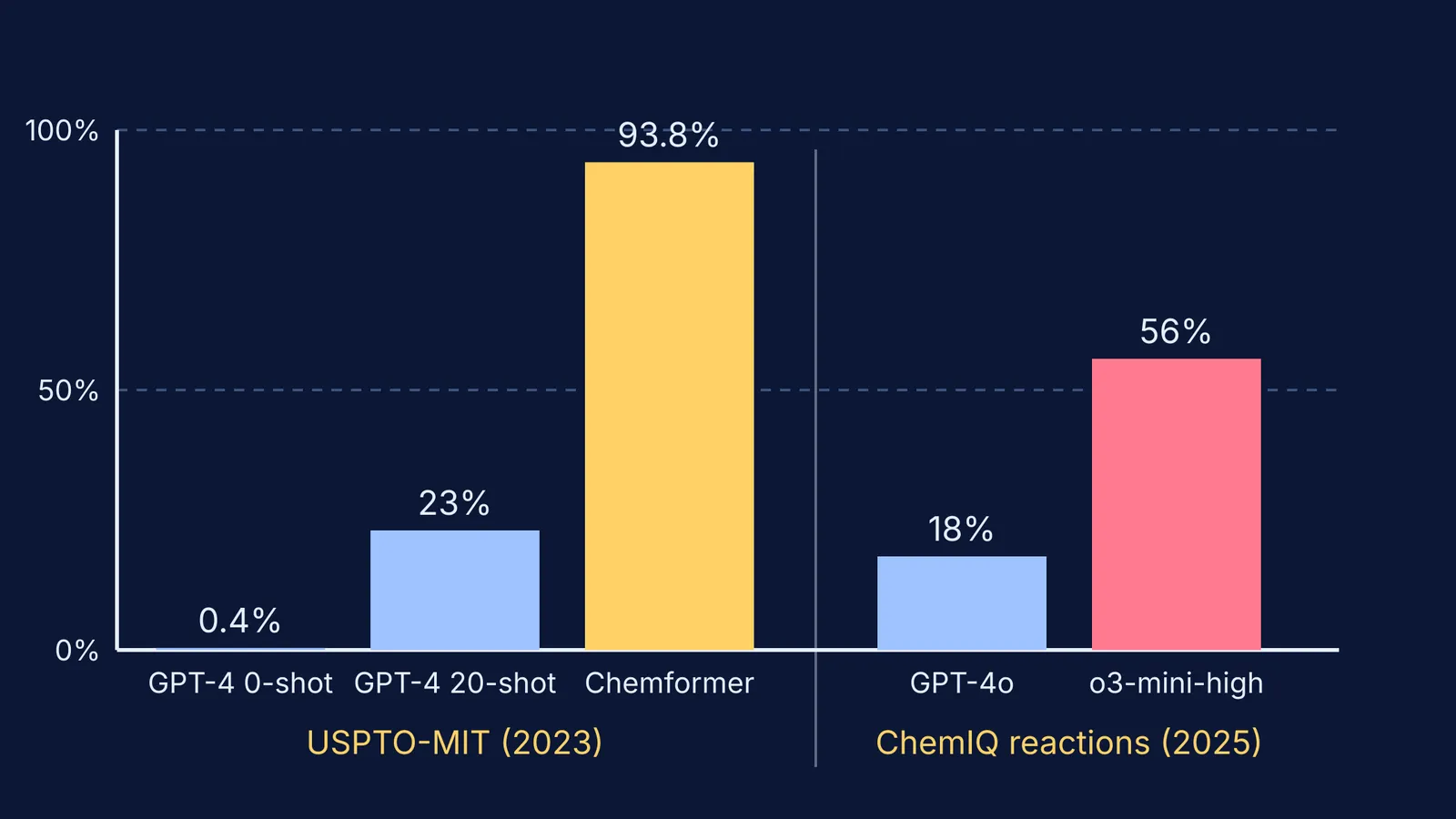
General chatbots are a different story. In a NeurIPS 2023 benchmark of eight chemistry tasks, GPT-4 predicted the correct product for 23.0% of reactions when given 20 closely similar worked examples, against 93.8% for the specialist Chemformer model. With no examples it scored 0.4%, and 17.4% of its answers were not valid chemical structures.
Newer reasoning models have closed some of the gap. A 2025 Oxford study, ChemIQ in the Journal of Chemical Information and Modeling, asked models to write the products of undergraduate-level reactions: o3-mini at its highest reasoning setting got 56% right, against 18% for GPT-4o. Real progress, yet close to half the answers were still wrong.
Where does AI go wrong in reaction questions?
In the ChemIQ study, o3-mini-high ranged from 100% on SN2 substitutions to 18% on Suzuki-Miyaura couplings (five questions per reaction class), and accuracy generally tracked how many changes were needed to write the product. Put plainly: one-step swaps are fairly safe; anything with several moving parts is not.
Four patterns to watch for in Class 11-12 work:
Conditions ignored. The reagent is right, but the condition that decides the product is skipped: peroxide or no peroxide, acidic or alkaline medium, hot or cold, dilute or concentrated.
Wrong reaction recalled. Two named reactions with similar reagents get swapped, such as Cannizzaro for aldol, or Wurtz for Wurtz-Fittig.
Atoms that do not add up. A carbon appears or vanishes, or a step that should lose one carbon (Hofmann bromamide) keeps it. The NeurIPS study describes models misreading the starting structure and then writing chemically unreasonable products.
Confidence that is not earned. The ChemBench study in Nature Chemistry tested models on more than 2,700 chemistry questions. The best models, on average, outperformed the best human chemists in the study, yet struggled with some basic tasks and gave overconfident predictions.
How do you check an AI answer against a named-reaction table?
Your NCERT chapters and your notes already hold the reference you need. Turn them into a table with five columns for each named reaction; if you do not have one yet, start from our map of named reactions in organic chemistry.
Reactant class. Which functional group goes in? Does the AI's starting material match it?
Reagent. Is it the exact reagent in your table, not a near cousin?
Conditions. Medium, temperature, catalyst, light or peroxide. Ask the AI to state them, then compare.
Product and by-product. Draw both. Count carbons on each side.
Exceptions. Most tables carry a "does not work when" note, such as aldehydes with an alpha-hydrogen not giving the Cannizzaro reaction.
Then run one stress test: change a single condition and ask again. If the product does not change when your table says it should, the first answer was pattern-matching, not chemistry.
A worked example
Ask a chatbot: "What forms when propene reacts with HBr?" A good answer gives 2-bromopropane, by Markovnikov addition. Now ask: "What if benzoyl peroxide is present?" The peroxide (Kharasch) effect gives 1-bromopropane, by a free-radical route (see our guide to Markovnikov's rule and the peroxide effect). Then ask: "And with HCl and peroxide?" Your table says HCl and HI do not show the peroxide effect, so the product stays Markovnikov: 2-chloropropane. An AI that applies the peroxide rule to HCl has learned the pattern but not its exception. That third question is the one worth asking.
Does the same check work for inorganic chemistry?
Mostly, with one extra column: oxidation state. Inorganic products often hinge on the medium. Potassium permanganate is reduced to Mn2+ in acidic solution but to MnO2 in neutral or faintly alkaline solution, so an AI that skips the medium can hand you a confidently wrong product.
Check three things: the total rise in oxidation number equals the total fall, the charges balance, and the product matches your textbook for that medium. Our guide to permanganate and dichromate reactions lists the standard cases.
What should you use AI for in chemistry, then?
Use it to explain a mechanism, quiz you on your table or pose "what if the conditions change" questions, not as your answer key. When the gap is in reasoning rather than recall, Fermi's AI tutor holds a line of reasoning across a session, notices where you are stuck and decides whether to explain, ask or show. For practice, the Fermi Problem Library has worked problems with a step-by-step solver that explains the reasoning rather than printing an answer.
Tonight, pick three named reactions, ask an AI for each product, then change one condition at a time and check every answer against your table.


