

On this page
Problems involving elasticity often start with a simple setup: a weight hangs from a wire, and you are asked to find how much the wire stretches. To find the answer, you use Young's modulus, a measure of a solid material's stiffness. For instance, mild steel has a Young's modulus of approximately 200 GPa.
Before you can solve the problem, you need to understand the variables you are working with. While Elastic potential energy in a stretched wire, worked through gives you the energy stored, finding the extension itself is a matter of applying the stress-strain formula. However, getting the right number relies entirely on putting the correct units into the denominator. A small mistake early in the calculation will snowball into an impossible answer, such as a steel cable stretching further than its own original length.
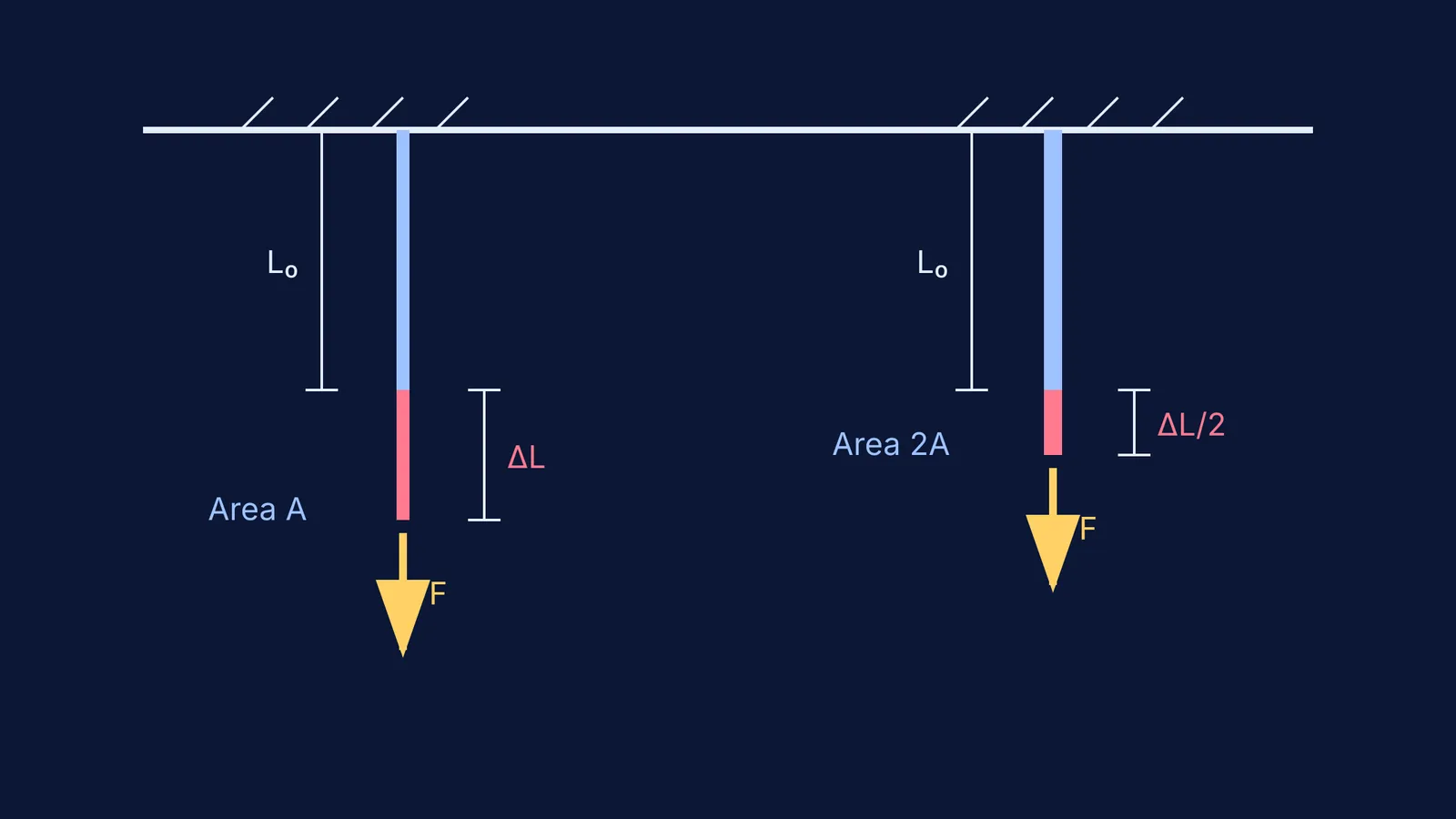
Why does a thicker wire stretch less?
When you apply a force (F) to a wire of original length (L₀) and cross-sectional area (A), the change in length (ΔL) depends on the material's Young's modulus (E). The relationship is given by the formula E = F L₀ / (A ΔL).
If you rearrange this equation to solve for the stretch, you get ΔL = F L₀ / (E A). This formula shows that the stretch is inversely proportional to the cross-sectional area. Because a thicker wire has a larger area A, the applied force is distributed over a much wider surface. This means the internal stress (force per unit area) is lower. As a result, the material experiences less strain, and the wire stretches less overall.
Just as A rod stretching under its own weight: the WL/2AY result depends on the area, any hanging mass will stretch a thick cable much less than a thin thread of the same material. Intuitively, bundling ten thin wires together creates a single thick wire that requires ten times the force to stretch by the same amount.
How do you convert mm² to m² in stress strain numericals?
The most common mistake in these problems happens before any algebra takes place. Physics questions typically give a wire's diameter or radius in millimetres (mm), and you must calculate the area in square metres (m²) to match the standard SI units of Pascals used for Young's modulus.
Because 1 m equals 1,000 mm, squaring both sides means that 1 m² equals 1,000,000 mm². Therefore, 1 mm² is exactly 10⁻⁶ m². Students in a rush often just multiply their area by 10⁻³ instead of 10⁻⁶, mixing up linear conversion with area conversion. This simple slip makes the area 1,000 times too large in the formula. Since area is in the denominator, it makes the calculated stretch 1,000 times too small.
If you are asked to calculate whether a bridge cable will hold, dropping a factor of a thousand could mean the difference between a minor stretch and a structural collapse.
How can an AI tutor check your physics units?
It is frustrating to understand the underlying physics perfectly but lose marks to a misplaced decimal point. This is where an AI can help you build better mathematical habits.
Instead of typing the whole question into a solver and copying the final answer, try setting up the equation yourself on paper. You can write out your known variables, your unit conversions, and your final formula, then prompt the AI with a specific request: "Check my unit conversions and area calculation for this steel wire problem before I solve it."
Fermi's AI tutor teaches—it holds a line of reasoning across a whole session, notices where a student is stuck, and decides whether to explain, ask, or show. If you use the Fermi Problem Library, you get worked problems with a step-by-step solver that explains the reasoning rather than printing an answer. It will spot if you forgot to square your 10⁻³ conversion factor and explain exactly why the units must match the Pascals (N/m²) used for Young's modulus. By having the AI check your setup, you train yourself to avoid the 10⁻⁶ trap on exam day.


