

On this page
Yuan Longping (1930–2021) was a Chinese agronomist who spent his life solving a problem many scientists thought was impossible: how to mass-produce hybrid rice (Wikipedia). His work fundamentally changed global agriculture, earning him the 2004 World Food Prize and helping to pull millions out of famine.
Who is Yuan Longping, the father of hybrid rice?
Yuan Longping is widely celebrated as the "father of hybrid rice" because he developed the first high-yield hybrid rice varieties in the 1970s. By discovering a rare male-sterile wild rice plant, his team created a breeding system that increased yields by 20% to 30% (Wikipedia). Today, his hybrid varieties feed an estimated 70 million additional people every year (Wikipedia).
Born in 1930, Yuan grew up during a period of immense turbulence and food shortages in China. He decided to study agronomy to help secure his country's food supply. After graduating, he was assigned to teach at an agricultural school in Hunan Province. It was during the severe famines of the early 1960s that he committed himself entirely to increasing rice yields. While most of the scientific community was focused on traditional crossbreeding or pure-line selection, Yuan took a more radical path, looking for ways to harness hybrid vigour in a crop that strongly resisted it.
Why is hybrid rice hard to make?
When you cross two different varieties of a plant, the offspring often grow taller, stronger and produce more grain than either parent. This phenomenon is called hybrid vigour, or heterosis. Corn farmers in the United States had been using heterosis since the 1920s to massively increase their harvests.
However, applying this to rice was a biological nightmare because rice is a strictly self-pollinating plant. Each rice flower contains both the male parts (stamens, which produce pollen) and the female part (the pistil). Before the flower even opens, it usually pollinates itself. To create a hybrid, a breeder has to manually remove the stamens from thousands of tiny flowers before they shed pollen, and then brush them with pollen from another variety. This manual removal—a key step in artificial hybridisation—is far too slow and expensive for producing the thousands of tonnes of seed that farmers need.
The discovery of the wild abortive plant
Yuan Longping reasoned that a naturally occurring male-sterile rice plant—one whose pollen does not work due to a failure in microsporogenesis—must exist in the wild. If he could find it, he could use it as the mother plant, allowing the wind or insects to cross-pollinate it with a different strain without needing manual emasculation.
In November 1970, Yuan and his team were searching in Hainan Province when they spotted a wild rice plant (*Oryza rufipogon*) growing near a railway line (Wikipedia). Its anthers were pale and shrivelled. They had found their male-sterile mutant. They named it "Wild Abortive" (WA), and it became the genetic master key for the entire hybrid rice revolution.
How does the three-line system work?
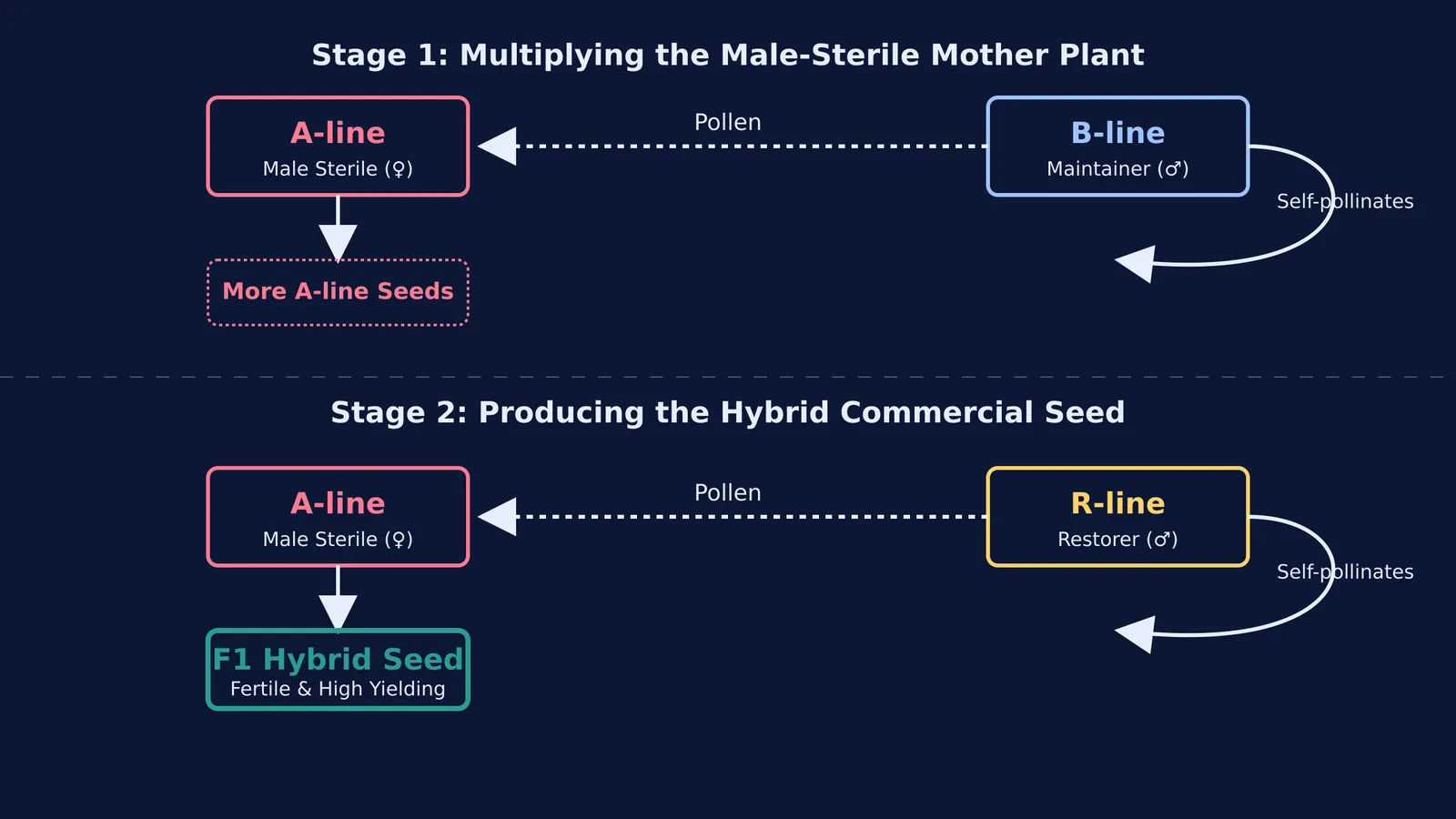
With the male-sterile plant in hand, Yuan Longping developed the practical "three-line system" in 1973.
Framework: The Three-Line Breeding Strategy
To mass-produce hybrid seeds without manual labour, breeders follow this three-step framework:
The Male-Sterile Line (A-line): This is the mother plant. Because it produces no viable pollen, it cannot pollinate itself and can only be fertilised by pollen carried by the wind from a neighbouring plant.
The Maintainer Line (B-line): This plant has normal pollen but is genetically identical to the A-line in all other respects. When it pollinates the A-line, the resulting seeds grow into more sterile A-line plants. This step is essential because it allows breeders to endlessly multiply the sterile mother plants.
The Restorer Line (R-line): This is a completely different, high-yielding variety. When pollen from the R-line fertilises the sterile A-line, it restores fertility in the offspring. These seeds are the final product: fertile, high-yielding hybrid rice that farmers buy and plant.
If you are studying genetics, understanding how traits like male sterility are inherited and maintained is crucial. The Fermi Concept Library contains every concept in biology, each with its own lesson and its place in the map.
What was the impact of Yuan Longping's discovery?
The hybrid varieties developed from Yuan's system were a resounding success. They yielded 20% to 30% more grain than conventional pure strains (Wikipedia). By 1976, his hybrid rice was being grown commercially on a massive scale across China, playing a critical role in ending the nation's cycle of famines.
Today, about 50% of China's rice paddies grow Yuan's hybrid rice, accounting for 60% of the country's total rice production (Wikipedia). In 1979, his technology was introduced to the United States, marking the first intellectual property rights transfer in the history of the People's Republic of China. For his monumental contributions, Yuan Longping was awarded the 2004 World Food Prize, sharing the honour with Dr. Monty Jones, who developed New Rice for Africa (Wikipedia).
His work has since been shared with dozens of countries, making him a towering figure in the fight for global food security. If you are struggling to picture how these three lines interact in a breeding programme, the Fermi Simulation Lab has interactive simulations for the ideas that are easier to see than to read.


