

On this page
You probably meet maxima and minima in Class 12, as an application of derivatives. In 1850 a Delhi College teacher, Ramchundra, showed that most of these problems yield to Class 10 algebra. His method is still a clean check on a calculus answer.
Who was Yesudas Ramchundra?
Ramchundra was born in 1821 in Panipat and died in Delhi on 11 August 1880, according to the MacTutor History of Mathematics biography. In 1844 he became teacher of European science in the Oriental department of Delhi College.
He was baptised a Christian in Delhi in 1852; his autobiographical notes give the date as 11 May 1852. Historians Dhruv Raina and S. Irfan Habib, in a 1990 paper in Social Studies of Science, call him Yesudas Ramchandra (paper record).
What was in his maxima and minima book?
In his 1850 preface, he wrote: "For the last four or five years I was desirous of solving almost all problems of Maxima and Minima by the principles of Algebra, and not by those of the Differential Calculus."
The book contains about 130 problems, taken chiefly from English calculus texts such as Simpson's Fluxions, says the same preface. Chapter one solves problems leading to quadratics. Chapter two tackles cubics, with a method he says "baffled all my endeavours for the space of three years."
How did he find a maximum without calculus?
For quadratics he used what his preface calls the method of imaginary roots: ask for a value above the maximum and the equation for x has no real roots. Here it is on a problem of our own.
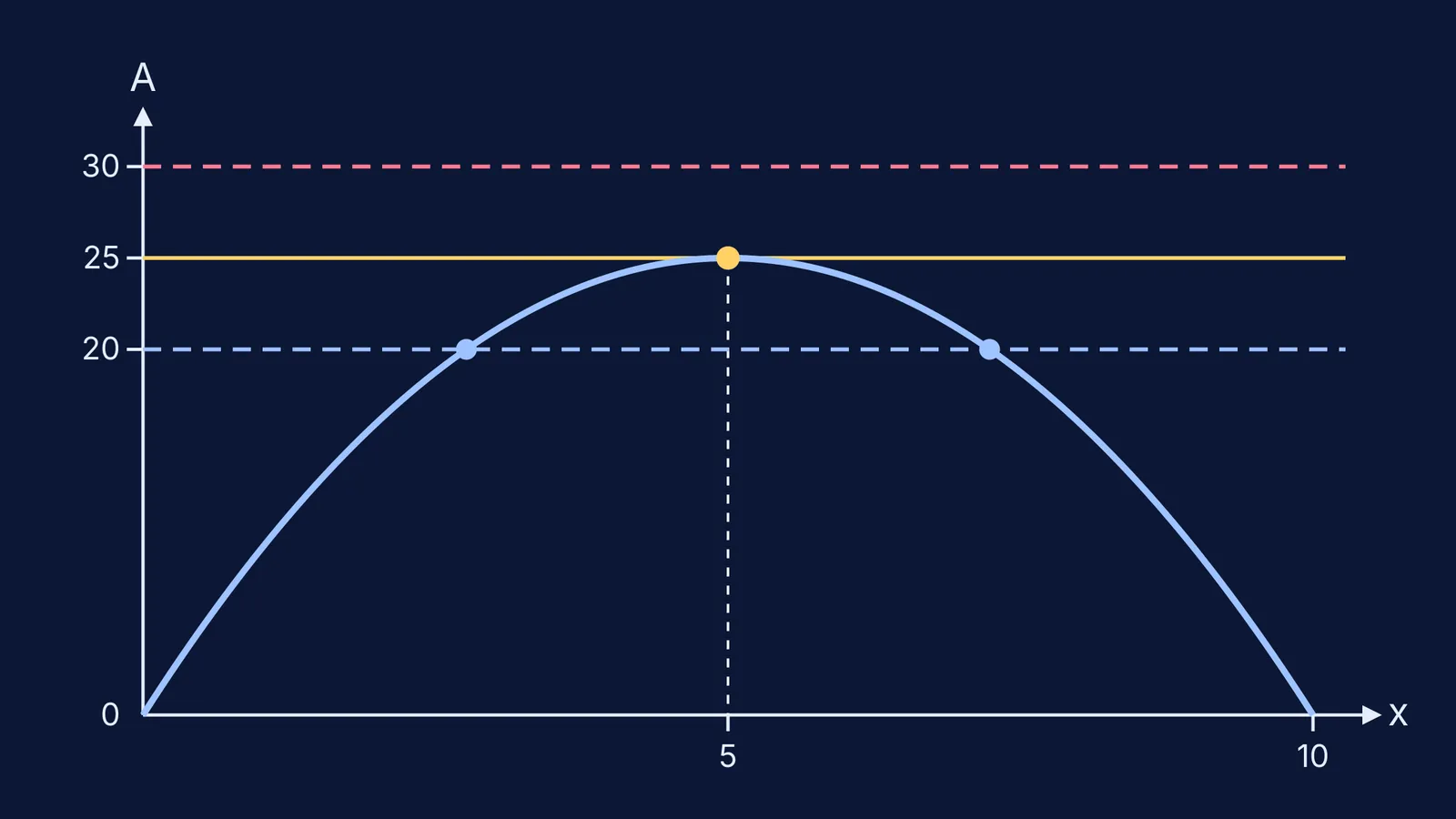
Problem 1. A rectangle has a perimeter of 20 cm. What is the largest area it can have?
Call one side x, so the other is 10 − x and the area is A = x(10 − x).
Treat A as a fixed number and rearrange: x² − 10x + A = 0.
A real rectangle needs a real x, so the discriminant must not be negative: 100 − 4A ≥ 0.
So A ≤ 25. At A = 25 the two roots become equal, x = 5: the best rectangle is a square.
For cubics, the Calcutta Review of 1859 explains his idea: write r for the value sought, divide F(x) − r by a linear factor, make the remainder vanish, and require the quotient to have equal roots. At the maximum, F(x) − r has a repeated root.
Problem 2. Cut a square of side x from each corner of a 12 cm square sheet and fold up an open box. Its volume is V = x(12 − 2x)², with 0 < x < 6.
The repeated-root condition gives x = 2, so V = 2 × 8² = 128 cm³.
Check: V − 128 = 4x³ − 48x² + 144x − 128 = 4(x − 2)²(x − 8).
For 0 < x < 6, (x − 2)² ≥ 0 and x − 8 < 0, so V − 128 ≤ 0. No derivative needed.
Calculus agrees: dV/dx = (12 − 2x)(12 − 6x), which is zero at x = 2.
Why did Augustus De Morgan promote the book in England?
In 1850 J. E. Drinkwater-Bethune sent copies to England, one to De Morgan, who wrote in his 1859 editor's preface that he saw in it "not merely merit worthy of encouragement, but merit of a peculiar kind." In a letter of 24 July 1856 he drew the Court of Directors' attention to the work, and they accepted his offer to superintend a reprint "for circulation in Europe and in India." More on him: Augustus De Morgan, born in Madurai, and his laws for sets.
The London edition appeared in 1859 from Wm. H. Allen and Co. (Wikipedia). In his autobiographical notes, Ramchundra recorded a reward of 2,000 rupees and a khillut (dress of honour) of five pieces.
The Calcutta Review said his quadratic method was "as old as the time of Cardan", called the working "clumsy", but gave him credit for "an ingenious and original application" to cubics and quartics. Raina and Habib note that the book never found a place in Indian school or college curricula (abstract).
How can you use his method in board and JEE maths today?
Use it to check a derivative answer:
Write the quantity as y = f(x), then treat y as a constant.
Quadratic in x? Set the discriminant ≥ 0 to get the range of y. Our guide to when ax² + bx + c is positive for all x covers the test.
Cubic? Find the y that gives a repeated root, then factor f(x) − y to prove it.
Check the allowed range of x; on a closed interval, test the endpoints too.
Confirm with calculus, as in our post on maxima, minima and rates of change.
If you cannot see the next step, the Fermi Problem Library has worked problems with a step-by-step solver that explains the reasoning rather than printing an answer.
Try Problem 1 with a 36 cm perimeter, then check it by differentiating.


