

On this page
What is the Yerkes-Dodson law?
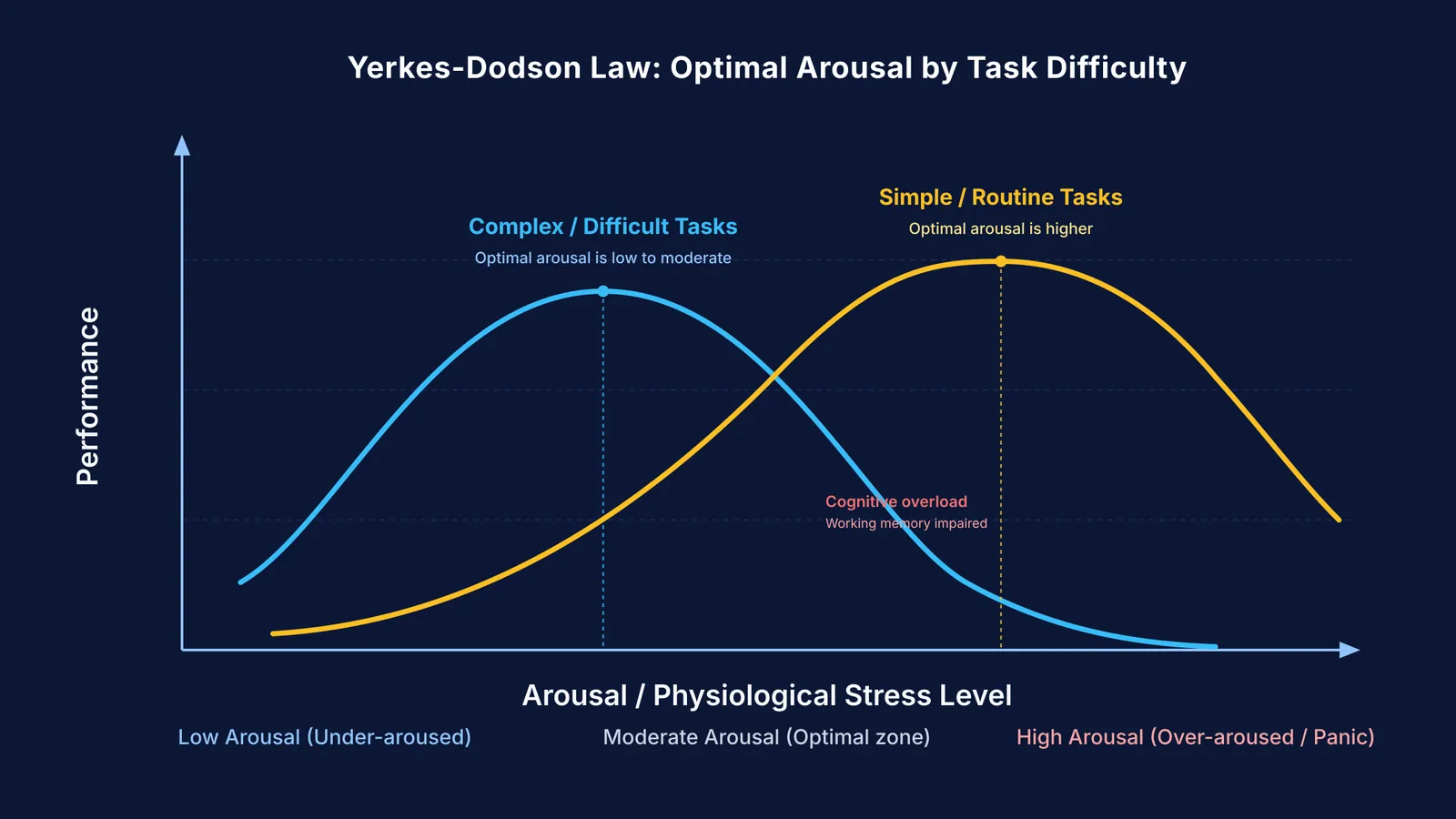
If you have felt sharp during an easy quiz but blanked during a demanding physics exam, you have experienced the Yerkes-Dodson law. Formulated in 1908, the principle states that performance increases with physiological or mental arousal up to an optimal peak, after which additional stress causes performance to decline.
Visualized as an inverted-U curve, the relationship reveals a critical nuance: optimal arousal depends entirely on task difficulty. For simple drills, high drive and pressure improve execution. For complex problem-solving—such as multi-step derivations in competitive exams—optimal arousal occurs at a much lower level of stress. When anxiety climbs too high, cognitive performance drops.
In his historical review of the principle, psychologist Karl Halvor Teigen documented how this animal learning study gradually became an enduring model for human stress and anxiety in *Theory & Psychology*. Yet the core insight remains vital: stress is not a simple enemy to eliminate, but an energizing curve that must be calibrated to the difficulty of the challenge.
What did the 1908 dancing mice experiment show?
At Harvard University in 1908, psychologists Robert M. Yerkes and John D. Dodson set out to measure how electrical shock intensity affected the speed of habit formation in Japanese dancing mice (*Mus wagneri*), publishing their findings in the *Journal of Comparative Neurology and Psychology*. The animals had to learn to choose a white passage over a black passage; entering the incorrect black passage delivered an electric shock.
Yerkes and Dodson tested three distinct visual discrimination conditions:
Easy discrimination (high brightness contrast): As shock intensity increased, the mice learned steadily faster, taking fewer trials to master the habit.
Medium discrimination (moderate brightness contrast): Mice trained with a moderate shock of 300 units formed the habit in an average of 80 tests, whereas those trained with a weak shock of 125 units took 187 tests, and those receiving a strong shock of 500 units took 155 tests.
Difficult discrimination (slight brightness contrast): When the white and black boxes looked almost identical, optimal learning occurred at a weak stimulus of 125 to 195 units. Strong shocks caused agitation and disorientation, sharply slowing learning or halting it entirely.
From these numbers, Yerkes and Dodson concluded that as task difficulty increases, the stimulus strength most favourable to habit formation approaches the sensory threshold. In 1957, psychologist P. L. Broadhurst confirmed this in the *Journal of Experimental Psychology* using rats in underwater mazes under 0 to 10 seconds of air deprivation, showing that difficult discriminations fail under high drive. In 1955, Canadian psychologist Donald O. Hebb formalized the inverted-U curve in the *Psychological Review*, linking arousal directly to cortical functioning.
Why does exam stress hurt complex problem-solving first?
The reason difficult tasks unravel before routine habits lies in brain architecture. In a 2009 review in *Nature Reviews Neuroscience*, neuroscientist Amy Arnsten showed that the prefrontal cortex—the seat of working memory and abstract reasoning—is exceptionally sensitive to chemical stress signals. Under calm alertness, moderate releases of norepinephrine and dopamine engage high-affinity alpha-2A and D1 receptors, strengthening circuits needed to hold multiple concepts in mind.
When pressure spikes, the body triggers Walter Cannon and the fight-or-flight response. Floods of catecholamines activate lower-affinity alpha-1 and beta-1 adrenoceptors, disconnecting prefrontal networks and handing control to primitive structures like the amygdala. This shift preserves fast reflexes for physical survival, but it cripples the mental workspace described in Alan Baddeley's working memory model.
When students face unfamiliar, high-stakes questions, cognitive overload can paralyze problem-solving. Breaking complex challenges into structured steps restores clarity. The Fermi Problem Library has worked problems with a step-by-step solver that explains the reasoning rather than printing an answer, helping students practice breaking down unfamiliar questions before exam day.
How can students stay in the optimal performance zone?
Because high stress degrades higher reasoning, keeping arousal in the middle zone is a concrete skill rather than a matter of willpower. Research shows that simple behavioral protocols can shift the nervous system back toward its peak.
Reappraise bodily arousal: In a 2010 study in the *Journal of Experimental Social Psychology*, researcher Jeremy Jamieson and colleagues tested students taking the GRE. Students instructed that a racing heart aids cognitive performance scored a mean of 770.00 on the quantitative section of the actual exam taken 1 to 3 months later, compared to 705.71 in the control group. Remind yourself: *My heart is pumping oxygen to my brain, not failing.*
Offload testing worries in writing: In a 2011 study in *Science*, psychologists Gerardo Ramirez and Sian Beilock showed that spending 10 minutes writing freely about exam anxieties immediately before a test improved scores by nearly one full grade point among anxious students, freeing working memory capacity.
Partition your question paper: On test day, solve straightforward, familiar questions first. Routine tasks tolerate higher arousal, and early successes reduce sympathetic arousal before you tackle complex, multi-concept problems.
Build structured study sessions: Unstructured study schedules amplify anxiety because uncertainty elevates stress. When you are unsure where to begin your revision, Fermi's AI tutor can work out what you already know and build a plan for the session, so you sit down to a clear next step instead of feeling overwhelmed.
For students experiencing persistent distress that disrupts sleep or daily functioning, seek everyday support for exam stress or speak with a mental health professional. In India, students and parents can contact the Ministry of Health's national Tele MANAS helpline at 14416 (toll-free, 24/7) for free, confidential guidance.


