

On this page
What is the Triangle of U in Brassica genetics?
In 1935, botanist Woo Jang-choon, publishing under the Japanese reading of his name Nagaharu U, published a 64-page monograph in the *Japanese Journal of Botany* (Nagaharu U, 1935). Botanists were puzzled by agricultural crucifers: crops like turnips, cabbages, and mustards shared physical traits but had conflicting chromosome counts.
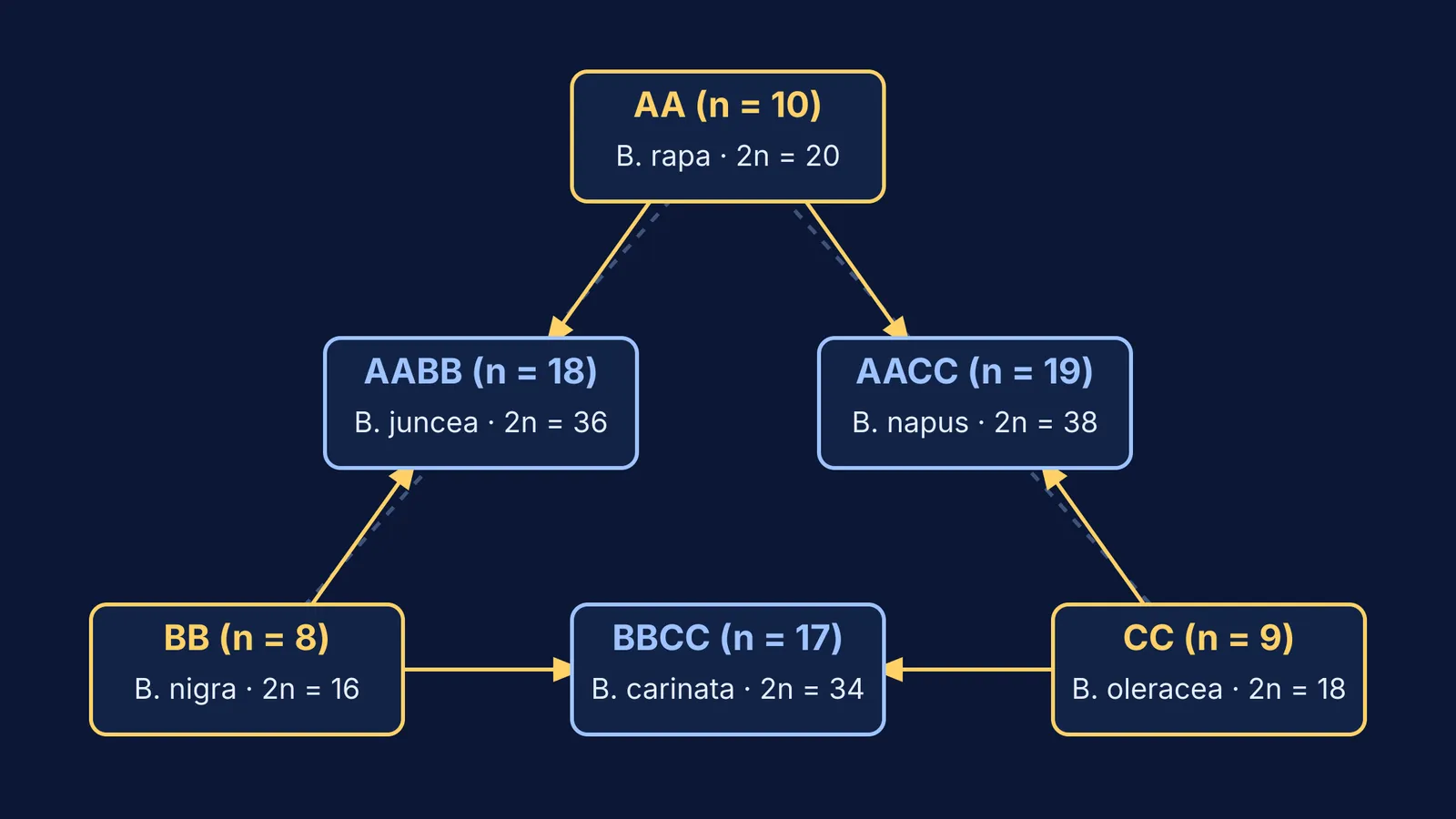
Woo proved that six *Brassica* crops form an evolutionary network known as the Triangle of U. At the three vertices sit ancestral diploids:
*Brassica rapa* (turnip, napa cabbage): genome AA, n = 10 (2n = 20).
*Brassica nigra* (black mustard): genome BB, n = 8 (2n = 16).
*Brassica oleracea* (cabbage, kale): genome CC, n = 9 (2n = 18).
Along the edges sit three allotetraploids (amphidiploids) formed through natural hybridisation between two ancestral diploids, followed by chromosome doubling (Science, 2014):
*Brassica juncea* (Indian mustard): genome AABB, n = 18 (2n = 36), from *B. rapa* × *B. nigra*.
*Brassica napus* (rapeseed, canola): genome AACC, n = 19 (2n = 38), from *B. rapa* × *B. oleracea*.
*Brassica carinata* (Ethiopian mustard): genome BBCC, n = 17 (2n = 34), from *B. nigra* × *B. oleracea*.
How did Woo Jang-choon synthesize Brassica napus in 1935?
To test his hypothesis, Woo recreated an existing crop species from scratch at the Konosu Agricultural Experiment Station.
Crossing distinct species typically yields sterile progeny. Woo pollinated *Brassica oleracea* with pollen from *Brassica rapa*, using controlled artificial hybridisation techniques to avoid self-pollination. The F1 generation carried disparate chromosomes (AC, 10 + 9 = 19 chromosomes) and was sterile (Nagaharu U, 1935).
Spontaneous chromosome doubling occurred in rare hybrid cells. The resulting amphidiploid plants possessed 2n = 38 chromosomes (AACC) and proved fully fertile. Morphologically and cytologically, Woo's synthetic plants matched naturally occurring *Brassica napus*, achieving the first experimental synthesis of a natural plant species.
During these crosses, Woo also documented a peculiar mode of fertilisation: foreign pollen stimulated egg cells to develop into maternal clones without genetic fusion, known as matromorphs. Tracing how reproductive structures govern chromosome complement remains essential when tracing ploidy in plant reproductive parts.
Why does allopolyploidy prevent hybrid sterility?
In an interspecific F1 hybrid like an AC plant (10 A and 9 C chromosomes), chromosomes are homeologous. While ancestrally related, they have diverged enough that they cannot pair during prophase I of meiosis (Science, 2014). They segregate haphazardly as univalents, creating inviable spores.
Allopolyploidy resolves this pairing failure through genome duplication. In an allotetraploid AACC plant, every chromosome has an identical homologue:
The 10 A-chromosomes pair exclusively with each other.
The 9 C-chromosomes pair exclusively with each other.
Meiosis forms 19 bivalents, producing viable gametes carrying n = 19 chromosomes.
Duplication also erects an instant reproductive barrier. Backcrossing an allotetraploid AACC (gamete n = 19) to diploid parent AA (gamete n = 10) yields an AAC triploid with 2n = 29 chromosomes, which cannot divide evenly in meiosis and remains sterile. Speciation occurs in a single step, paralleling what botanist E. K. Janaki Ammal demonstrated in sugarcane polyploids.
How do you solve Brassica chromosome numericals for NEET?
Questions on allopolyploid chromosome counts appear regularly in genetics exams. You can solve any Triangle of U problem in three steps (Science, 2014):
Constituent genomes: Identify the diploid parents (for example, Indian mustard *B. juncea* = A + B).
F1 hybrid count: Add parental haploids. For *B. juncea*, gametes contribute n = 10 (from AA) and n = 8 (from BB), giving 2n = 18 univalents (0 bivalents).
Amphidiploid values: Double the genome. Somatic count is 2n = 2(10) + 2(8) = 36 chromosomes, forming 10 + 8 = 18 bivalents at metaphase I.
Worked example:
Problem: Crossing *Brassica nigra* (2n = 16) with *Brassica oleracea* (2n = 18) yields *Brassica carinata*. Find the F1 chromosome count and bivalents in the amphidiploid.
Step 1: Gametes carry n = 8 (*B. nigra*) and n = 9 (*B. oleracea*).
Step 2: Sterile F1 hybrid has 2n = 8 + 9 = 17 chromosomes.
Step 3: Doubling produces amphidiploid *B. carinata* with 2n = 34 chromosomes, forming 17 bivalents at metaphase I.
When practicing genetics problems with unfamiliar ploidy levels or cross combinations, the Fermi Problem Library has worked problems with a step-by-step solver that explains the reasoning rather than printing an answer.
What does modern DNA sequencing reveal about the triangle?
Whole-genome sequencing has confirmed Woo's cytogenetic model at base-pair resolution.
In 2011, an international consortium sequenced the *Brassica rapa* genome (Nature Genetics, 2011), identifying approximately 41,000 protein-coding genes across 10 chromosomes. Sequencing of *Brassica oleracea* followed in 2014 (Nature Communications, 2014), alongside the allotetraploid genome of *Brassica napus* (Science, 2014). The *B. napus* assembly demonstrated that natural hybridisation occurred roughly 7,500 years ago, with both subgenomes remaining largely intact.
In 2016, researchers sequenced Indian mustard *Brassica juncea* (Nature Genetics, 2016), revealing homoeolog expression dominance between subgenomes that guided crop selection for seed oils and glucosinolates.
Woo Jang-choon later applied these cytogenetic principles to rebuild South Korea's post-war agriculture, breeding virus-free seed potatoes, high-yielding kimchi cabbages, and seedless watermelons.
The Fermi Concept Library covers every concept in physics, chemistry, biology, mathematics and computing, each with its own lesson and its place in the map.


