

On this page
Dropping zinc or limestone into hydrochloric acid triggers violent effervescence as the mineral acid dissolves the solid. For centuries, physicians believed a living organ could never produce such a destructive substance. Yet in 1823, English physician and chemist William Prout proved that the human and animal stomach routinely secretes free hydrochloric acid to digest food, a finding published in the Philosophical Transactions of the Royal Society of London.
Prout's findings reshaped physiology, transforming digestion from a mysterious, vitalist phenomenon into an applied branch of chemical science.
What did William Prout discover about gastric juice in 1823?
On 11 December 1823, William Prout read his paper before the Royal Society of London, documenting experiments on gastric fluid from rabbits, hares, horses, dogs, and human patients suffering from indigestion. Until then, most European physiologists followed the Italian biologist Lazzaro Spallanzani, who argued that pure gastric fluid was neutral or only weakly acidic due to fermentation. When acids were detected, contemporaries suspected organic compounds like lactic acid or acetic acid, or at most phosphoric acid.
Prout discovered that the acidity was caused by "free, or at least unsaturated muriatic acid", the historical name for hydrochloric acid. As medical historian Louis Rosenfeld detailed in Clinical Chemistry, Prout's work established that the fluid contained not just inert chloride salts like sodium chloride, but unneutralised mineral acid actively participating in food breakdown.
Why was finding hydrochloric acid in a living organ so shocking?
In the early 19th century, the dominant medical philosophy was vitalism: the belief that living tissues were governed by unique vital forces distinct from the inorganic world. Mineral acids like sulphuric, nitric, and muriatic acid were known as caustic industrial chemicals that blistered human skin and dissolved metals. The idea that delicate epithelial membranes could manufacture and contain such an acid seemed biologically impossible.
Prominent European chemists initially met Prout's claim with disbelief. In 1826, German researchers Friedrich Tiedemann and Leopold Gmelin confirmed Prout's finding in Heidelberg, as documented in Educación Química. Meanwhile, across the Atlantic, American army surgeon William Beaumont studied a patient with a permanent gastric fistula. Beaumont collected pure human gastric juice and confirmed its mineral acidity, as explored in our look at William Beaumont's direct observations of gastric digestion.
How did Prout prove stomach acid was hydrochloric acid?
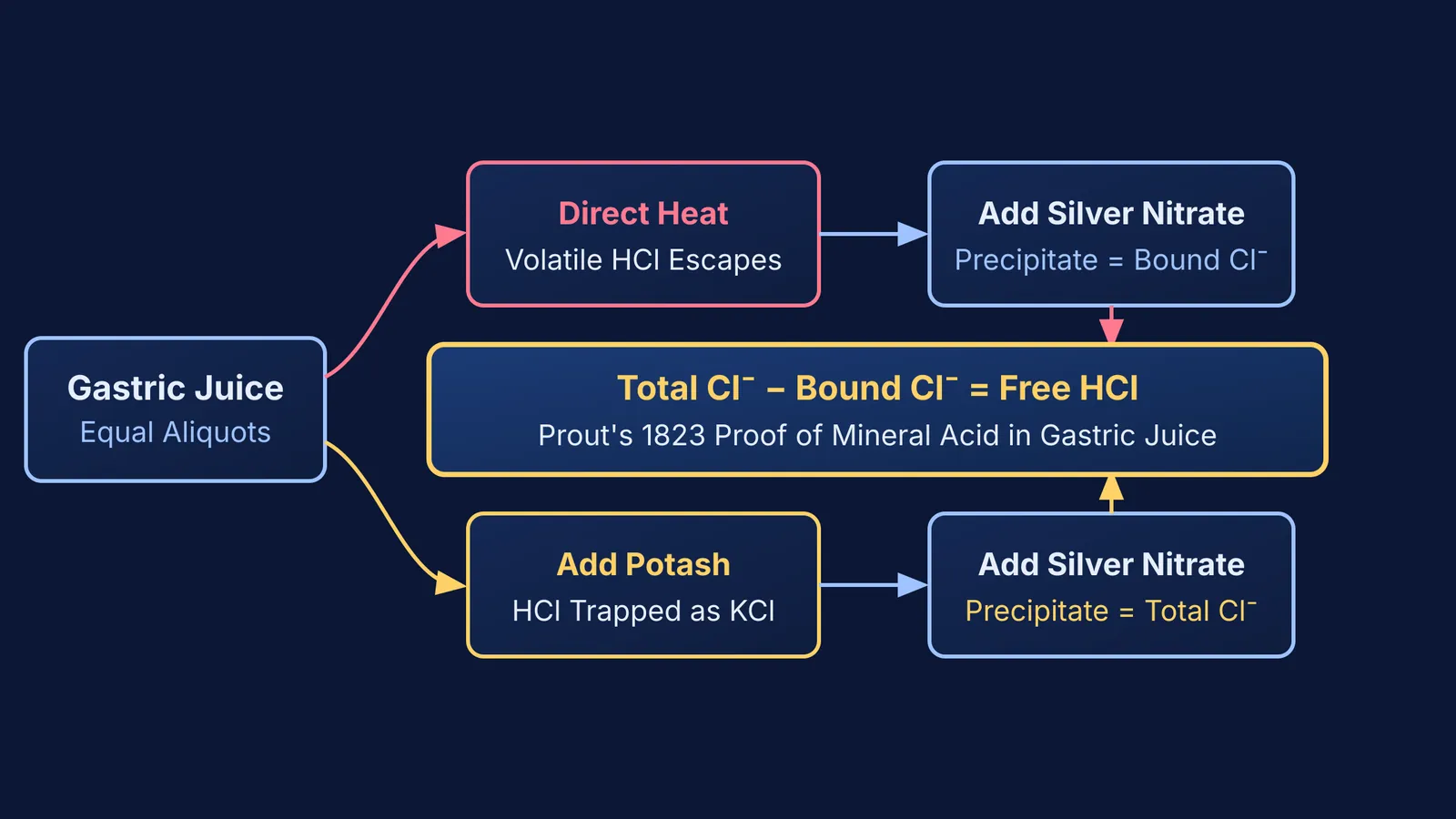
Prout knew that simple litmus paper could not distinguish hydrochloric acid from organic acids or acidic salts. To provide irrefutable quantitative proof, he devised an analytical separation using silver nitrate precipitation and potash neutralisation:
Extraction and filtering: He collected gastric fluid from animals after feeding and filtered it to remove solid food debris.
Measuring bound chlorides: He took an aliquot of filtered juice, evaporated it to dryness, and ignited it to red heat. Heating drove off all volatile free hydrochloric acid as gas. He dissolved the remaining ash and added silver nitrate, precipitating silver chloride. This measured only the chloride bound to fixed bases such as sodium and potassium.
Measuring total chlorides: In an identical aliquot, he neutralised the liquid with potash (potassium carbonate) before evaporation. The alkali reacted with free hydrochloric acid to form stable potassium chloride, preventing any chlorine from evaporating during heating. Adding silver nitrate yielded a larger mass of silver chloride, representing total chlorides.
Calculating free acid: Subtracting the bound chloride mass from the total chloride mass yielded the exact quantity of free hydrochloric acid.
Confirmation by distillation: He gently distilled fresh gastric juice and demonstrated that volatile muriatic acid passed into the condenser, forming a precipitate with silver nitrate.
How does the stomach make and survive hydrochloric acid?
Modern molecular biology has revealed the cellular machinery behind Prout's discovery. In the gastric glands, specialized parietal cells use an active transport pump known as the H+/K+-ATPase to pump protons into the stomach lumen against a concentration gradient exceeding one million to one, as reviewed in Physiological Reviews. The resulting gastric juice typically achieves a pH between 1.5 and 2.0, an acidity easily quantified using Søren Sørensen's logarithmic pH scale.
To survive this caustic bath, the stomach lining employs a protective mucus-bicarbonate barrier:
Epithelial mucus layer: Surface mucous cells secrete a viscous gel layer roughly 200 micrometres thick that traps water and prevents pepsin from contacting the cell surface.
Bicarbonate neutralisation: The same cells continuously release bicarbonate ions into the gel, maintaining a neutral pH of approximately 7.0 at the cell membrane despite the harsh acid only micrometres away.
Rapid cell turnover: Surface mucous epithelial cells replace themselves every 3 to 5 days, repairing minor acid damage before deeper mucosal layers are breached.
When mastering acid-base equilibria and biological transport, students often struggle to connect chemical titrations to active cellular transport. The Fermi Concept Library maps every concept across biology and chemistry, showing how thermodynamic gradients drive biochemical reactions. For practice balancing gravimetric precipitation and neutralisation problems, the Fermi Problem Library offers worked problems with a step-by-step solver that explains the chemical reasoning, just as you can explore in calculating hydronium ion concentration in dilute acids.


