

On this page
Every time you write 3 × 4 you use a symbol introduced by a village rector in Surrey. William Oughtred also invented an early form of the slide rule, the hand calculator of generations of engineers. This post covers who he was, how a slide rule turns multiplication into addition, and the argument he picked about learning tricks without reasons.
Who was William Oughtred?
Oughtred was baptised at Eton on 5 March 1574 and died at Albury, Surrey, on 13 June 1660, according to his MacTutor biography. He entered King's College, Cambridge, in 1592. Very little mathematics was taught there, so he taught himself, writing that he studied it at night, time he "redeemed night by night from my natural sleep."
He was ordained in 1603 and became rector of Albury in 1610, a post he kept for the rest of his life. Mathematics stayed a private passion. He took pupils into his home free of charge, and MacTutor lists John Wallis and Christopher Wren among those he taught or influenced. Wallis read Oughtred's *Clavis Mathematicae* in 1647 and, MacTutor says, mastered it in a couple of weeks.
Where did the × sign come from?
*Clavis Mathematicae* ("Key to mathematics") appeared in 1631 and ran to only 88 pages. MacTutor says Oughtred tried many new symbols in it, including × for multiplication and :: for proportion. The MacTutor page on the earliest symbols of operation adds that he also used ± in the same book, and that × appears in a 1618 appendix to a translation of Napier's work believed to be Oughtred's.
Not everyone liked it. The same page quotes Leibniz writing to Johann Bernoulli in 1698 that he disliked × because it is easily confused with the letter x. That is why algebra often uses a dot or simply writes ab.
How does a slide rule multiply?
The trick is the logarithm rule log(ab) = log a + log b, the idea behind our post on John Napier and logarithms. If you mark a ruler so that the number n sits at a distance proportional to log n, then laying two such lengths end to end adds logarithms, and the point you land on is the product.
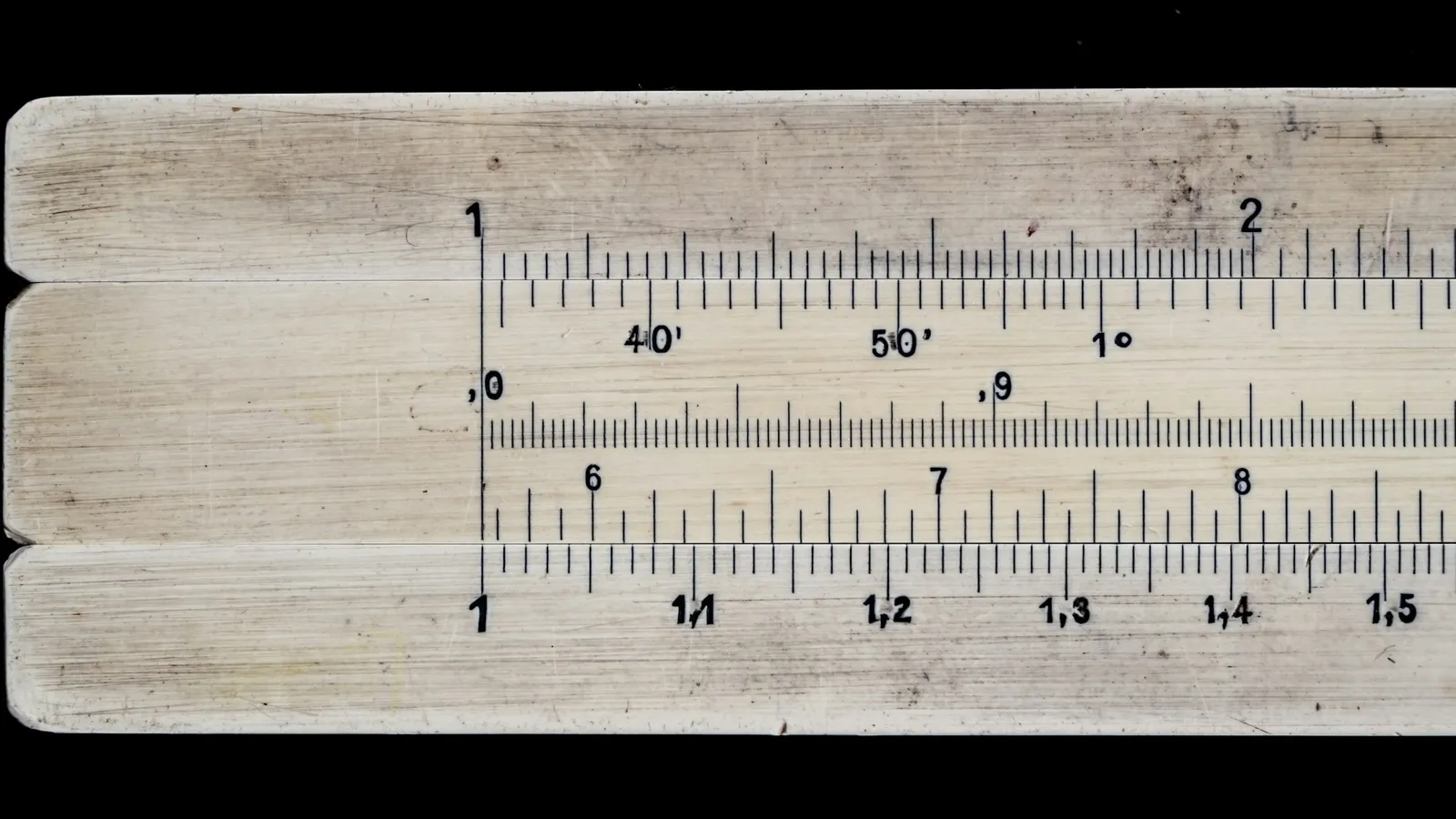
MacTutor describes the steps. In 1620 Edmund Gunter drew a logarithmic scale on a single two-foot ruler and added lengths with a pair of dividers. In 1630 Oughtred invented a circular slide rule, and in 1632 he used two Gunter rulers sliding against each other, so the dividers were no longer needed. His pupil William Forster published the English description, *The Circles of Proportion and the Horizontal Instrument*, in 1632. The modern straight form was designed in 1850 by Amédée Mannheim.
Worked example: multiplying with logarithms
Use five-figure values (log means log base 10):
2.5 × 3.2. log 2.5 = 0.39794 and log 3.2 = 0.50515. Their sum is 0.90309, and the number whose log is 0.90309 is 8.000. So 2.5 × 3.2 = 8.
4 × 5. 0.60206 + 0.69897 = 1.30103. The 1 in front means one power of ten, and 0.30103 is log 2, so the answer is 2 × 10 = 20.
9 ÷ 1.5. Subtract: 0.95424 − 0.17609 = 0.77815, which is log 6. So 9 ÷ 1.5 = 6.
Step 2 is exactly the problem a slide rule user faced: the scale only reads 1 to 10, so the instrument shows "2" and you place the decimal point by estimating (4 × 5 is about 20, not 2 or 200).
Common mistakes with logarithms
Splitting a sum. log(a + b) is not log a + log b. Only products split.
Losing the power of ten. The part before the decimal point (the characteristic) sets the place value. Estimate the answer first.
Mixing bases. Slide rules and log tables use base 10; calculus uses base e. The JEE (Main) 2026 syllabus lists logarithmic functions in both settings. Check the syllabus for your exam year.
Writing × next to x. Leibniz's complaint still applies; in algebra, use a dot or brackets.
Why did Oughtred argue about teaching?
Richard Delamain, another of his pupils, published a circular slide rule in 1630, and a bitter priority dispute followed. MacTutor says it came down to a teaching question. Delamain thought it was fine to teach people to use instruments without the theory. Oughtred held that no one should use the Circles of Proportion without understanding logarithms, writing "That the true way of Art is not by Instruments, but by Demonstration." MacTutor suggests both men may have invented the instrument independently.
What can a student take from Oughtred?
Oughtred's view is a good test for any shortcut, whether a calculator key, a memorised formula or a coaching trick: can you say why it works? If you can, the tool saves time. If you cannot, it fails you the first time a question changes shape.
When a formula works but you do not know why, the Fermi Concept Library covers every concept in physics, chemistry, biology, mathematics and computing, so you can read the idea behind it.
Practice routine for this week:
Multiply 3.5 × 2.4 and divide 7.2 ÷ 1.8 using log values, then check with a calculator.
Draw a logarithmic scale from 1 to 10 on a strip of paper, 10 cm long, with n at 10 × log n cm. Make two and multiply 2 × 3 by sliding them.
Explain in one sentence why the scale must start at 1, not 0.
Start with step 2: a home-made paper slide rule shows in five minutes what Oughtred argued for in a whole book.


