

On this page
In 1977, the Citicorp Center (now Citigroup Center) opened as the seventh-tallest building in the world. It was an engineering marvel, sitting on four massive, 112-foot-tall stilts. But in 1978, its structural engineer, William LeMessurier, discovered a mathematical oversight that meant a strong storm could bring the tower crashing down onto Manhattan.
The flaw was discovered not by a peer review, but through a question from an undergraduate student. It became a masterclass in engineering ethics, demonstrating how to handle a catastrophic mistake.
Why was the Citicorp Tower built on stilts?
When Citicorp bought the land in New York, the plot included St. Peter's Lutheran Church. The church agreed to the sale on one condition: a new church had to be built on the exact same corner of the lot, completely structurally separate from the skyscraper.
To avoid the church, LeMessurier could not put the building's supporting columns in the corners. Instead, he placed four massive stilts at the midpoints of the tower's four sides. To carry the load down to these central stilts, he designed a system of chevron (V-shaped) steel braces that stacked up the outside of the building.
What are quartering winds?
When you design a tall building, you must calculate how wind will push against it. In the 1970s, standard building codes only required engineers to calculate the forces of perpendicular winds—winds hitting the flat faces of a building head-on.
LeMessurier's firm did exactly that. But the Citicorp Tower was not a normal building. Because its supports were in the middle of the walls rather than the corners, it reacted differently.
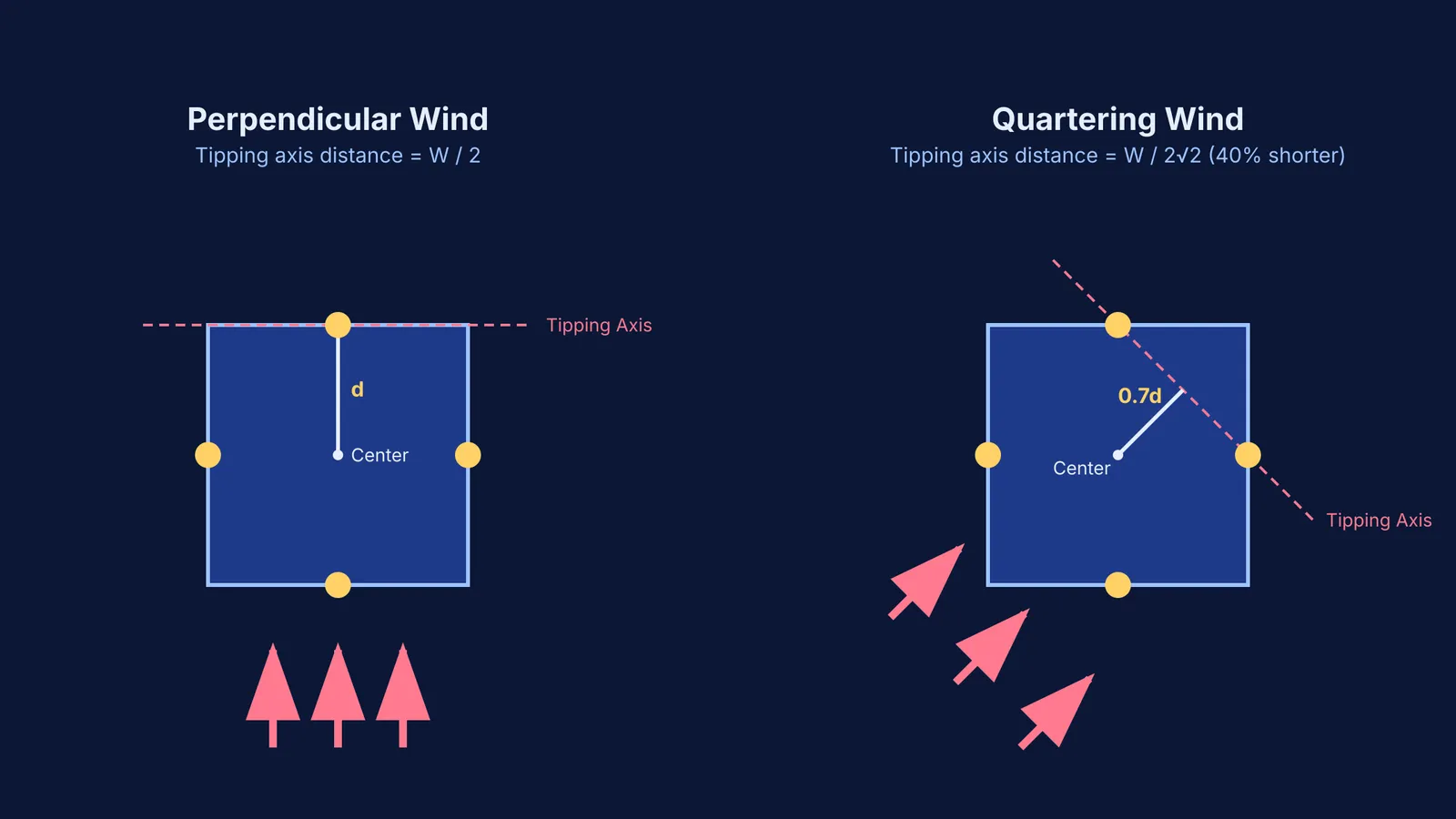
In 1978, Diane Hartley, an undergraduate engineering student at Princeton University, was writing her senior thesis on the building's design. She called LeMessurier's firm to ask how the tower would handle "quartering winds"—winds hitting the corners of the building diagonally at a 45-degree angle.
When LeMessurier went back and recalculated the physics, he found that quartering winds increased the stress on the chevron braces by 40%. (When you are studying forces and vectors and struggling to see how angles change the stress, the Fermi Simulation Lab lets you interactively change angles and watch the loads shift in real time).
What made the 16-year storm so dangerous?
The 40% increase in stress was bad, but it became catastrophic due to a change made during construction.
LeMessurier's original design called for the chevron braces to be welded together. But the steel contractor, Bethlehem Steel, had suggested using bolted joints instead to save time and money. LeMessurier's office approved the change without recalculating the new joint strength against quartering winds. The bolted joints were much weaker than welds.
With the bolts in place, LeMessurier calculated that a wind strong enough to snap the joints and topple the building had a 1-in-16 chance of occurring in any given year, assuming the building's tuned mass damper (a 400-ton concrete block on the roof that reduced sway) lost power during a storm. This meant a "16-year storm" could cause a total collapse.
Identifying the invisible assumptions that make a solution fall apart is exactly what sets apart a good engineer. When learning physics, using a step-by-step tool like the Fermi Problem Library helps you track the reasoning behind a calculation rather than blindly trusting the final answer.
How do you fix a skyscraper in secret?
LeMessurier faced a terrible choice: keep quiet and hope a storm never came, or confess his mistake, risking his career and causing public panic. He chose to speak up, taking his calculations directly to Citicorp and city officials.
They immediately launched a secret emergency repair operation. From August to October 1978, welding crews worked through the night, every night, welding two-inch-thick steel plates over more than 200 bolted joints. During the day, the offices remained open, the public completely unaware of the danger.
The tension peaked in September 1978 when Hurricane Ella began moving up the East Coast toward New York while the repairs were only half finished. Emergency evacuation plans for a 10-block radius were quietly drawn up, but the hurricane fortunately veered out to sea.
The repairs were finished, and the tower became one of the safest in the city. The crisis remained a closely guarded secret for 17 years until journalist Joe Morgenstern revealed the story in a 1995 article in *The New Yorker*. Today, LeMessurier is remembered not for the mistake, but for his courage in fixing it.
Related reading:


