

On this page
The early 19th century was an exciting time for chemistry. Scientists were rapidly identifying new elements, but crude platinum ore remained a stubborn puzzle. It was extremely brittle and difficult to work with, largely because it contained a mixture of undiscovered transition metals.
William Hyde Wollaston, an English chemist and physicist, took on the challenge. In doing so, he not only solved the mystery of malleable platinum but also discovered two entirely new elements hidden within the crude ore.
How did Wollaston discover palladium and rhodium?
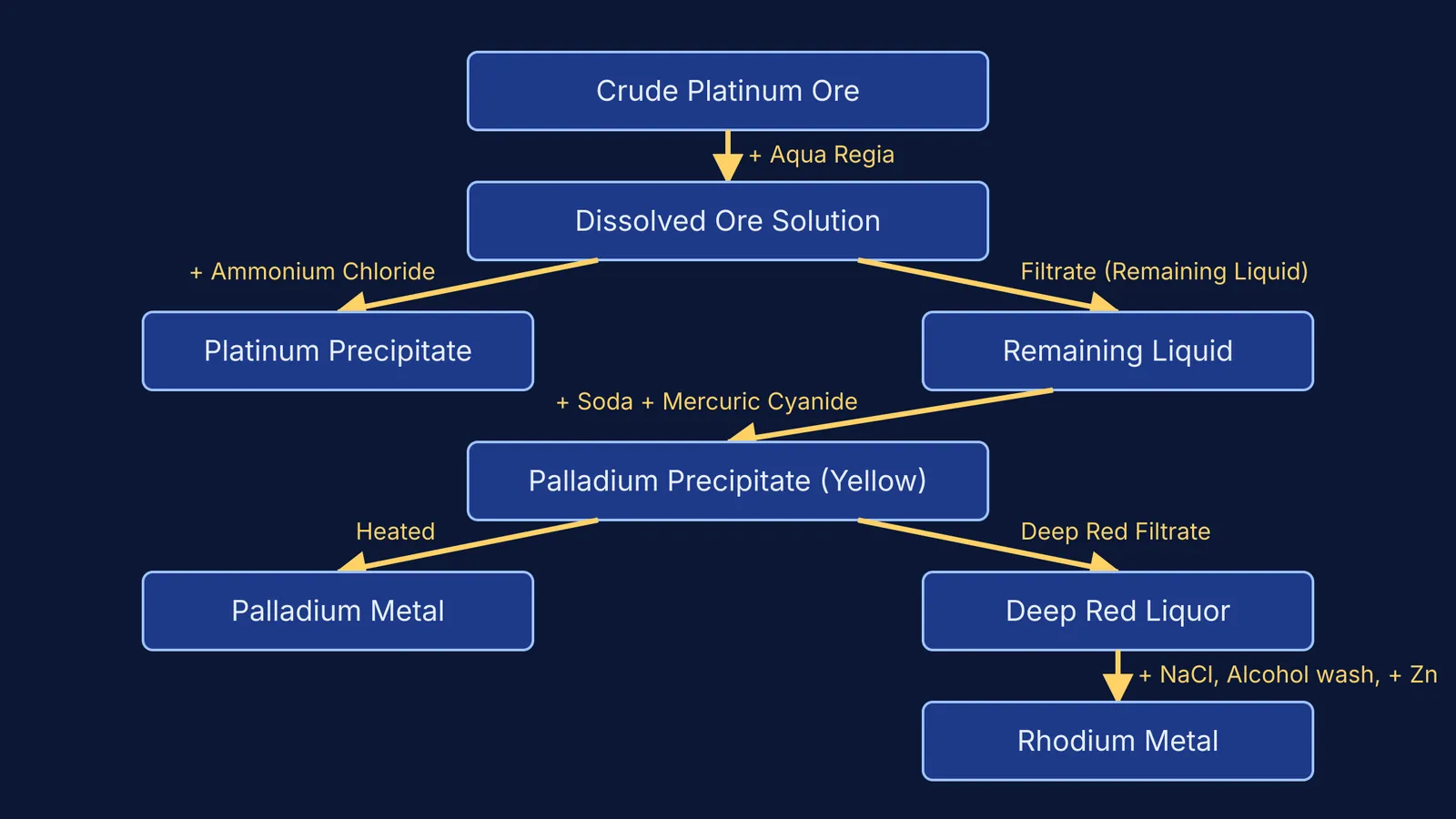
In 1802, Wollaston began his chemical separation by dissolving crude platinum ore in *aqua regia*—a powerful mixture of nitric and hydrochloric acids (Wikipedia). After precipitating the platinum out of the solution using ammonium chloride, he noticed a strange residual liquid left behind.
If you are studying how metals are extracted via roasting and reduction, you know that chemical extraction relies on exploiting the different reactivities of elements. Wollaston applied this principle masterfully. He neutralised the remaining liquid with soda and added mercuric cyanide. This caused a yellow precipitate to form. When he heated this yellow solid, it left behind a new white metal. He named it palladium, after the recently discovered asteroid Pallas.
Two years later, in 1804, Wollaston examined the deep red liquor that remained after both platinum and palladium had been extracted. By treating this residue with sodium chloride, he produced a deep red salt. He washed this salt with alcohol and reduced it using zinc to isolate another new metal. Because of the rose-pink colour of its salts, he named it rhodium, derived from the Greek word *rhodon*, meaning rose (Wikipedia). The varying colours of these salts are classic indicators of stable transition metal oxidation states.
Why did he keep his platinum process a secret?
While discovering two elements was a monumental achievement, Wollaston's primary source of wealth came from what he did with the platinum itself.
He developed a powder metallurgy technique to turn the brittle ore into malleable ingots. He refined the ore into a pure platinum powder, compressed it into a cake using a powerful lever press, and then forged it at white heat. This allowed him to produce large, uniform sheets of platinum, which were in extremely high demand for laboratory equipment and sulfuric acid boilers.
Wollaston kept the exact details of this highly profitable process a secret for over 20 years. By acting as the sole supplier of malleable platinum in England, he amassed a fortune of approximately £30,000 (Wikipedia). He only revealed his methods to the Royal Society in his final Bakerian Lecture in November 1828, mere weeks before his death.
Was the anonymous handbill a scientific prank?
Wollaston had a famously unconventional approach to publishing his findings. Instead of writing a formal scientific paper immediately after isolating palladium, he distributed anonymous handbills at a shop in Soho, London, in April 1803. The bills advertised "Palladium; or, New Silver" for sale.
This unorthodox move sparked fierce debate. The prominent chemist Richard Chenevix publicly declared the new substance to be a fraud, insisting it was merely an alloy of platinum and mercury. Wollaston remained silent, even offering a reward to anyone who could artificially recreate the supposed "alloy." It was not until 1805 that he finally stepped forward and claimed the discovery as his own.
Today, when students tackle complex extraction sequences or stoichiometry problems, keeping track of precipitates and filtrates can feel overwhelming. Fermi's AI tutor can work out what you already know and build a plan for the session, guiding you through the reasoning step by step instead of just giving you the final chemical equation.
William Hyde Wollaston's work bridged the gap between pure scientific discovery and commercial engineering. His meticulous chemical separations gave us palladium and rhodium, metals that remain essential today in everything from catalytic converters to fine jewellery.


