

On this page
For centuries, anatomists and doctors debated what exactly caused the heart to beat. By the late 19th century, this debate had split into two rival camps. The dominant "neurogenic" theory held that the heartbeat was controlled entirely by a network of nerves within the heart. The emerging "myogenic" theory argued that the electrical signal started and travelled within the heart muscle itself.
The greatest anatomical problem for the myogenic theory was the physical gap in the heart. The upper chambers (the atria) and the lower chambers (the ventricles) were separated by a tough, fibrous ring, and scientists believed there was no muscular connection between them. If no muscle crossed the gap, the beat had to be carried by nerves.
Who discovered the bundle of His in the heart?
In 1893, the Swiss cardiologist and anatomist Wilhelm His Jr published a paper titled *Die Thätigkeit des embryonalen Herzens* (The activity of the embryonic heart). In it, he provided the anatomical missing link that would change cardiology forever.
His Jr identified a thin, specialised bundle of muscle fibres that originated in the right atrium, passed straight through the fibrous septum, and entered the ventricles. This structure, now known as the bundle of His, proved that a direct muscular pathway existed for electrical impulses to travel from the top of the heart to the bottom.
Wilhelm His Jr came from a family deeply embedded in anatomical research. His father, Wilhelm His Sr, was a famous anatomist who invented the microtome—a tool used to slice tissue into incredibly thin sections for the microscope—and coined the term "endothelium". Growing up in this environment of precise microscopic observation undoubtedly prepared His Jr to find a tiny muscular bundle that everyone else had missed.
He had looked closely at the developing hearts of embryos, where the structures were easier to trace, and then confirmed his findings in new-born dogs, mice, and human adults. This discovery proved that the heart's rhythm is conducted through specialised muscle rather than nerves.
What is the pathway of the heartbeat?
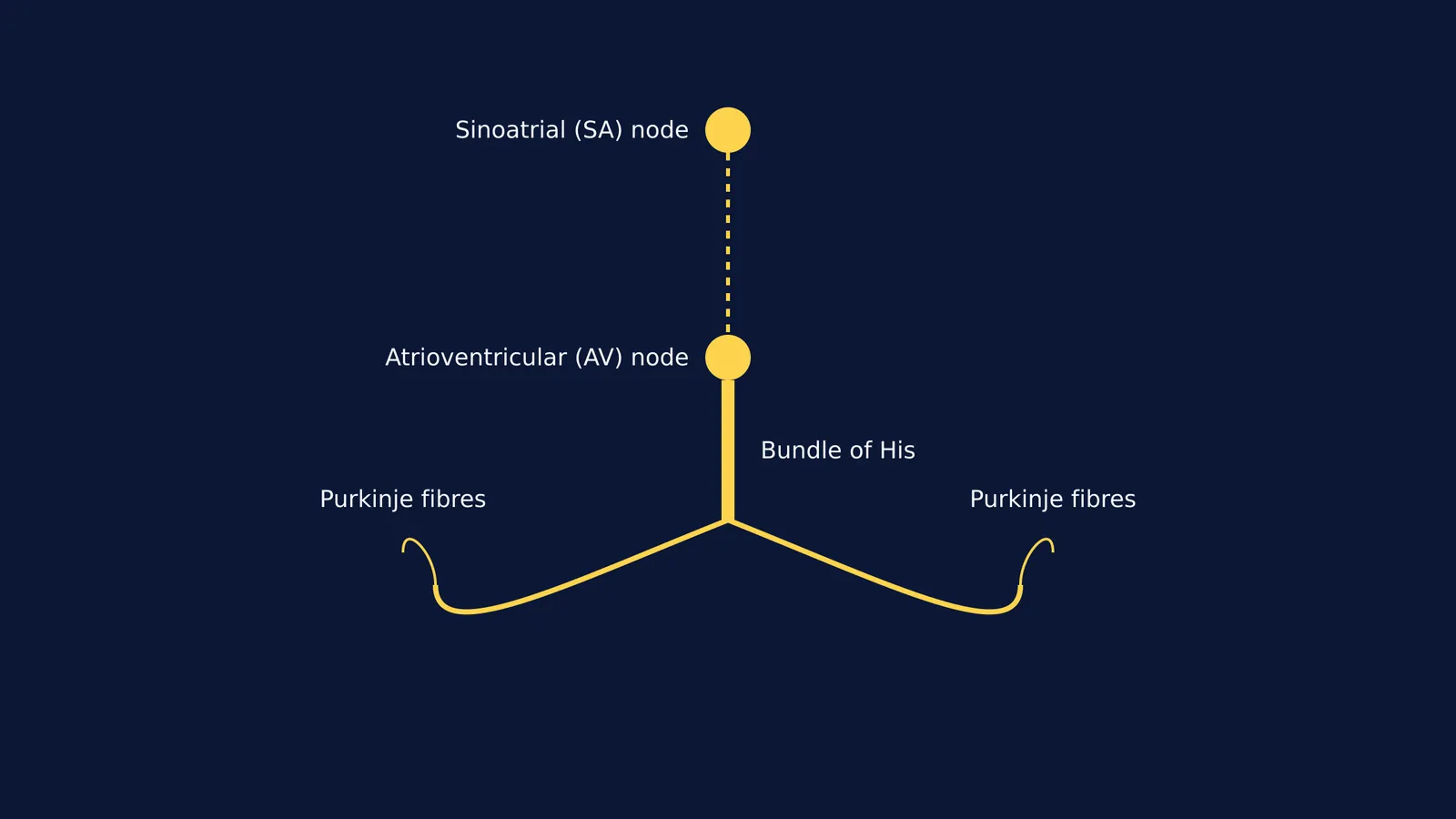
We now know that the bundle of His is a crucial component of the cardiac conduction system. The pathway of the electrical impulse that triggers a heartbeat follows a precise route:
Sinoatrial (SA) node: The natural pacemaker in the upper right atrium spontaneously starts the electrical signal.
Atrioventricular (AV) node: The signal reaches the lower right atrium and pauses for about 0.1 seconds, allowing the atria to empty their blood into the ventricles. The delay at the AV node is vital; without it, the ventricles would squeeze before they were full, reducing the amount of blood pumped to the body. The AV node was mapped a decade later; you can read about how Sunao Tawara and the atrioventricular node of the heart completed the picture.
Bundle of His: The signal travels down this single muscular bridge into the interventricular septum.
Purkinje fibres: The bundle immediately splits into left and right branches, spreading into a fine network of fibres that causes the thick ventricular walls to contract simultaneously.
If you are revising the human circulatory system or the cardiac cycle for an exam, the Fermi Concept Library can walk you through these electrical pathways step by step. It covers every concept in physics, chemistry, biology, mathematics and computing, each with its own lesson to ensure you understand how the nodes and bundles connect.
What happens when the bundle is cut?
Wilhelm His Jr did more than just find the bundle; he tested what it did. In a series of physiological experiments on rabbit hearts, he surgically severed the bundle.
He observed that once the bundle was cut, the atria and ventricles began to beat completely independently and out of sync. The electrical signal from the top could no longer cross the gap to the bottom. His Jr coined the term "heart block" to describe this dissociation.
He correctly suggested that damage to this bundle in humans was the underlying cause of Adams-Stokes disease, a dangerous condition where patients suffer fainting spells because their ventricular pulse drops extremely low. When surgeons eventually performed complex procedures like Christiaan Barnard and the first human heart transplant, a complete understanding of this conduction system was essential to keep the heart beating.
By proving that the heart contains its own muscular wiring, His Jr laid the foundation for modern electrophysiology. His 1893 discovery transformed our understanding of the heart from a nerve-driven pump to a self-contained electrical organ.


