

On this page
Walther Kossel was a German physicist who, in 1916, gave chemists an electronic picture of the ionic bond. In Class 11 chemistry you meet him in the opening pages of chemical bonding, where his name is paired with Gilbert Lewis's as the Kossel-Lewis approach. Here is what he actually said, how measured energies back him up, and where his idea stops working.
Who was Walther Kossel?
Kossel was born in Berlin on 4 January 1888 and died in Tübingen on 22 May 1956, according to his Wikipedia biography. His father was Albrecht Kossel, a biochemist who won the Nobel Prize. Walther himself was a physicist rather than a chemist, and he did important work on X-ray spectra. In the late 1920s he also proposed a theory of how crystals grow, now known as the terrace-ledge-kink model.
What did Kossel propose about ionic bonding in 1916?
His paper, Über Molekülbildung als Frage des Atombaus (On molecule formation as a question of atomic structure), filled pages 229 to 362 of the journal Annalen der Physik in 1916, according to its Crossref record.
The chemist and historian George B. Kauffman, in his Dictionary of Scientific Biography entry on Kossel, sums up the argument in three steps:
The outer electrons of an atom, its valence electrons, decide how it behaves chemically.
Noble gases are unusually stable because their outer shell is closed: eight electrons, or two for helium.
Metals reach the arrangement of the nearest noble gas by losing electrons, and non-metals by gaining them. The electrons pass from metal to non-metal, and the oppositely charged ions are held together by electrostatic attraction.
Kauffman also notes that Lewis published his own paper a month after Kossel's, dealing especially with compounds formed by sharing electrons. Irving Langmuir refined these ideas into the 'octet theory' in 1919, as the history of the octet rule records. So the textbook pairing is fair: two people working independently, one stressing transfer and one stressing sharing.
How does Kossel's theory explain sodium chloride?
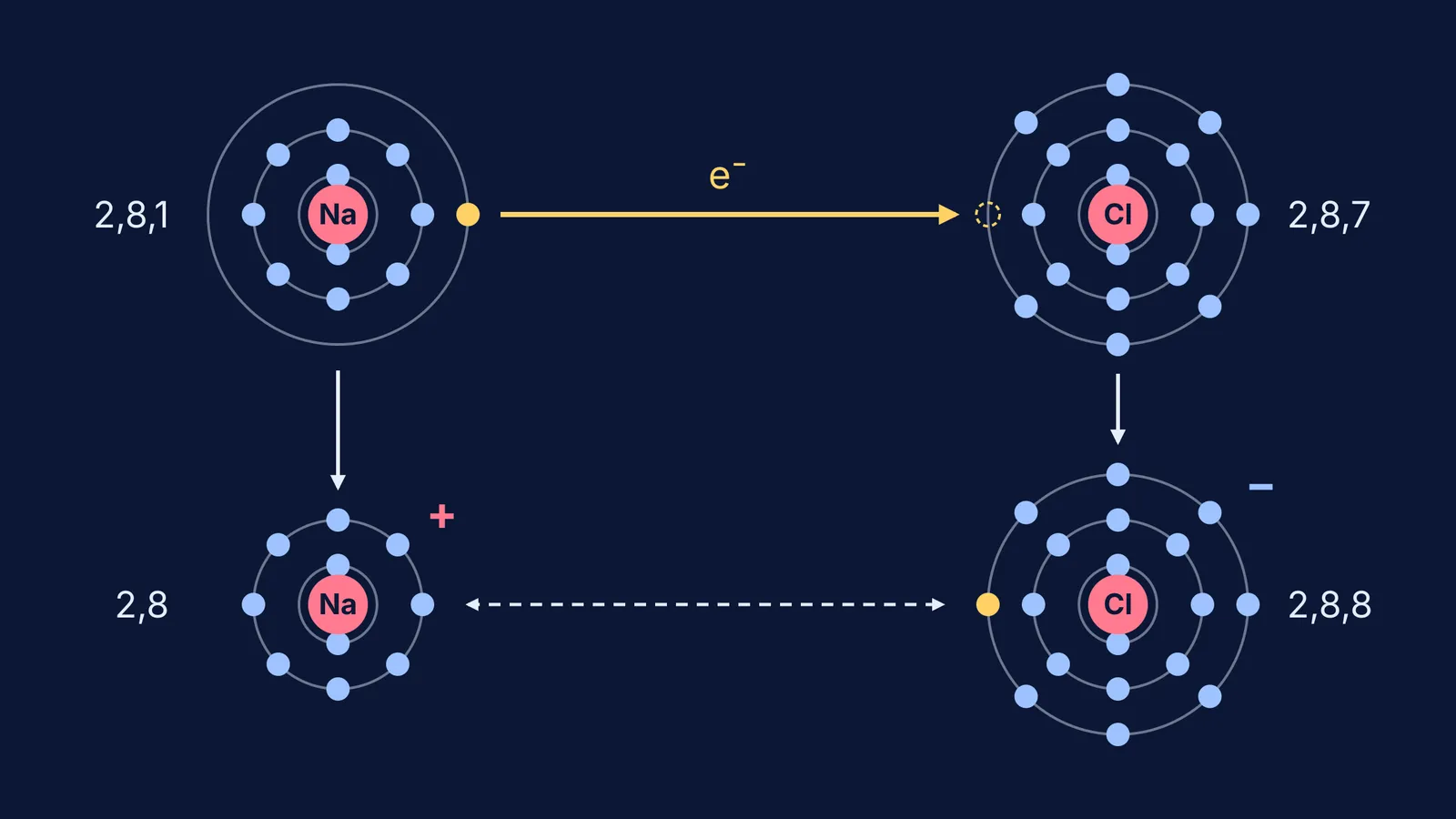
Sodium has the arrangement 2,8,1 and chlorine has 2,8,7. Sodium gives up one electron and becomes Na+ with 2,8, the same as neon. Chlorine takes it and becomes Cl− with 2,8,8, the same as argon. Opposite charges attract, and you get NaCl.
The energy numbers show something most summaries skip. Removing sodium's first electron costs 495.8 kJ/mol, according to the table of ionisation energies. Chlorine releases 349 kJ/mol when it gains an electron, according to its electron affinity. So the transfer on its own costs about 147 kJ/mol: it is uphill. What pays for it is the attraction between ions packed into a crystal; NaCl's lattice energy is about 786 kJ/mol. Kossel's noble-gas rule tells you which ions form, and the electrostatic attraction he pointed to is what makes forming them worthwhile. Our guide to the Born-Haber cycle and lattice enthalpy adds the remaining steps.
The same ionisation energy table shows why sodium stops at one electron. Its second ionisation energy is 4562 kJ/mol, about nine times the first, because that electron would have to come out of the closed, neon-like shell. That jump is Kossel's idea showing up in measured data.
What could Kossel's model not explain?
Transfer needs a giver and a taker. In H2, Cl2 or O2 the two atoms are identical, so neither has a reason to hand an electron to the other. Lewis's electron-sharing idea filled this gap; read our piece on how Gilbert Lewis pictured the shared electron pair. And some compounds do not follow the eight-electron rule at all, as our post on exceptions to the octet rule shows.
How do you use Kossel's idea to write an ionic formula?
Run this five-step check on any metal and non-metal pair:
Write the shell arrangement of both atoms.
Find the nearest noble gas for each.
Count the electrons the metal loses and the non-metal gains.
Balance them: total lost must equal total gained.
Write the ions with their charges, then the formula.
Worked example, calcium fluoride. Calcium is 2,8,8,2 and loses two electrons to become Ca2+, with the argon arrangement. Fluorine is 2,7 and gains one to become F−, with the neon arrangement. One calcium atom's two electrons need two fluorine atoms, so the formula is CaF2. Now try magnesium oxide yourself: Mg is 2,8,2 and O is 2,6, which should lead you to Mg2+, O2− and MgO.
If electron configurations still feel shaky, the Fermi Concept Library gives each chemistry concept its own lesson and its place in the map, so you can step back to what you missed. For formula and energy questions, the Fermi Problem Library has worked problems with a step-by-step solver that explains the reasoning rather than printing an answer.
Next time you write Na+ Cl−, remember that you are using an idea from a 1916 physics paper.


