

On this page
For more than two centuries yellow fever terrorised people living near the places where it was common, and in 1900 nobody knew for certain how it spread. Many doctors blamed contaminated clothing and bedding. A small US Army team in Cuba settled the question in a few months with experiments that were carefully designed and that also cost lives. This post tells Walter Reed's story from his own 1902 report and peer-reviewed commentary, explains the design, and works through the numbers.
Who was Walter Reed?
The US National Library of Medicine's finding aid for his papers records that Walter Reed (1851-1902) was born in Gloucester County, Virginia, earned medical degrees from the University of Virginia in 1869 and Bellevue Hospital Medical College in 1871, and joined the Army Medical Corps in 1876. He became professor of bacteriology at the Army Medical School in 1893 and studied typhoid fever during the Spanish-American War. He died in Washington, D.C., in 1902 of complications after an operation for appendicitis.
Why was a commission sent to Cuba?
A commentary by Derrick Baxby in Epidemiology and Infection explains the background. Yellow fever kept reaching the United States and had hit US troops in the 1898 war. Surgeon-General George Sternberg sent a small commission to US-occupied Cuba, led by Reed, with James Carroll, Jesse Lazear and Aristide Agramonte. They arrived in June 1900.
The Cuban physician Carlos Finlay had suggested in 1881 that mosquitoes were involved, but this had not been confirmed. Reed knew of Ronald Ross's work showing mosquitoes carry malaria, and he discussed the problem with Finlay. You can read how Ross did that in our post on Ronald Ross and malaria.
How did they test bedding against mosquitoes?
Reed described the experiments in a 1902 report in the Journal of Hygiene. At an isolated station called Camp Lazear, occupied from 20 November 1900 to 1 March 1901, they built a small, poorly ventilated one-room house, "14 x 20 feet", with windows sealed by wire screens of 0.5 mm mesh. Non-immune volunteers slept there on sheets, pillowcases and blankets heavily soiled by yellow fever patients. None caught the disease.
In a separate building, divided by a wire-screen partition, one volunteer entered a room where fifteen infected mosquitoes had been released, and was bitten. He fell ill about four days later. Two control volunteers on the other side of the screen, breathing the same air but protected from bites, stayed well.
What did the numbers show?
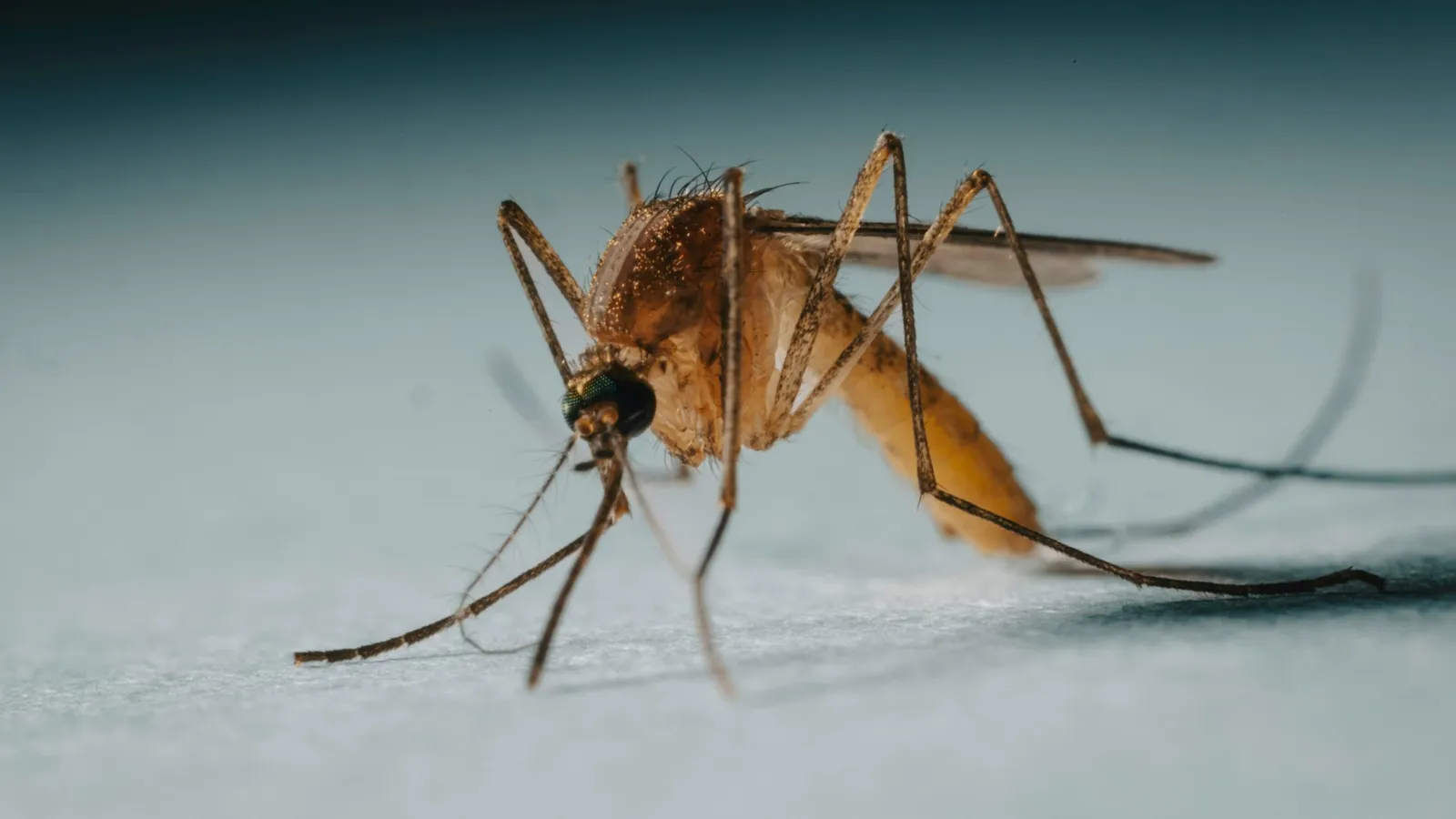
Baxby summarises the mosquito trials. The mosquitoes, then called Stegomyia fasciata and now Aedes aegypti, came from Finlay's breeding stock. In early tests, 2 of 11 people bitten developed yellow fever, one of them Carroll. In the definitive trial from December 1900 to February 1901, transmission succeeded in 14 of 16 cases, and all the volunteers recovered.
The early failures had a reason. Reed wrote that "an interval of about twelve days or more after contamination appears to be necessary before the infected Stegomyia is capable of conveying the disease". Mosquitoes that had fed on patients only two to ten days earlier never transmitted it.
The team also passed patients' serum through a fine Berkefeld filter and showed that it still caused the disease, pointing to an agent smaller than any bacterium. Baxby calls this the first such observation for a human disease. Today the WHO describes yellow fever as caused by a virus carried by Aedes and Haemagogus mosquitoes, preventable by a single vaccine dose that gives lifelong protection.
Worked example: reading the trial results
Early tests: 2 ÷ 11 ≈ 0.182, about 18%.
Definitive trial: 14 ÷ 16 = 0.875, or 87.5%.
Why the jump? The early mosquitoes were often used before the roughly 12-day interval Reed identified. Fix the timing and the success rate rises sharply.
A check on Reed's building: the report gives a floor of 14 × 20 = 280 square feet and a volume of 2,800 cubic feet, so the room was 2,800 ÷ 280 = 10 feet high.
What did it cost?
Baxby is direct about the price. Lazear was accidentally bitten and died. Three of the first seven volunteers in a parallel series by the Cuban doctor Juan Guiteras also died. Baxby writes that such studies "would now be unthinkable". The lesson for any student is that a well-designed experiment still has to be judged by how it treats the people in it.
What happened next?
Once the route was known, control was possible. Reed's report says that after sanitary measures began on 15 February 1901, Havana was freed from yellow fever "within ninety days". William Gorgas led that work, screening patients from mosquitoes and destroying mosquitoes in infected houses. Later, Max Theiler developed the 17D vaccine and received the 1951 Nobel Prize for his discoveries on yellow fever.
What mistakes do students make with this topic?
Calling the mosquito the cause. The virus causes yellow fever; the mosquito is the vector that carries it. The NCERT chapter Human Health and Disease uses the same word for the Anopheles mosquito in malaria.
Forgetting the waiting period. An infected mosquito is not infectious immediately.
Reading a percentage without its count. 87.5% from 16 people is less certain than the same rate from 1,600.
If you mix up pathogens and vectors across diseases, the Fermi Concept Library covers every concept in physics, chemistry, biology, mathematics and computing, so you can line up each disease with its cause and carrier.
What can a student take from how Reed worked?
Test the popular explanation directly. The bedding experiment took the fomite theory seriously and disproved it.
Use a control that differs in one thing only. The screen separated bites from everything else.
Count the human cost honestly. Good science and ethical science are both required.
Next step: make a two-column table for malaria, dengue and yellow fever listing each disease's cause and its vector, then check it against your NCERT chapter.


