

On this page
On 22 February 1915, Polish mathematician Wacław Sierpiński published a concise note in Paris titled "Sur une courbe dont tout point est un point de ramification" (Comptes Rendus, Tome 160, pp. 302–305). Interned in Russia during World War I, Sierpiński had relocated to Moscow through mathematicians Dmitri Egorov and Nikolai Luzin, as detailed in his MacTutor biography. Over a prolific career spanning 724 research papers and 50 books, he established foundational results across topology and set theory.
The pattern had medieval roots in the 1231 Cosmatesque pavement of Italy's Anagni Cathedral, where marble inlays formed recursive triangles documented in architectural geometry (Brunori et al., 2018). While medieval artisans stopped after three or four physical subdivisions, Sierpiński explored the infinite mathematical limit: a continuous plane curve where every single point is a branching point.
How did Wacław Sierpiński construct his triangle in 1915?
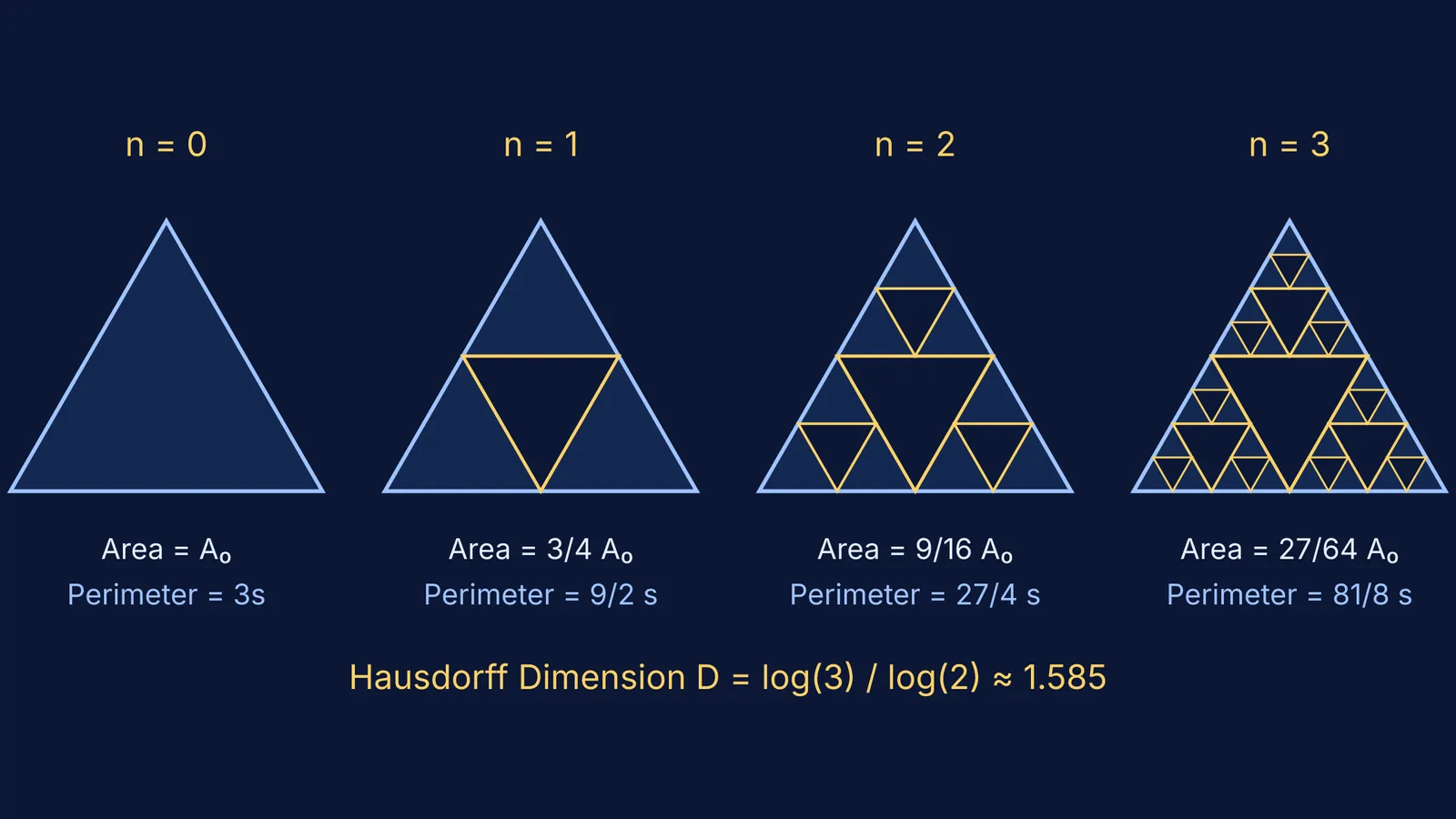
In his 1915 note presented to the French Academy of Sciences (Sierpiński, 1915), the construction begins with a solid equilateral triangle with side length s and area A₀.
Connecting the midpoints of the three sides divides the shape into four congruent triangles, each of side s/2 and area (1/4)A₀. Removing the central inverted triangle leaves three solid triangles behind.
Repeating this excision across every remaining triangle defines an iterative rule:
At step 0, you have 1 solid triangle of side s.
At step 1, excising 1 central triangle leaves 3 triangles of side s/2.
At step 2, excising 3 inner triangles leaves 9 triangles of side s/4.
At step n, the pattern leaves 3ⁿ triangles, each with side length s/2ⁿ.
Why does the Sierpiński triangle have zero area and infinite perimeter?
The infinite limit yields two contrasting results.
First, consider area. Each step keeps three-quarters of the previous area:
Aₙ = A₀ × (3/4)ⁿ
Because the common ratio 3/4 is less than 1, the area approaches zero:
lim (n → ∞) Aₙ = 0
Adding the removed areas as an infinite geometric series confirms this. Step 1 removes (1/4)A₀, step 2 removes 3 × (1/16)A₀, and step k removes 3ᵏ⁻¹ / 4ᵏ of A₀:
Total removed area = (A₀ / 4) × [1 + 3/4 + (3/4)² + …] = (A₀ / 4) / (1 − 3/4) = A₀
Every unit of initial area is excised.
Meanwhile, perimeter grows without bound. At step n, the 3ⁿ solid triangles each have three edges of length s/2ⁿ:
Pₙ = 3ⁿ × 3(s / 2ⁿ) = 3s × (3/2)ⁿ
Since 3/2 exceeds 1, lim (n → ∞) Pₙ = ∞. The limit is a dust-like continuum of zero area with infinite boundary length, much like the counterintuitive limits in Zeno's paradoxes of infinite division.
How does the triangle connect to geometric progressions?
In Class 11 CBSE mathematics and JEE Main, students use geometric progression formulas for nth terms (Tₙ = a rⁿ⁻¹) and infinite series sums (S = a / [1 − r]). The Sierpiński triangle translates these formulas into geometry:
Step 0: 1 triangle, side s, area A₀, perimeter 3s
Step 1: 3 triangles, side s/2, area (3/4)A₀, perimeter (9/2)s
Step 2: 9 triangles, side s/4, area (9/16)A₀, perimeter (27/4)s
Step 3: 27 triangles, side s/8, area (27/64)A₀, perimeter (81/8)s
Step n: 3ⁿ triangles, side length s/2ⁿ, area (3/4)ⁿ A₀, perimeter 3s(3/2)ⁿ
Similar recursive reasoning governs circuit problems like an infinite ladder of resistors and algebraic techniques for summing geometric progressions.
When applying sequence formulas to geometry and limits, the Fermi Problem Library provides worked problems with a step-by-step solver that explains the reasoning rather than printing an answer. For multi-stage recursions that are difficult to picture from static figures, the Fermi Simulation Lab offers interactive simulations for ideas that are easier to see than to read.
What makes a fractal dimension different from ordinary dimensions?
In classical geometry, dimensions are integers: a point has dimension 0, a curve has dimension 1, and a surface has dimension 2.
In 1918, Felix Hausdorff published "Dimension und äußeres Maß" in *Mathematische Annalen* (doi:10.1007/BF01457179), defining fractional dimensions. Decades later, Benoit Mandelbrot coined the word "fractal" from the Latin *fractus* (fragmented) in his 1975 *Les Objets Fractals* and 1982 *The Fractal Geometry of Nature*, defining fractals as sets whose Hausdorff dimension strictly exceeds their topological dimension.
The similarity dimension D of the Sierpiński triangle reflects its scaling: doubling the linear size (r = 1/2) yields N = 3 self-similar copies:
N = (1 / r)ᴰ 3 = 2ᴰ D = log(3) / log(2) ≈ 1.585
Because 1.585 sits between 1 and 2, the triangle is rougher than a line but too sparse to fill a plane.
The Fermi Concept Library covers every concept in mathematics, each with its own lesson and its place in the topic map, helping you link geometric sequences to fractal dimensions.


