

On this page
When you look into a flat bathroom mirror, your reflection appears to stand behind the glass. But in 1980, an invention changed how we interact with reflections, pulling the image out of the mirror and into the room.
Who is Valerie Thomas?
Valerie Thomas is an American data scientist, physicist and inventor who worked at NASA for 31 years, from 1964 to 1995. She graduated with highest honors in physics from Morgan State University in 1964, a time when very few women, particularly African American women, were encouraged to study science.
During her extensive career, she managed the development of digital media formats for Landsat, the first satellite to send multispectral images of Earth from space. The image processing systems she helped build allowed scientists to monitor global crop health, track deforestation, and map resources across the planet. Later, she oversaw the growth of the Space Physics Analysis Network (SPAN), a critical early computer network that expanded from 100 to 2,700 computer nodes worldwide, forming a foundational part of NASA's science networking.
In 2018, Thomas was inducted into the National Inventors Hall of Fame, recognising a lifetime of achievement and her most famous invention.
How does the illusion transmitter work?
Thomas received US Patent No. 4,229,761 on October 21, 1980, for an optical system she called the "illusion transmitter". Inspired by a 1976 science exhibit that used a lightbulb and a curved mirror to trick the eye, she wanted to find a way to transmit 3D illusions over a distance without using expensive lasers or complex holography.
The device relies entirely on the optical properties of parabolic, or concave, mirrors. In her patented setup, a video camera is trained on an illuminated object that is reflected in a first concave mirror. Because of the object's placement, the mirror creates a "real image" in space rather than a flat reflection on the glass. The camera converts this visual into an electronic signal and transmits it to a remote location.
At the receiving end, a projector beams the received video signal onto a second concave mirror. This second mirror reflects the projected light outward, creating a three-dimensional optical illusion of the original object that appears to float in the air in front of the viewer. The system requires no special 3D glasses, making it a precursor to modern 3D visualization tools used in surgery and television.
What is a real image?
The key to the illusion transmitter is the physics of a real image. A virtual image—like the one you see in a standard flat mirror—is formed by diverging light rays that only appear to intersect behind the mirror's surface. You cannot project a virtual image onto a screen.
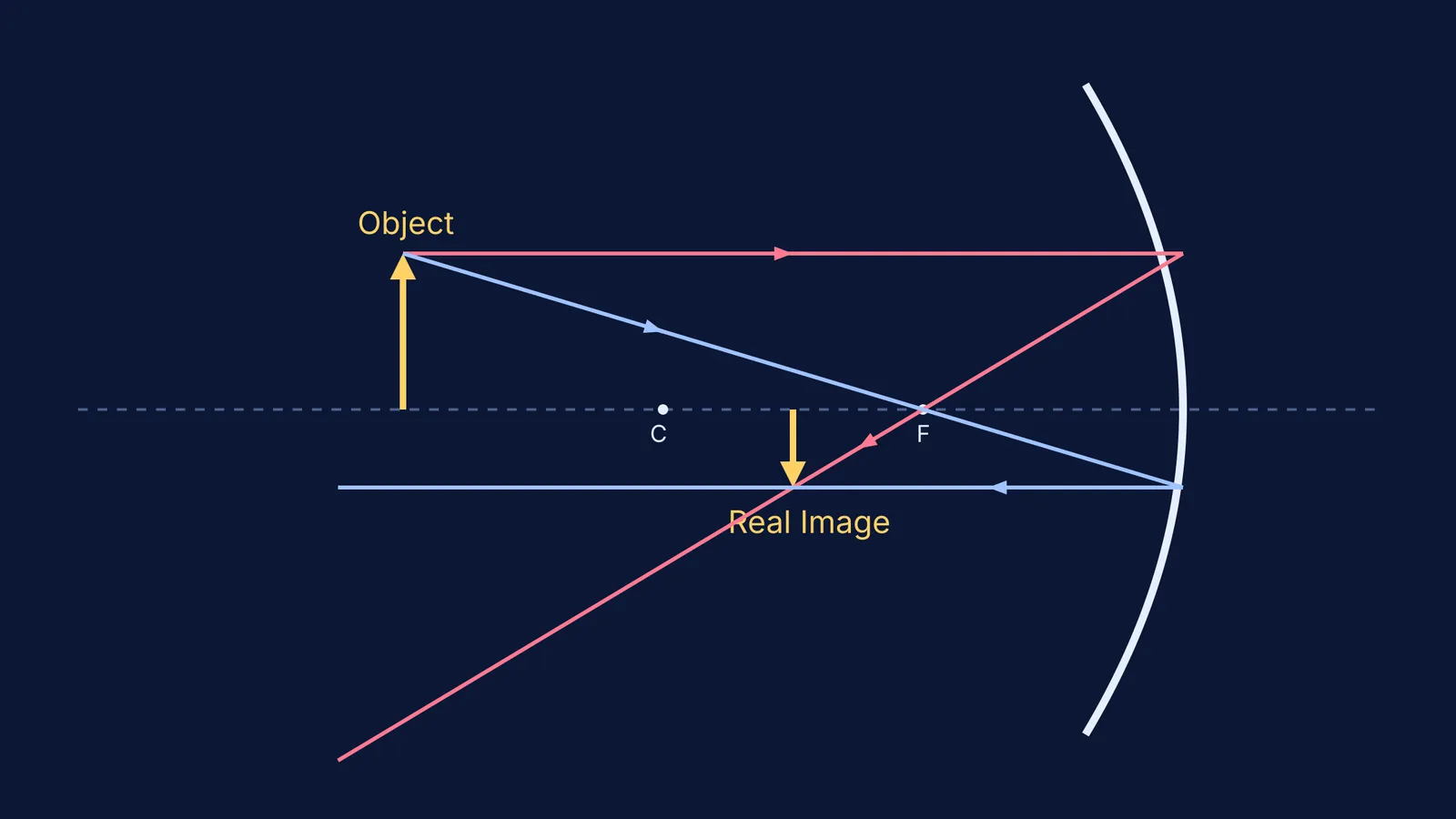
A real image, however, forms when light rays physically converge in the space in front of the mirror. Because the light energy is actually present at that location, a camera can record it directly, or a piece of paper can capture the projection. Concave mirrors form a real image whenever the object is placed farther away than the mirror's focal point.
If you struggle to picture how changing an object's distance changes the image it forms, the Fermi Simulation Lab provides interactive simulations for the ideas that are easier to see than to read. You can drag an object back and forth along the principal axis and watch the light rays redraw themselves in real time.
How do you trace rays for a concave mirror?
Understanding how concave mirrors form real images is a core part of optics. You can read a complete guide to concave mirror images for all six object positions to master the specific cases.
When you need to find where an image forms, use this ray-tracing framework to build your diagram:
Draw the principal axis (a straight horizontal line) and mark the pole (the center of the mirror), the focus (F), and the centre of curvature (C).
Trace the first ray from the top of the object parallel to the principal axis. It reflects back through the focus (F).
Trace the second ray from the top of the object straight through the focus (F). It reflects parallel to the principal axis.
Mark the exact intersection of these two reflected rays. This is where the top of the real image forms.
Draw the image from the principal axis down (or up) to this intersection point.
For complex problems involving multiple optical devices, such as a lens and mirror set apart, you simply repeat this framework. Find the image for the first device, and then treat that image as the new object for the second device.
If you make a mistake with sign conventions while solving these multi-step optics questions, the Fermi Problem Library has worked problems with a step-by-step solver that explains the reasoning rather than printing an answer.


