

On this page
In 1965, three physicists shared the Nobel Prize in Physics for independently solving the biggest mathematical problem in quantum electrodynamics (NobelPrize.org). Richard Feynman did it with intuitive visual diagrams. Julian Schwinger used dense, rigorous operator mathematics. The third, Sin-Itiro Tomonaga, built a flawless relativistic framework—and he did it while completely cut off from the global scientific community during World War II.
Tomonaga's story is not just a piece of physics history. It is a masterclass in how to learn deeply, build unshakeable foundations, and turn extreme intellectual isolation into an advantage.
What did Sin-Itiro Tomonaga discover in quantum electrodynamics?
By the late 1930s, quantum field theory had a severe mathematical problem. When physicists tried to calculate the mass or charge of an electron, the equations returned an infinite value. The theory was clearly incomplete. Furthermore, it relied on a single "global" time, which clashed with the core principles of Einstein's 1905 papers on special relativity.
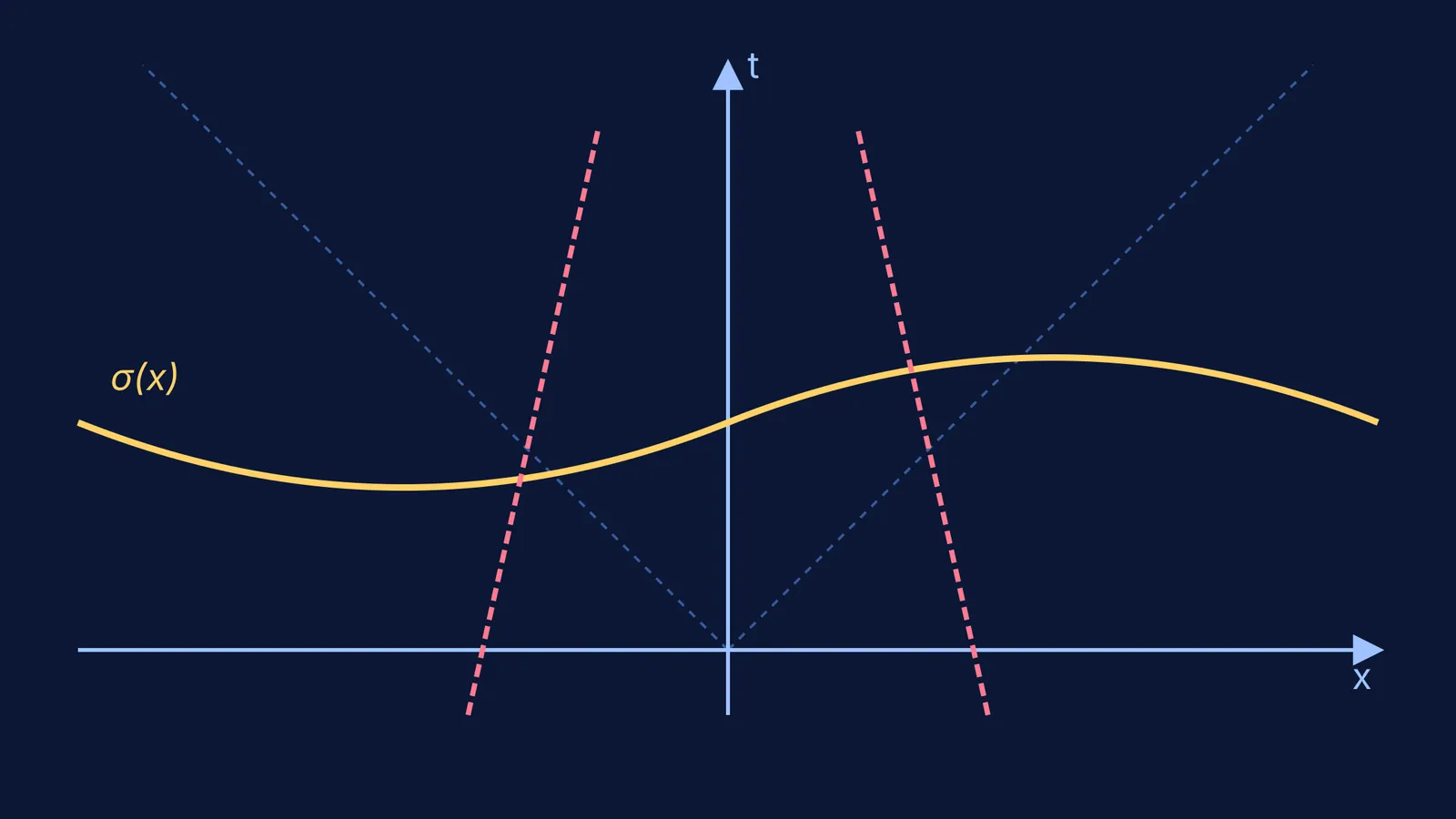
Working in Japan, Tomonaga resolved this clash. In 1943, he completed his "super-many-time" theory (Wikipedia). Instead of a single clock ticking for the whole universe, his formulation allowed time to be defined locally on arbitrary spacelike surfaces. This made quantum electrodynamics fully consistent with special relativity.
Building on this, Tomonaga and his students developed the method of "renormalization." By carefully restructuring the theory, they proved that the mathematical infinities could be systematically canceled out, leaving behind finite, testable predictions.
If you find yourself stuck on a physics concept that feels mathematically impossible to unravel, the Fermi Concept Library covers every concept in physics, chemistry, biology, mathematics and computing, each with its own lesson and its place in the map.
How did wartime isolation shape his physics research?
Between 1941 and 1945, the Pacific War placed Japanese physicists in what amounted to an intellectual quarantine. International scientific journals stopped arriving, and communication with Western scientists ceased entirely (Britannica). Tomonaga and his students were left to work in a vacuum, eventually facing severe food shortages and the destruction of their cities.
Yet, this isolation forced a unique kind of focus. Unable to chase the latest rapid-fire publications from Europe or America, Tomonaga focused on deep, structural problems. He spent his time finding rigorous mathematical paths rather than racing for quick, intuitive leaps.
Because his work was published in Japanese during the war, the Western physics community remained entirely unaware of it. It was only in 1947, when his wartime work finally reached Western scientists, that the global community realised a physicist working in Tokyo had already solved the problems they were just beginning to unravel.
What can we learn from Tomonaga's study habits?
Tomonaga's approach to learning and problem-solving offers a powerful framework for tackling difficult subjects today. While his co-winner Richard Feynman became famous for his intuitive teaching style in The Feynman Lectures on Physics, Tomonaga relied on extreme mathematical discipline.
Re-derive past failures. In 1948, Tomonaga and his students re-examined a 1939 paper by Sidney Dancoff that had failed to cancel the infinities in QED. Rather than assuming the underlying theory was completely broken, they meticulously checked Dancoff's calculations step by step. Their rigorous method allowed them to spot a simple missing term in the perturbation series. Once corrected, the infinities canceled out perfectly.
Prioritise rigorous calculations. Tomonaga believed that physical meaning would emerge from flawless mathematics. He did not guess; he built systems where the logic was impossible to break.
When you need that level of granular feedback, the Fermi Problem Library has worked problems with a step-by-step solver that explains the reasoning rather than printing an answer. This builds the very discipline Tomonaga used to solve the toughest equations of his generation.


