On this page
By the 1960s, molecular biology was settling into a comfortable certainty. The discovery of the double helix and Sydney Brenner and the 1960 experiment that caught messenger RNA had established the "central dogma": genetic information flows from DNA to RNA to protein. Every known infectious agent, from the smallest virus to the largest bacterium, carried its instructions in nucleic acids.
But a disease in sheep called scrapie refused to fit the rules.
What was the mystery of the scrapie agent?
Scrapie is a fatal, neurodegenerative disease that causes sheep to scrape their fleece off against fences. Researchers knew it was infectious because they could pass it from one animal to another. However, the agent causing it was incredibly hardy. It survived boiling, chemical treatments and standard sterilisation methods that would easily destroy any known bacterium or virus.
Scientists assumed they were simply dealing with an unusually tough "slow virus". They just needed to find its DNA or RNA.
How did Tikvah Alper test the agent in 1967?
Radiobiologist Tikvah Alper approached the problem not by looking for the agent under a microscope, but by trying to destroy it with radiation. In a landmark paper published in *Nature* in May 1967, Alper and her colleagues detailed their experiments using target theory [[1]](https://doi.org/10.1038/214764a0).
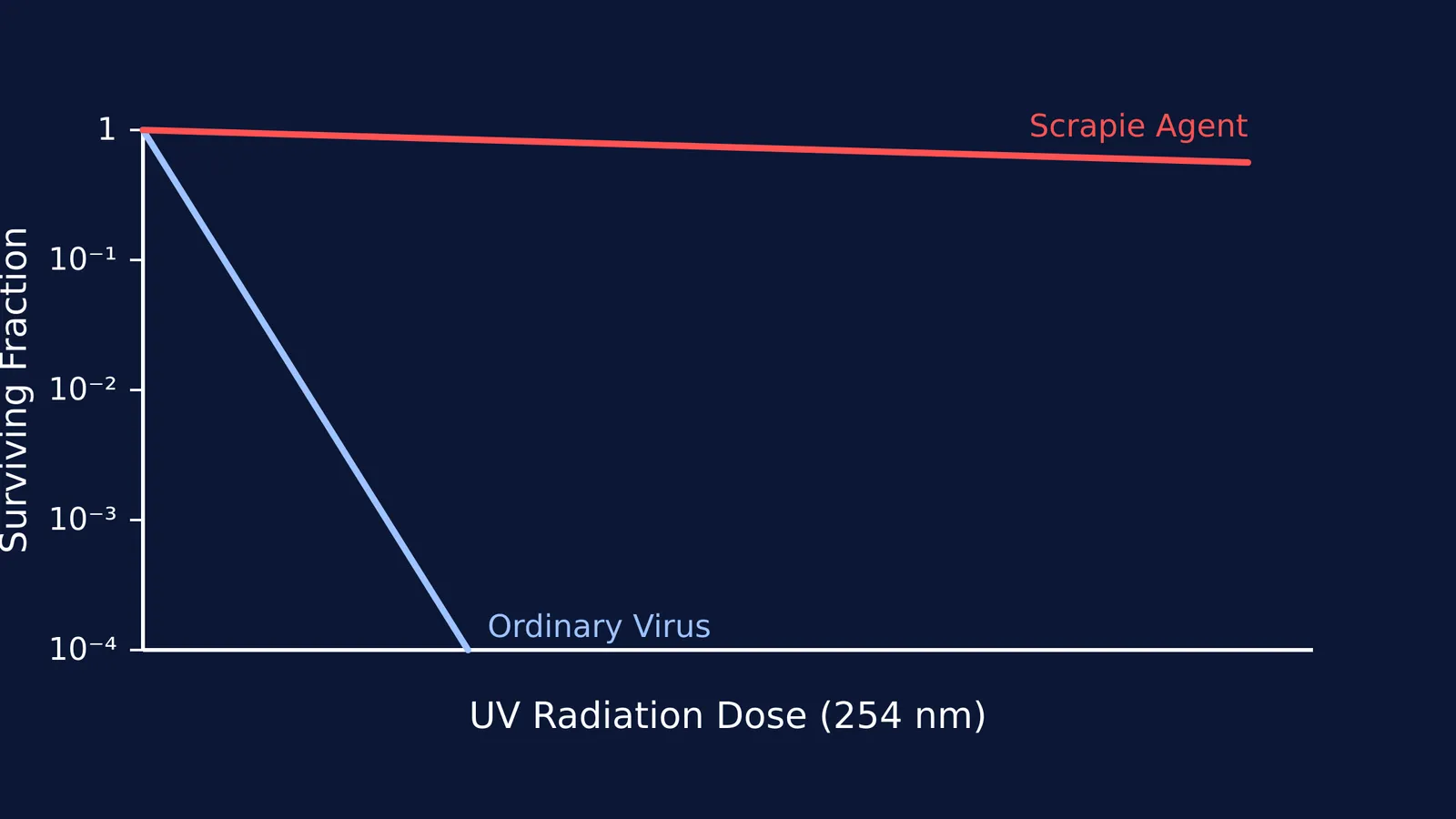
Target theory uses radiation to estimate the size of a biological molecule by seeing how much radiation is needed to "hit" and destroy it. Alper bombarded the scrapie agent with ultraviolet (UV) radiation. Crucially, she measured its survival at a wavelength of 254 nm [[1]](https://doi.org/10.1038/214764a0). This specific wavelength is strongly absorbed by nucleic acids; it reliably damages the DNA or RNA of ordinary viruses and bacteria, stopping them from replicating.
What did the radiation survival curves show?
The results were astonishing. The scrapie agent was highly resistant to UV radiation at 254 nm, suggesting its genetic blueprint was unharmed because it simply did not have one [[1]](https://doi.org/10.1038/214764a0). Furthermore, calculations using ionising radiation showed the "target size" of the infectious unit was significantly smaller than any known virus.
Alper concluded that the scrapie agent might be able to replicate without nucleic acid.
Understanding how radiation interacts with biological molecules requires a solid grasp of wavelength, energy and target theory. If you are preparing for exams and these topics feel abstract, the Fermi Concept Library holds every concept in physics, chemistry, biology, mathematics and computing, each with its own lesson and its place in the map.
How did this lead to the prion hypothesis?
Alper's conclusion was a radical challenge to the central dogma. If the agent had no DNA or RNA, how could it pass on instructions to multiply?
In the same year, mathematician J.S. Griffith read her findings and proposed a theoretical model: perhaps the infectious agent was a protein that could change the shape of other, normal proteins in the host.
This idea laid the groundwork for Stanley Prusiner and prions, infectious proteins. In 1982, Prusiner successfully isolated the infectious agent, named it a "prion" (proteinaceous infectious particle), and later won the Nobel Prize. He frequently cited Alper's 1967 radiation studies as the catalyst for the field.
When studying the central dogma or the structure of proteins, students often struggle to picture how macromolecules fold and misfold. The Fermi Simulation Lab provides interactive simulations for the ideas that are easier to see than to read.
A practical framework: Answering exam questions on prions
If you are asked to explain prions or the exceptions to the central dogma in a biology exam, use this three-point checklist:
Define the agent: State that a prion is an infectious protein particle devoid of nucleic acid (no DNA or RNA).
Explain the mechanism: Describe how a misfolded prion protein induces normal proteins in the brain to misfold into the disease-causing shape.
Cite the evidence: Mention that early evidence came from target theory experiments (like Alper's), which showed the agent survives UV radiation (254 nm) [[1]](https://doi.org/10.1038/214764a0) that normally destroys nucleic acids.
To practise answering biology questions with clear reasoning, the Fermi Problem Library has worked problems with a step-by-step solver that explains the reasoning rather than printing an answer.