

On this page
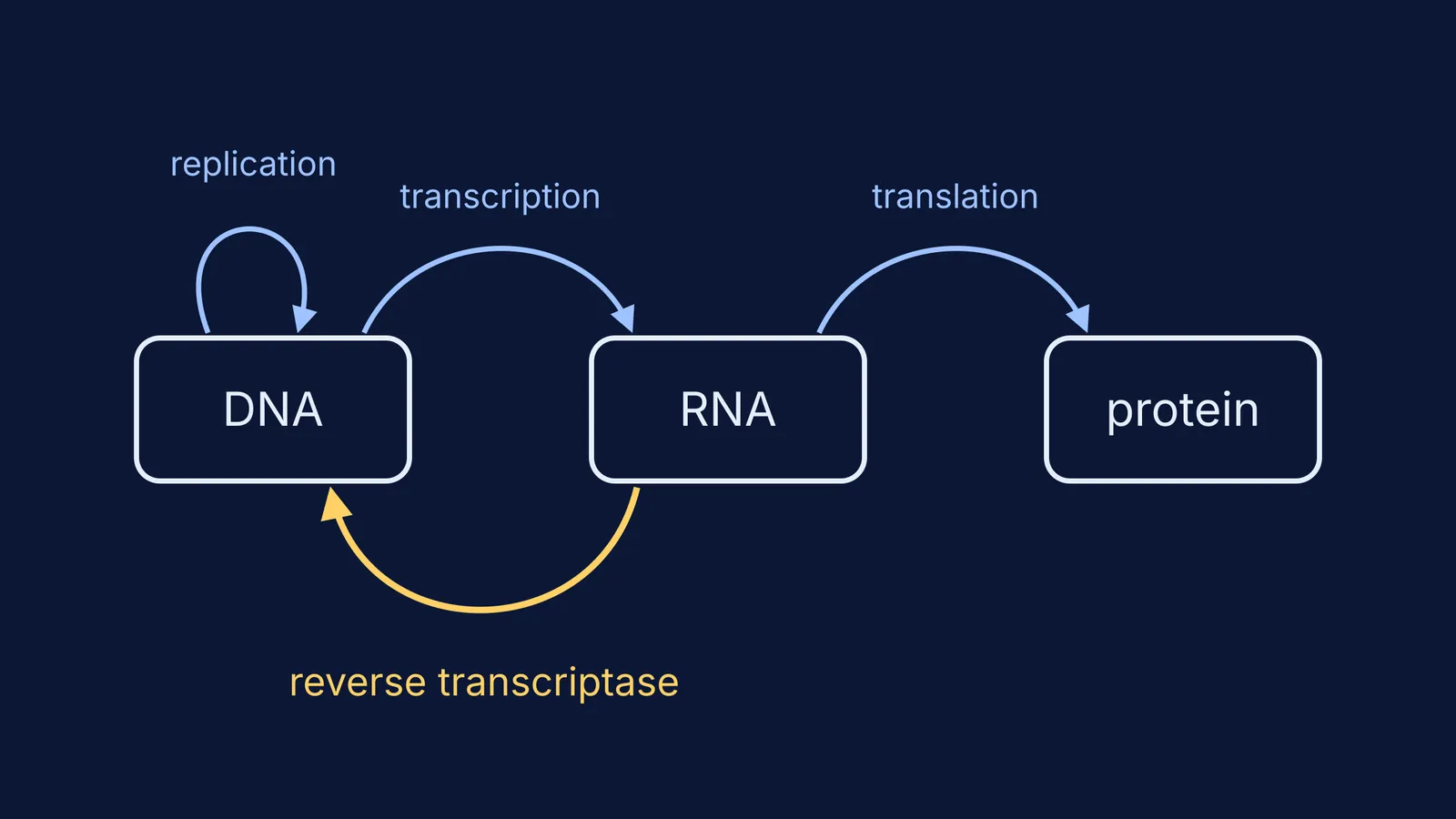
In June 1970 two American labs, working separately, reported the same surprising thing: some viruses carry an enzyme that reads RNA and writes DNA. Howard Temin at the University of Wisconsin and David Baltimore at MIT had found what we now call reverse transcriptase. It reversed the textbook arrow from DNA to RNA and became a basic tool of biotechnology.
What did scientists believe before 1970?
By the 1960s most biologists drew genetic information flowing one way: DNA is copied into RNA, and RNA is read to make protein. The Karolinska Institutet's 1975 Nobel press release puts it plainly: "This dogma implied that information transfer in nature occurred only from DNA to RNA and not in the other direction."
Temin studied Rous sarcoma virus, a chicken tumour virus whose genes are made of RNA. Around 1960 he proposed the provirus hypothesis: the virus makes a DNA copy of its RNA, and that copy joins the cell's chromosomes. According to John Coffin's 50th-anniversary account in Molecular Biology of the Cell, the idea was met not only with scepticism but often with outright derision. The Nobel press release says most scientists considered it heresy.
Temin kept collecting indirect evidence. In 1963 he showed that virus production was blocked by actinomycin D, a drug that stops RNA being made from DNA. In 1964 he found that methotrexate, which blocks DNA synthesis, stopped infection if cells were treated early. Both results suggested DNA sits in the middle of the virus's life cycle (Coffin, 2021).
How was reverse transcriptase discovered by Temin and Baltimore?
Temin and his postdoc Satoshi Mizutani asked a direct question: does the virus particle itself carry an enzyme that copies RNA into DNA? As Coffin describes it, they opened virus particles with a detergent and added the four DNA building blocks (deoxyribonucleoside triphosphates, one of them radioactive), buffer and a magnesium salt. New DNA formed. When they first treated the mix with an enzyme that destroys RNA, no DNA was made, so the template had to be RNA (Lasker Foundation).
Baltimore came at the question from a different direction. He had been studying virus enzymes that copy RNA from RNA, and the Nobel press release notes he used similar molecular techniques to show the same RNA-to-DNA step. Working with a mouse leukaemia virus, his assay worked even without detergent (Coffin, 2021).
The two papers were printed side by side in Nature volume 226 on 27 June 1970: Baltimore's on pages 1209 to 1211 and Temin and Mizutani's on pages 1211 to 1213. An unsigned Nature News and Views piece in the same issue ran under the headline Central Dogma Reversed. Its author, Nature's cell biology correspondent John Tooze, later coined the name reverse transcriptase (Coffin, 2021).
Did reverse transcriptase break the central dogma?
It broke the popular version, not Francis Crick's own. In his reply, Central Dogma of Molecular Biology (Nature, August 1970), Crick said the dogma had always been a negative statement: sequence information cannot flow from protein back to nucleic acid. As Asimov Press summarises the paper, he had never ruled out RNA to DNA. We unpack that distinction in our post on what Crick's central dogma really says.
Where is reverse transcriptase used today?
Coffin's review lists what followed:
cDNA: copying a cell's messenger RNA into complementary DNA, which can be cloned into plasmids.
RT-PCR: turning viral RNA into DNA so it can be amplified and measured; see our explainer on how PCR copies DNA.
HIV: HIV is a retrovirus, so the enzyme is a drug target; read how HIV replicates by reverse transcription.
Our own genome: telomerase works as a reverse transcriptase, and nearly half of human DNA is made of mobile elements inserted by reverse transcription.
The Lasker Foundation notes that AZT, a reverse transcriptase inhibitor, received US approval in 1987 as the first drug for treating AIDS. In 1975 Temin and Baltimore shared the Nobel Prize in Physiology or Medicine with Renato Dulbecco, for discoveries concerning the interaction between tumour viruses and the genetic material of the cell (Nobel press release).
How can you work through the 1970 experiment yourself?
Questions about experiments often test whether you understand the controls. Try predicting each result before reading the answer.
Tube A: broken virus particles, four DNA building blocks (one radioactive), magnesium. Prediction: radioactive DNA forms. Meaning: something in the particle makes DNA.
Tube B: as A, but treated first with an enzyme that destroys RNA. Prediction: no new DNA. Meaning: the template is RNA.
Now say it in one line: a virus-carried enzyme uses RNA as a template to make DNA.
If step 3 feels shaky, the gap is usually in transcription and replication themselves. The Fermi Concept Library has a lesson for each concept in biology, so you can revisit the DNA to RNA step before returning to its reverse. And if you want to talk an experiment through, Fermi's AI tutor asks questions and checks your understanding as it goes.
Next time you see an RT-PCR report, you are reading a test that runs on a 1970 discovery.


