

On this page
In 1851 (Wikipedia), Japanese inventor Tanaka Hisashige completed a clock that solved an almost impossible physics problem: how do you use steadily turning gears to track a unit of time that changes its length every day?
The result was the Myriad Year Clock, a device so complex it took three years to assemble (The Hour Markers). Hisashige's ability to manipulate mechanical linkages and kinematics laid the foundation for modern Japanese industry, leading directly to the creation of the technology giant Toshiba.
What is Tanaka Hisashige's myriad-year clock?
Completed in 1851, the Myriad Year Clock (*Man-nen Jimeishō*) is a mechanical timepiece containing over 1,000 hand-crafted parts (Wikipedia). Standing 63 centimetres tall, it is driven by two large brass mainsprings. To ensure the clock maintains a constant speed as the mainsprings unwind and lose tension, it uses a fusee mechanism. This mechanism involves a cone-shaped pulley that acts as a continuously variable gear, perfectly balancing the diminishing force of the spring with an increasing radius to keep torque constant. This design allows it to run for an entire year on a single winding.
The device features six distinct dial faces that display standard Western time, the day of the week, the month, the current moon phase, the 24 solar terms, and traditional Japanese temporal hours (The Hour Markers). On top of the wooden case, a celestial globe rotates to show the relative positions of the sun and moon exactly as they would appear from Kyoto. Today, this Important Cultural Property is preserved at the National Museum of Nature and Science in Tokyo.
How did the Japanese temporal hour system work?
To appreciate Hisashige's genius, you have to understand the timekeeping system of Edo-period Japan. Instead of using 24 identical hours, the Japanese used a temporal hour system known as *futei jihō* (Wikipedia).
In this system, the daylight period (from local sunrise to sunset) was divided into six equal parts, and the nighttime period (from sunset to sunrise) was divided into another six equal parts. Because the Earth's axial tilt causes the ratio of daylight to darkness to shift throughout the year, the length of a single "hour" changed daily. A daytime hour in the middle of summer was significantly longer than a nighttime hour, while the reverse was true in winter. This complex system was finally replaced by the Gregorian calendar and Western 24-hour time on 1 January 1873 (Wikipedia).
For a standard mechanical clock, this is a nightmare. A pendulum clock beats at a constant rate, which is why studying the Seconds pendulum: how its period changes with length and g and calculating the Simple pendulum string tension at any angle: mg cos θ + mv²/l are standard physics topics. Traditional Japanese clockmakers usually solved this changing-time problem by having two separate swinging balances—one for the day and one for the night—which switched automatically at dawn and dusk.
Why did the myriad-year clock need over 1,000 parts?
Tanaka rejected the standard two-balance solution and pushed the complexity into the dial itself using a system called an automatic *wari-koma* or movable index dial (The Hour Markers).
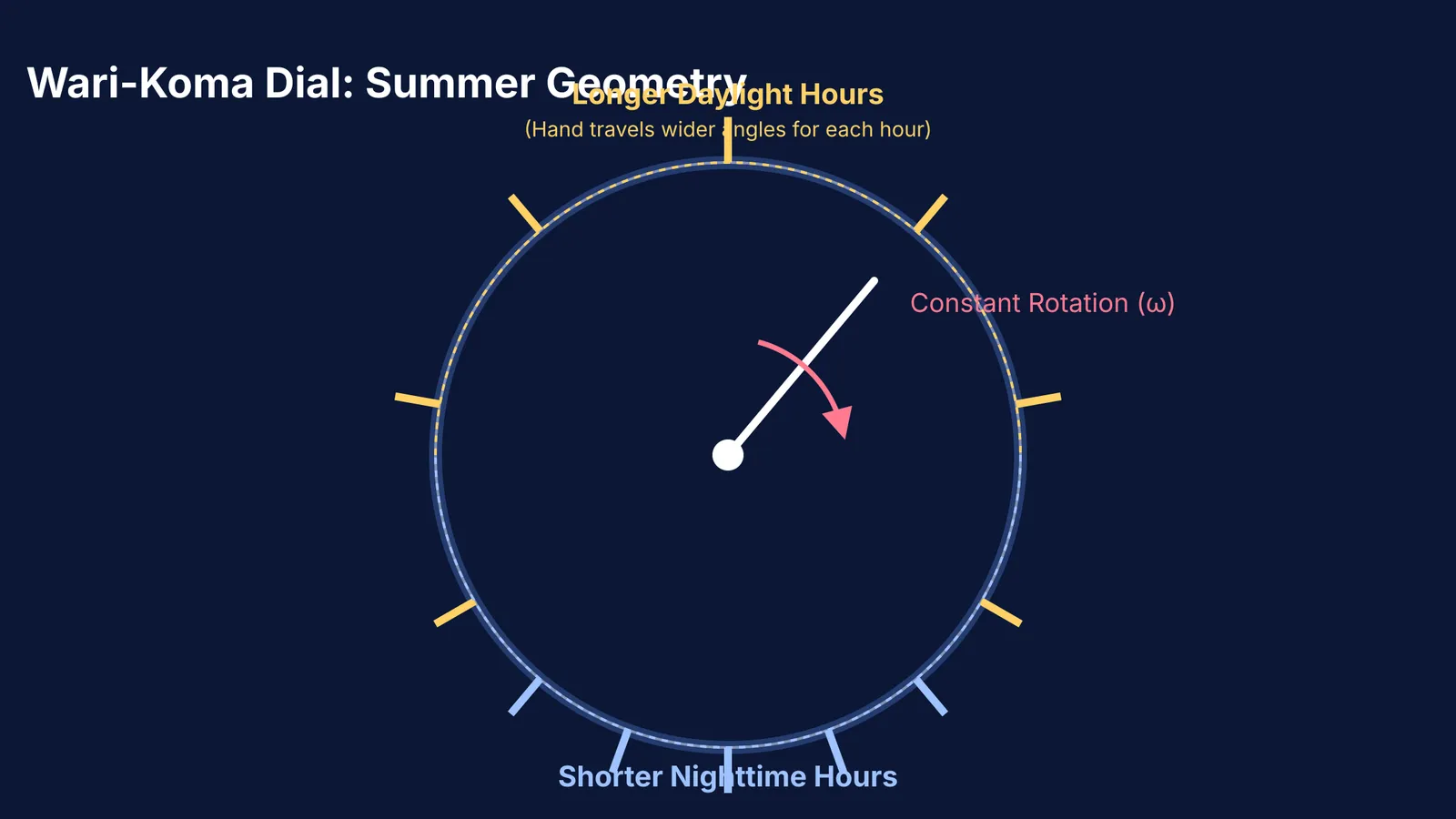
On this dial, the markers for the hours are not painted on; they are physical metal pieces resting in a circular groove. Inside the clock, a specialised seasonal cam rotates slowly over the course of the 24 solar terms. As this cam turns, it operates a series of linkages that physically push and pull the hour markers closer together or further apart. In summer, the daytime markers spread out over a wide arc, forcing the steadily moving clock hand to spend more time travelling between them.
Translating rotational motion into variable outputs using cams is a cornerstone of mechanical engineering. If you are struggling to picture how these linkages constrain and redirect motion, the Fermi Simulation Lab features interactive simulations for the ideas that are easier to see than to read. By experimenting with simulated mechanisms, you can observe how changing a cam's shape alters the output velocity without needing to build physical models.
How did Tanaka's clockmaking lead to Toshiba?
Tanaka's expertise in solving complex physics problems with physical machinery made him a pioneer of Japan's industrial modernisation. He had spent his youth building *karakuri*—mechanised automata and trick puppets—which taught him how to translate energy into complex, precise motions.
In 1875, at the age of 76, he established Tanaka Seizosho (Tanaka Engineering Works), which was Japan's first private mechanical factory (Companies History). The company initially manufactured telegraph equipment to support the country's developing infrastructure. Decades after his death, his company merged with Tokyo Electric in 1939 to form a new entity. They took parts of both names—Tokyo Shibaura Denki—which was eventually abbreviated to a name known worldwide today: Toshiba.
How do you solve variable-motion kinematics problems?
When studying kinematics or gears, converting a steady input into a changing output (like Tanaka's clock) requires tracking variables carefully. When you need to set up the calculus and build a plan to solve the differential equations, Fermi's AI tutor can work out what you already know and build a plan for the session, so you always know what to tackle next. To tackle these problems on your own, follow this checklist:
Identify the constant: What is driving the system? In the clock, it is the constant angular velocity (ω) of the mainspring gear.
Define the constraints: How are the moving parts connected? Write down the geometric relationship (e.g., x = r cos θ) before taking any derivatives.
Link to time: Differentiate your constraint equations with respect to time (t) to find velocities. Remember the chain rule: dx/dt = (dx/dθ) × (dθ/dt).
Check the boundaries: What happens at the extremes? In the clock, the markers hit a physical limit at the summer and winter solstices where the rate of change is briefly zero.


