

On this page
When Charles Darwin established natural selection as the engine of adaptation, he showed how environmental pressures preserve useful traits and eliminate harmful ones. Yet geneticists faced a deeper riddle: where do brand-new genes come from? If an organism carries only a single copy of an essential gene, such as an enzyme in DNA replication, it cannot freely experiment. Any alteration in that sole copy risks killing the cell. Purifying natural selection acts strictly as an inspector, weeding out mutants before novel functions can emerge.
Why was natural selection alone not enough to explain new genes?
Susumu Ohno, a geneticist at the City of Hope National Medical Center whose work was chronicled in a biographical memoir by Ernest Beutler, tackled this exact bottleneck. In his landmark 1970 monograph *Evolution by Gene Duplication*, Susumu Ohno argued that natural selection is fundamentally a conservative force rather than a creative one. In his preface, Ohno summarized the dilemma: "natural selection merely modified, while redundancy created." Without duplicate genes, an organism cannot innovate without risking death. To make major evolutionary leaps, genomes needed spare parts.
How does gene duplication give genomes spare parts to experiment?
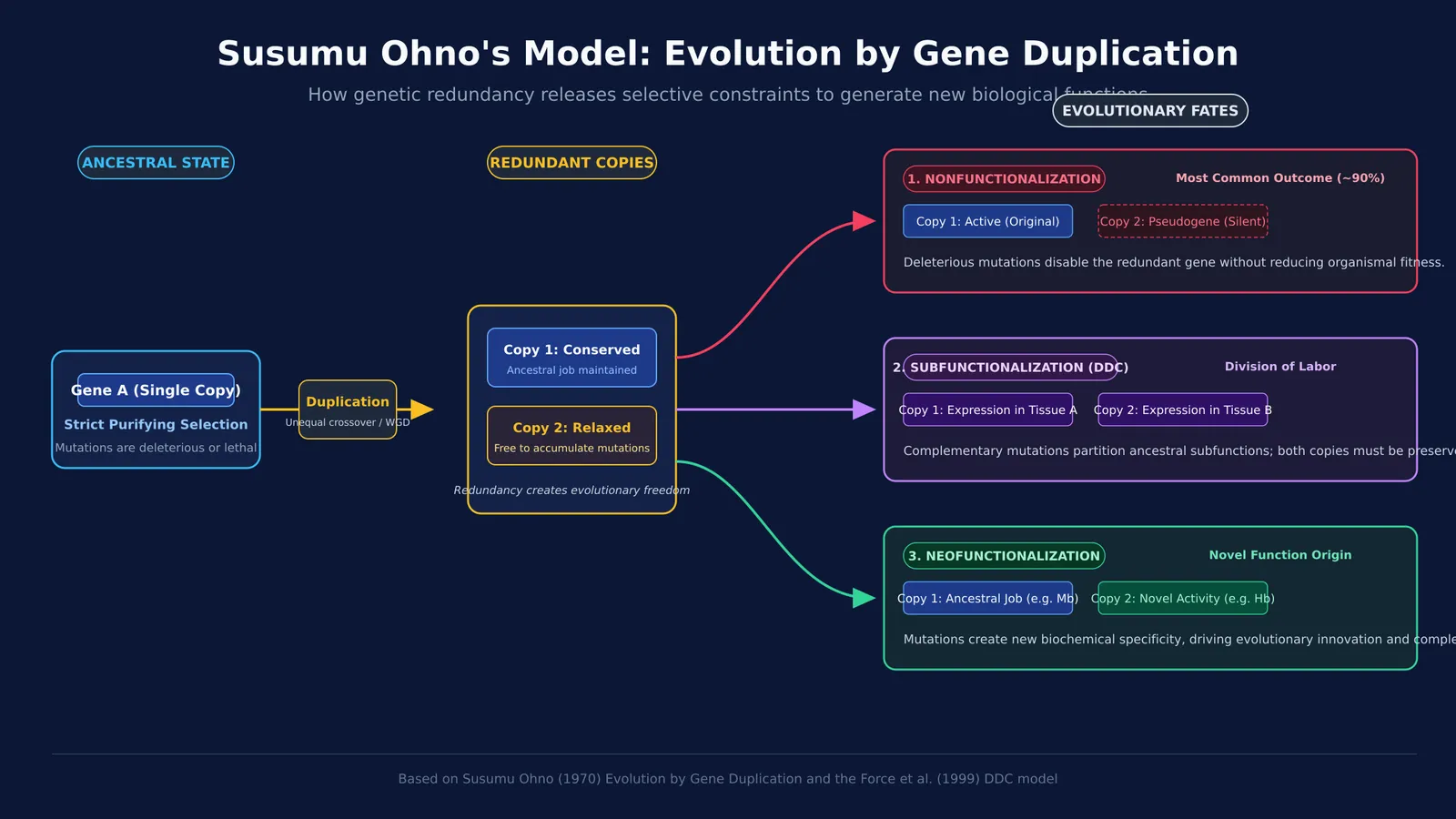
Gene duplication provides those spare parts. During meiosis, events like unequal crossing over or non-disjunction accidentally copy DNA segments, giving the organism two copies of the same gene locus.
This redundancy transforms evolutionary possibilities. The first copy continues performing the ancestral job, shielding the organism from reduced fitness. The second copy is released from purifying selection. Because survival no longer depends on it, the duplicate can accumulate point and frameshift mutations without fatal consequences. Over generations, these mutations can forge a novel active site or expression pattern, a process known as neofunctionalization.
A textbook case is the globin superfamily. An ancestral oxygen-binding gene duplicated roughly 500 million years ago, as documented by Federico G. Hoffmann and colleagues. One copy became myoglobin for muscle oxygen storage. The other duplicated again into alpha- and beta-globin genes, creating tetrameric hemoglobin for cooperative oxygen transport in blood. Repeated duplications similarly generated the massive olfactory receptor gene families animals use to smell.
What are the three evolutionary fates of duplicated genes?
A duplicated gene does not always gain a new function. Research synthesized by John S. Taylor and Jeroen Raes identifies three distinct paths for duplicate loci:
Nonfunctionalization: Harmful mutations disable the redundant copy, turning it into a silent pseudogene. This is the outcome for the vast majority of duplicate genes.
Subfunctionalization: The two copies divide ancestral duties. Under the duplication-degeneration-complementation model demonstrated by Allan Force and colleagues, regulatory mutations cause copy A to express in one tissue and copy B in another, preserving both.
Neofunctionalization: One copy maintains the ancestral role while the duplicate evolves a completely novel biochemical activity.
How did the 2R hypothesis prove Ohno right decades later?
Ohno also looked at entire genomes, proposing the 2R hypothesis: early in chordate evolution, vertebrate ancestors underwent two rounds of whole-genome duplication. Doubling every chromosome preserved gene dosage balance while providing thousands of spare genes at once.
Decades later, comparative genomics confirmed his proposal. In 1994, Jordi Garcia-Fernàndez and Peter W. H. Holland showed that the invertebrate chordate amphioxus carries only 1 Hox cluster, whereas mammals possess 4 distinct clusters (HoxA, HoxB, HoxC, and HoxD). This 4:1 ratio confirmed that vertebrate developmental architecture expanded through two genome doublings. In 2005, whole-genome analysis by Paramvir Dehal and Jeffrey L. Boore verified that two rounds of whole-genome duplication occurred before jawed vertebrates diverged.
In tribute to Ohno's foresight, geneticist Kenneth H. Wolfe in 2000 coined the term "ohnologs" for genes that survive from these ancestral genome duplications.
How do geneticists classify duplicate gene outcomes in practice?
When analyzing evolutionary genetics or preparing core evolutionary concepts for NEET, students and researchers use this 3-step framework to trace duplicate genes:
Map chromosomal synteny: Determine whether the gene pair lies in tandem on one chromosome (local crossover) or spans paralogous chromosome blocks (an ohnolog from whole-genome duplication).
Compare expression domains: Check whether the copies share expression, partition expression across tissues (subfunctionalization), or show complete silencing (pseudogenization).
Test selective constraint: Compare non-synonymous and synonymous substitution rates to confirm whether purifying selection preserved the original protein while positive selection shaped the new duplicate.
Connecting molecular genetics to anatomical evolution requires linking individual mutations to broader phylogenetic trees. The Fermi Concept Library covers every concept in physics, chemistry, biology, mathematics and computing, each with its own lesson and its place in the map. The Fermi Problem Library offers worked problems with a step-by-step solver that explains the reasoning rather than printing an answer.


