

On this page
Some fish in the fast streams of Kerala and Karnataka look a lot like fish in the hills of northeast India and the Malay region, with dry plains in between. How did they get across? The Indian ichthyologist Sundar Lal Hora gave an answer that shaped Indian biogeography for decades.
Who was Sundar Lal Hora?
Hora (also spelt Sunder) was born in Hafizabad, in Punjab, in 1896 and died on 8 December 1955. From 1947 he was Director of the Zoological Survey of India (Wikipedia summary of his life). His speciality was torrential fauna: animals that live in fast, rocky hill streams. His 1930 paper in the Philosophical Transactions of the Royal Society argued that such animals are shaped by a series of gradual changes induced by their environment (Hora 1930).
To stay put in a torrent, many hill-stream fishes have sucking discs around the mouth that let them cling to rock surfaces. Hora reasoned that these features also tie them to torrents: they live in oxygen-rich water and cannot easily spread through ordinary rivers, only along corridors of hill streams (Daniels 2001, Current Science).
What is the Satpura hypothesis?
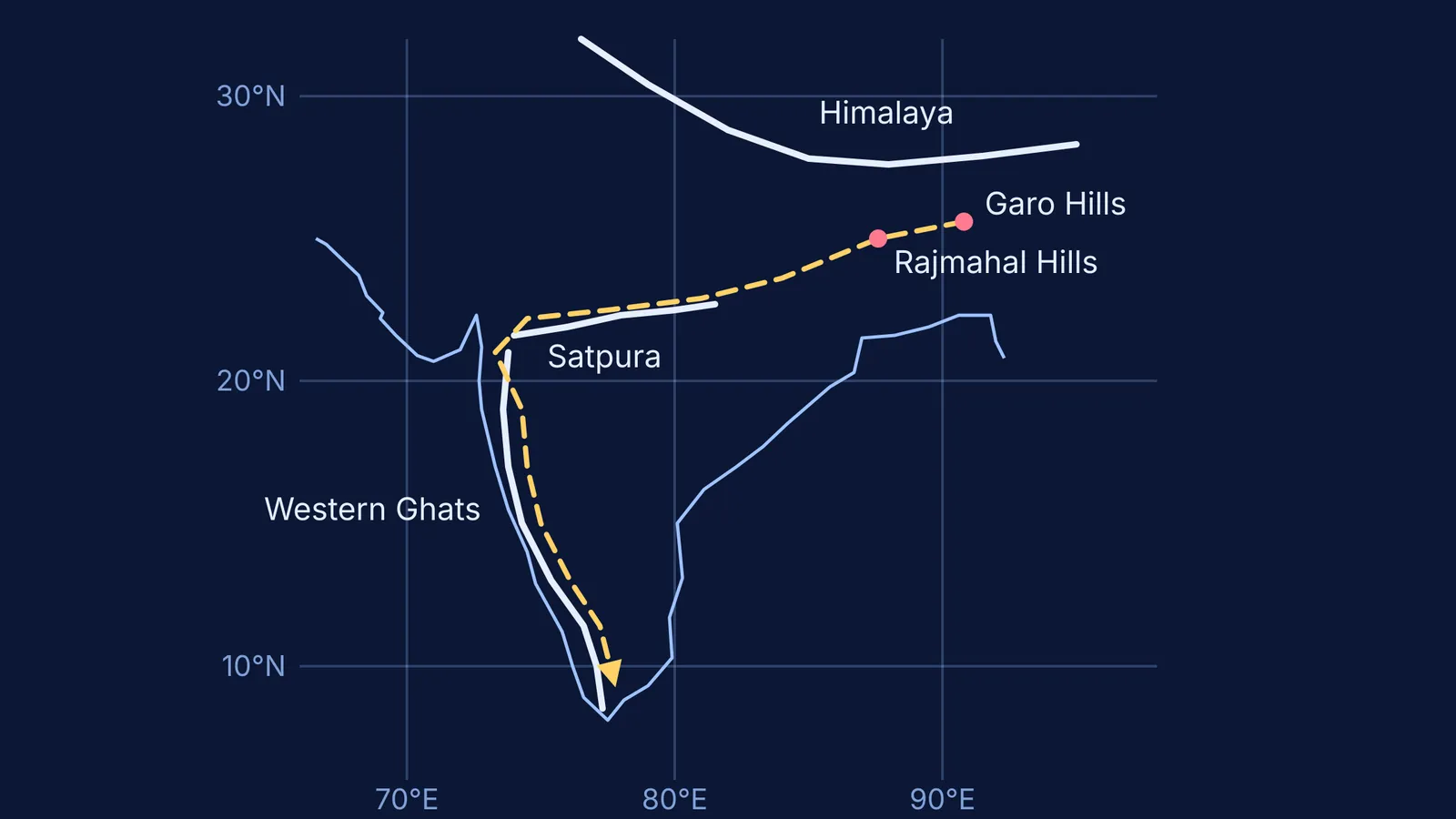
The Satpura hypothesis is Hora's proposal that hill-stream fishes moved from the Assam (Garo) Hills via the Rajmahal Hills and the Satpura ranges, then down into the Western Ghats through Gujarat (Daniels 2001). He set it out in a series of papers between 1937 and 1953, including a 1949 paper in the Proceedings of the National Institute of Sciences of India.
The story ran like this, as summarised in the Journal of the Bombay Natural History Society and in Daniels' review:
Malayan freshwater fishes began moving west into India after it joined mainland Asia.
In the late Miocene, about 15 to 10 million years ago, the rising Himalayas disrupted an ancient river, the Indo-Brahm, and blocked the path west.
Hill-stream fishes were deflected south-west along the Satpura-Vindhya ranges.
From there they travelled south along the Western Ghats towards the tip of the peninsula.
Key to the idea was Hora's view that the Garo-Rajmahal gap, where the Ganga and Brahmaputra now drain, did not exist until the late Miocene, so hills once formed a bridge.
Why was the Satpura hypothesis rejected?
In 2001 R. J. Ranjit Daniels argued in Current Science that newer taxonomy, ecology and geology had made the hypothesis untenable (Daniels 2001).
The fish were renamed. Hora used the catfish genus Laguvia as evidence; it was later merged into Glyptothorax. Daniels wrote that revisions left just one catfish, Amblyceps mangois, ranging from the Rajmahal Hills to Thailand, to support the idea.
The pattern is weak. Of 218 freshwater fish species in the Western Ghats, 114 (52%) are endemic. For each endemic species there is less than a 10% chance that a species of the same genus lives in the eastern Himalayas and South-east Asia, but over 45% that one lives elsewhere in the subcontinent.
Torrent fish are hardier than assumed. Daniels once carried a torrent fish, Bhavania australis, on a 24-hour train journey in half a litre of water in a bottle, and it survived.
In 2003 K. Praveen Karanth proposed a sharper test in the same journal (Karanth 2003). He noted that species split between two far-apart wet zones (over 250 cm of rain a year) could be explained three ways: dispersal along a corridor, vicariance (a once-continuous forest broken up by drying), or convergence, where unrelated species evolve similar features in similar conditions. He wrote that a survey of molecular studies suggests convergence may be quite common, so the first step is to check whether a gap is real or an artefact of wrong classification.
How can you test an idea like Hora's?
Here is Karanth's logic turned into a checklist you can use on any "how did this species get here?" question:
Is the relationship real? Do DNA trees put the two populations together, or did similar habitats produce similar bodies?
If real, which came first? If the species arrived after the dry zone formed, it dispersed. If it was there before and was cut off, that is vicariance.
Does the tree have steps? Dispersal from the east predicts South-east Asian forms branch off first, then northeast India, then the Western Ghats.
Are there other routes? Karanth notes that other authors proposed the Eastern Ghats, the Aravalli range and the Brij region as alternatives to the Satpuras.
Worked example: two stone-sucking fish, one in the Garo Hills and one in Kerala, look nearly identical. Under Hora's view they are cousins that used the Satpura bridge. Under convergence, DNA would show the Kerala fish is closer to a slow-river fish nearby, and its sucker evolved on its own.
This is the same distinction between homologous and analogous structures that your Class 12 evolution chapter asks about. If convergent evolution or vicariance still feels fuzzy, the Fermi Concept Library gives each biology concept its own lesson and shows its place in the map of related ideas.
For more on reading history from where species live, see Alfred Wegener and continental drift, what Darwin and Wallace argued in 1858 and Ernst Mayr's biological species concept.


