

On this page
In 1914, a young chemist in Vienna weighed lead taken out of uranium ore and found it was measurably lighter than ordinary lead. The gap, recorded in Marie Curie's table of lead atomic weights, was less than one unit of atomic weight, but it was some of the first hard evidence that one element can come in atoms of different mass. Her name was Stefanie Horovitz, and after her collaborator's death her part in it was nearly forgotten.
Who was Stefanie Horovitz?
Stefanie Horovitz was born in Warsaw in 1887, began studying at the University of Vienna in 1907 and finished a PhD in organic chemistry there in 1914, according to her Wikipedia biography. On Lise Meitner's recommendation she joined Otto Hönigschmid, an atomic-weight specialist at Vienna's Institute for Radium Research, and worked with him until about 1918.
She later set up a foster home in Vienna with the psychologist Alice Friedmann, returned to Warsaw in 1937, and was murdered by the Nazis; records indicate she died at Treblinka in 1942. A 2020 Chemistry World profile by Katharine Sanderson calls her "a meticulous and talented experimentalist, destined to be overlooked by history."
What did Horovitz measure in 1914?
The radioactive displacement law of Kazimierz Fajans and Frederick Soddy predicted that lead produced by the decay of uranium or thorium should have a different atomic weight from ordinary lead (our post on Frederick Soddy, isotopes and the displacement law explains the reasoning). Fajans and Soddy asked Hönigschmid to test it, and Horovitz did the laborious separation and weighing, using lead from uranium-rich pitchblende mined at St Joachimsthal, as her biography records.
Marie Curie's 1924 review L'isotopie et les éléments isotopes describes the most precise method: purify the lead again and again, finishing in quartz and platinum vessels, turn it into lead chloride, then precipitate the chlorine as silver chloride and weigh it. Curie notes on the next page that the largest difference theory predicted was about 1/300 of the silver chloride's weight, from a few grams of material.
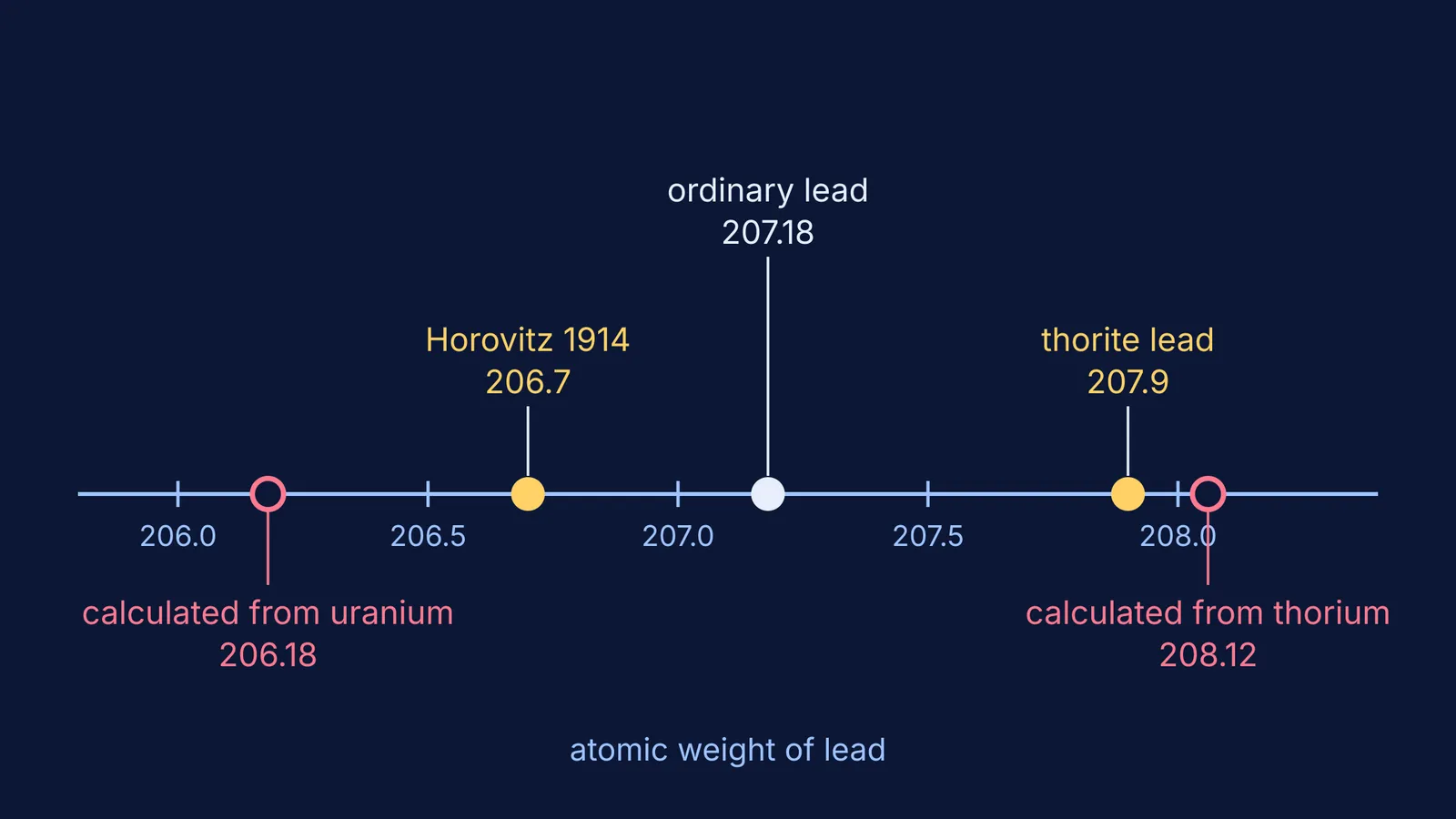
The result: Curie's table of lead atomic weights lists Hönigschmid and Horovitz's Joachimsthal pitchblende lead at 206.7, and a second sample at 206.4, against 207.18 for ordinary lead. Her Wikipedia biography gives the finer figures as 206.736 against 207.190.
The paper, "Sur le poids atomique du plomb de la pechblende", by Hönigschmid and Horovitz, appeared on page 1796 of the Comptes rendus of the French Academy of Sciences, volume 158 (1914). They were not alone: Theodore Richards and Max Lembert at Harvard published The atomic weight of lead of radioactive origin the same year, and Curie records that Soddy and Hyman, Maurice Curie, Richards, Lembert and Hönigschmid all reported results independently in 1914, each showing differences that matched the predictions. Agreement between separate labs made the finding hard to dismiss.
Why does lighter lead prove isotopes exist?
Isotopes are atoms of the same element, with the same chemistry, but different masses. Lead from uranium ore behaves chemically like ordinary lead; only the balance could tell them apart.
Here is the arithmetic, using the values in Curie's 1924 review:
Uranium (238.18) reaches lead by giving off 8 helium nuclei (alpha particles) of mass 4.0 each: 238.18 - 32.0 = 206.18.
Thorium (232.12) reaches lead by losing 24.0, that is six alpha particles: 232.12 - 24.0 = 208.12.
Ordinary lead (207.18) sits between the two, so lead from uranium ore should be lighter and lead from thorium ore heavier.
Both came true. Uranium-ore lead measured 206.7 in Horovitz's sample and as low as 206.05 in very pure crystallised pitchblende from Morogoro, as Curie's discussion shows, while lead from Norwegian thorite measured 207.9, according to her thorite results.
To practise counting the alpha steps yourself, see counting alpha and beta decays in a radioactive decay series.
How can you use this in your own chemistry?
Try this simplified exercise, the same maths as average atomic mass from isotope abundance, using the values from Curie's table. Treat a lead sample as a mix of pure uranium lead (206.05) and ordinary lead (207.18). If it measures 206.7, the uranium-lead fraction x solves 206.05x + 207.18(1 - x) = 206.7, so 1.13x = 0.48 and x is about 0.42. Real ores are messier, because ordinary lead is itself a mix of isotopes, but the method is the same.
When you read about any experiment, ask Horovitz's questions:
What number does the theory predict?
Is the expected difference bigger than the measuring error?
Did other labs get the same answer on their own?
Does the effect go the predicted way in every case?
If isotopes or atomic mass still feel shaky, the Fermi Concept Library has a lesson for every concept in chemistry and physics, and the Fermi Problem Library has worked problems with a step-by-step solver that explains the reasoning rather than printing an answer.
Next time you see 207.2 for lead in your periodic table, remember that it is an average, and that a chemist in Vienna helped show why.


