

On this page
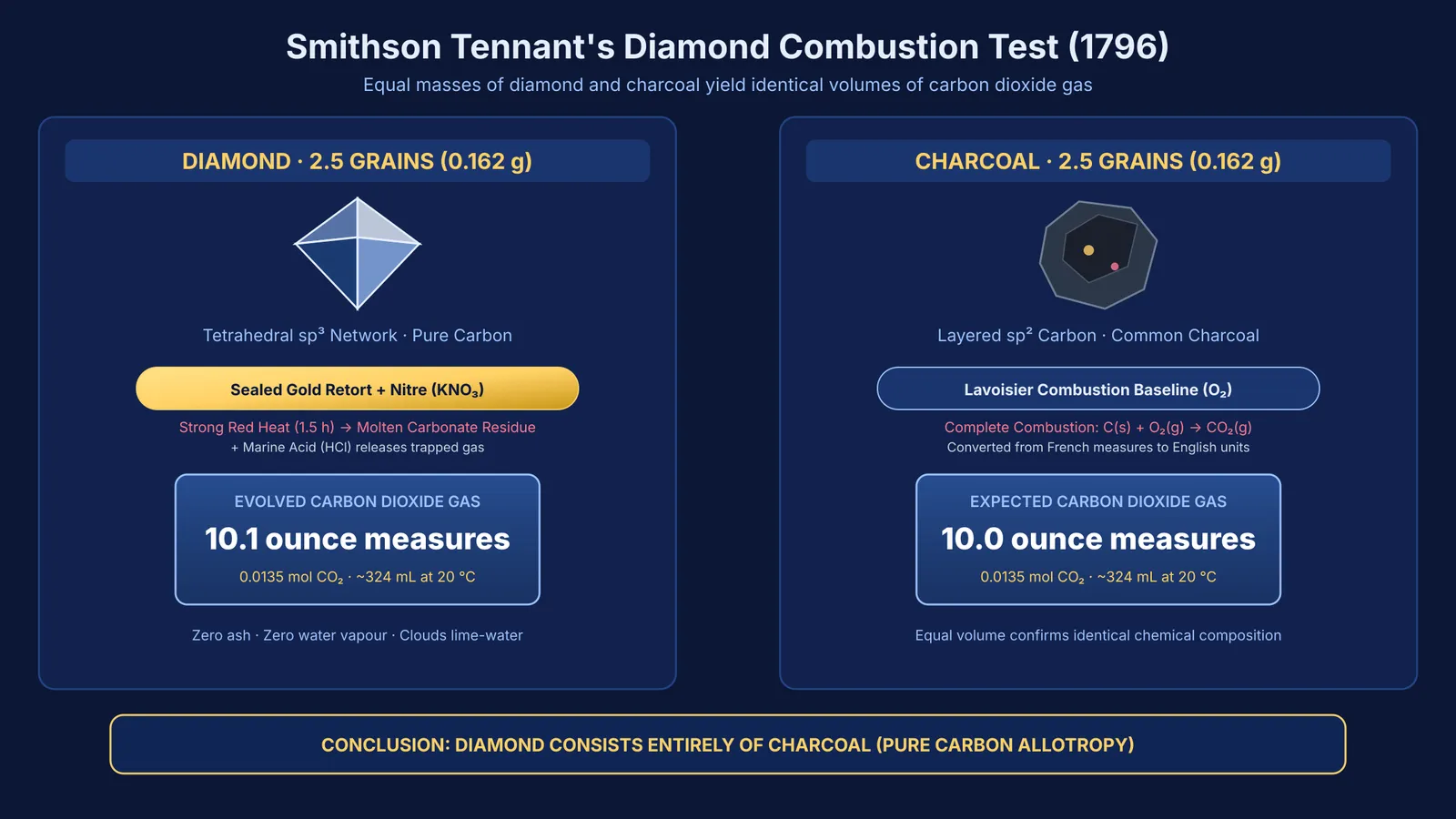
In 1796, English chemist Smithson Tennant settled one of the greatest mysteries in natural philosophy by burning a diamond in a sealed gold tube, publishing his findings in the Philosophical Transactions of the Royal Society of London. By demonstrating that 2.5 grains of diamond produced the exact same volume of carbon dioxide gas as 2.5 grains of common charcoal, Tennant proved that diamond is chemically pure carbon. His quantitative test shattered the ancient assumption that diamond was an unrelated, indestructible mineral and established the foundation of elemental allotropy.
Why did early chemists suspect diamond could burn?
For centuries, naturalists regarded diamond as an eternal gem incapable of alteration by fire. In 1704, Sir Isaac Newton noted in his treatise *Opticks* that substances with unusually high refractive power relative to their density were combustible, citing camphor, turpentine, and olive oil. Newton conjectured that diamond's extraordinary optical density indicated it was likely "an unctuous body coagulated."
In 1772, French chemist Antoine Lavoisier tested Newton's hypothesis by focusing solar rays through a large Tschirnhaus burning lens onto diamonds enclosed in a glass vessel over mercury. As detailed in our article on Antoine Lavoisier's conservation of mass experiments, the gemstone vanished into fixed air (carbon dioxide) that clouded lime-water. Yet Lavoisier could not determine whether diamond was pure carbon or a complex compound containing hydrogen or mineral bases. Burning a gemstone proved it was combustible, but not what it was made of.
How did Smithson Tennant burn a diamond in 1796?
Tennant recognized that burning a diamond directly in open air required intense heat and allowed gases to escape into the atmosphere. To achieve complete combustion in a closed, uncontaminated vessel, his 1797 Royal Society paper described placing 2.5 grains of small diamonds (about 162 milligrams) inside a sealed gold tube along with a quarter of an ounce of nitre (potassium nitrate, KNO₃).
Tennant selected gold specifically because it does not oxidize at red heat and resists attack by molten alkalis, preventing foreign carbon from contaminating the products. He heated the gold tube to a strong red heat for about an hour and a half. As the nitre decomposed, it released oxygen that oxidized the diamond into potassium carbonate ("aerated alkali").
To verify that neither the gold vessel nor the nitre produced false positive gases, Tennant ran a control test: heating nitre alone in the gold tube produced no gas that clouded lime-water. After the diamond was consumed, he dissolved the salt residue in water and added acid, liberating the trapped carbon dioxide gas into an inverted glass globe over quicksilver (mercury) to prevent the gas from dissolving.
Why did measuring carbon dioxide prove diamond is pure carbon?
The turning point was quantitative equivalence. As documented in Tennant's 1797 Royal Society report, 2.5 grains of diamond yielded slightly more than 10.1 ounce measures of carbon dioxide gas.
To evaluate this yield against common charcoal, Tennant converted Antoine Lavoisier's benchmark French combustion proportions into English weights and measures. He computed that burning 2.5 grains of charcoal ought to occupy very nearly the bulk of 10.0 ounce measures of water. Because equal masses of diamond and charcoal produced the identical volume of carbon dioxide gas, with zero ash, water vapour, or secondary gases, Tennant concluded that diamond "consists entirely of charcoal, differing from the usual state of that substance only by its crystallized form."
In 1807, chemists William Allen and William Hasledine Pepys confirmed these findings in the Philosophical Transactions using mercury gasometers, proving that diamond, charcoal, and plumbago (graphite) yield identical masses of carbon dioxide per gram of material. Today, carbon's versatile network bonding includes graphene sheets and Sumio Iijima's discovery of carbon nanotubes.
How does quantitative combustion solve modern chemistry problems?
Tennant's experiment established the foundation for modern quantitative elemental combustion analysis in Class 11 and competitive exams like JEE Advanced. By capturing every atom of carbon as evolved carbon dioxide, chemists determine empirical formulas and verify elemental purity against IUPAC standard atomic weights.
Worked Example: Reconstructing Tennant's Stoichiometry
Suppose you burn 2.5 grains of pure diamond (where 1 grain = 64.8 milligrams, giving 0.162 grams of carbon). Using standard values from IUPAC atomic weight determinations, where carbon is 12.01 g/mol and carbon dioxide is 44.01 g/mol:
Moles of carbon: 0.162 g / 12.01 g/mol = 0.0135 moles of carbon.
Reaction stoichiometry: C(s) + O₂(g) → CO₂(g). One mole of carbon atoms produces one mole of carbon dioxide molecules, giving 0.0135 moles of CO₂.
Mass and gas volume: 0.0135 moles × 44.01 g/mol = 0.594 grams of CO₂. At 20 °C and 1 atmosphere (molar volume 24.0 L/mol), 0.0135 moles occupies 324 millilitres of gas. This calculated volume matches Tennant's historical measurement of 10.1 ounce measures (~295–300 millilitres) in his calibrated receiver.
When tackling combustion stoichiometry numericals in chemistry exams, use this 3-step checklist:
Check mass balance: Confirm that all carbon from the sample is accounted for in the carbon dioxide absorbed by potassium hydroxide.
Screen for water: Formation of water droplets indicates hydrogen in the reactant, ruling out an allotrope of pure carbon.
Compare molar volumes: Verify that the evolved gas volume matches the expected molar volume at the given temperature and pressure.
Visualizing how identical carbon atoms build completely different materials requires seeing the atomic lattice. The Fermi Simulation Lab provides interactive simulations for the ideas that are easier to see than to read, allowing you to manipulate tetrahedral sp³ diamond networks alongside planar sp² graphite sheets.
For students mastering stoichiometric combustion numericals and empirical formulas, the Fermi Problem Library offers worked problems with a step-by-step solver that explains the reasoning rather than printing an answer.


