

On this page
The space age began with a polished metal ball and a radio beep. On 4 October 1957 the Soviet Union put Sputnik 1 into orbit, and the engineer who drove the project, Sergei Korolev, was a man whose name the world was not allowed to know. This post sets out what his team built, using NASA and ESA history pages, checks Sputnik's orbit with the Kepler's law you meet in Class 11, and ends with what you can learn from the way he worked.
Who was Sergei Korolev?
According to the European Space Agency, Korolev was born on 12 January 1907 in Zhytomyr, Ukraine, and designed his first glider at 17. He studied at the Kiev Polytechnic Institute and moved to rocket propulsion. In 1938, during Stalin's purges, he was arrested and sentenced to ten years of forced labour. NASA's history office describes his time in the Kolyma gold mines, part of the Gulag, before he was brought back to work as an engineer.
After the war he led Soviet long-range missile work. ESA records that the R-7, the first intercontinental ballistic missile, flew successfully on 21 August 1957. It was powerful enough to reach orbit. ESA adds that Korolev's identity was "a well-kept state secret" until his death on 14 January 1966.
Why did Korolev choose a simple satellite?
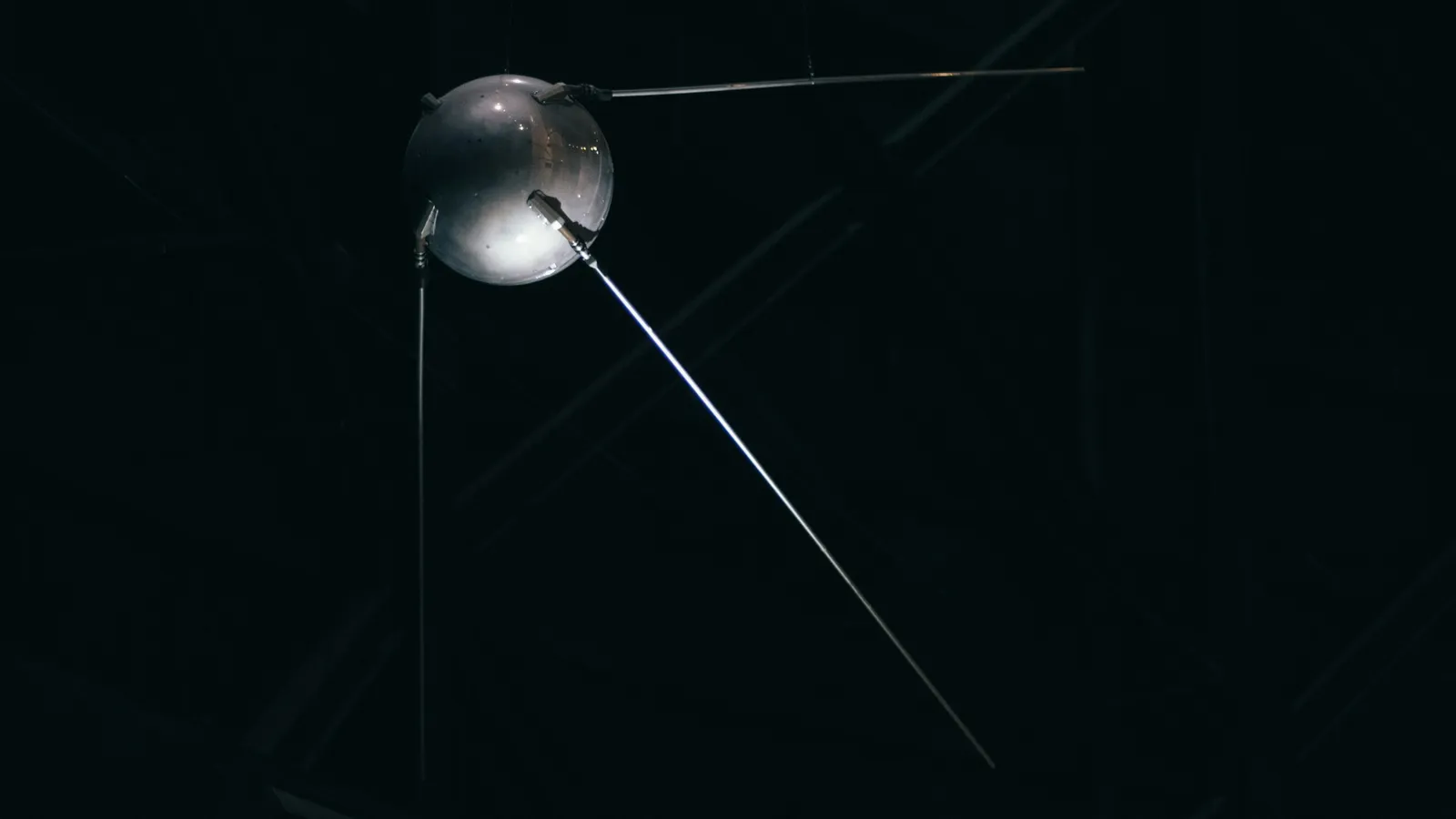
Korolev's first plan was a large scientific satellite called Object D. Historian Asif Siddiqi, writing for NASA's Sputnik history pages, explains that ground tests showed the R-7 engines falling short of their planned performance, too low for the heavy Object D. Korolev changed course. In January 1957 he asked to launch small, simple satellites first, and the design became Simple Satellite No. 1, or PS-1. James Harford's NASA essay adds that the delayed scientific satellite eventually flew as Sputnik 3.
Siddiqi records the details. PS-1 was a pressurised aluminium-alloy sphere with a total mass of 83.6 kg, of which 51.0 kg was batteries. Two radio transmitters worked at 20.005 and 40.002 MHz and sent the pulses heard around the world as "beep-beep". It lifted off at 22:28:34 Moscow time on 4 October.
You can check the radio figures yourself with λ = c/f. For 20.005 MHz, λ = 3.00 × 10⁸ / 2.0005 × 10⁷ ≈ 15.0 m; for 40.002 MHz, λ ≈ 7.5 m. (The NASA page prints the first as 1.5 m, which looks like a typo; the arithmetic is a good habit.) Our post on the electromagnetic spectrum shows where these short-wave radio signals sit.
How long did Sputnik take to go round the Earth?
Siddiqi gives the first orbit measured by Soviet ballistics experts: perigee 228 km, apogee 947 km, inclination 65.6 degrees and period 96.17 minutes. The NCERT Class 11 chapter Gravitation gives Kepler's third law for a satellite, T² = 4π²r³/GM, with G = 6.67 × 10⁻¹¹ N m² kg⁻², R = 6.37 × 10⁶ m and M = 5.97 × 10²⁴ kg. For an ellipse, use the semi-major axis a in place of r.
Heights are measured from the surface, so add the Earth's radius. Semi-major axis a = 6370 + (228 + 947)/2 = 6370 + 587.5 = 6957.5 km = 6.9575 × 10⁶ m.
GM = 6.67 × 10⁻¹¹ × 5.97 × 10²⁴ = 3.982 × 10¹⁴ m³ s⁻².
a³ = (6.9575 × 10⁶)³ = 3.368 × 10²⁰ m³.
T = 2π √(a³/GM) = 2π √(8.458 × 10⁵) = 2π × 919.7 ≈ 5778 s.
5778 s ÷ 60 ≈ 96.3 minutes.
The prediction is within about 0.15 per cent of the measured 96.17 minutes. A speed of the same order follows from v = 2πa/T ≈ 7.6 km/s, and at 96.17 minutes per orbit Sputnik went round about 15 times a day. Harford records that Sputnik 1 beeped for three weeks and made more than 1,400 orbits before burning up after three months.
What mistakes do students make with satellite orbits?
Using height instead of distance from the centre. Putting r = 587.5 km gives a period of under 3 minutes. Always add R.
Averaging the wrong thing. For an ellipse the semi-major axis is the mean of the closest and farthest distances from the Earth's centre, not of anything else.
Thinking speed is constant on an ellipse. Sputnik moved fastest at perigee and slowest at apogee; 7.6 km/s is only a representative value.
For more practice, our guide to gravitation and satellite problems works through the standard JEE types. If orbits are hard to picture, the Fermi Simulation Lab has interactive simulations for ideas that are easier to see than read.
What can a student take from Korolev's way of working?
Cut the problem down. Korolev dropped a heavy satellite for one that could fly on the rocket he had. In a long problem, solve a simpler version first.
Check before you celebrate. Siddiqi describes Korolev telling his team to wait for the satellite's signal after its first full orbit before celebrating. Harford records the opposite case too: Sputnik 3 was launched despite a failed tape-recorder test, and the recorder failed in orbit. Check units and orders of magnitude before you trust an answer.
Keep going after setbacks. Arrest and the labour camps did not end his work.
Next step: use Kepler's third law to find the period of a satellite with perigee 300 km and apogee 900 km, then compare it with Sputnik's.


