

On this page
Schrödinger's cat is the most famous paradox in modern physics. If you have studied quantum mechanics, you have likely heard of the cat that is simultaneously alive and dead inside a sealed box.
But the Austrian physicist Erwin Schrödinger did not actually believe a cat could exist in two states at once. He published the thought experiment in November 1935 in the journal *Naturwissenschaften*, Volume 23, to argue the exact opposite.
What is Schrödinger's cat thought experiment?
Schrödinger asked readers to imagine a cat placed in a sealed steel chamber along with an "infernal device". The device contains a Geiger counter and a tiny amount of radioactive substance. The amount is so small that the rules of quantum mechanics govern its behaviour completely.
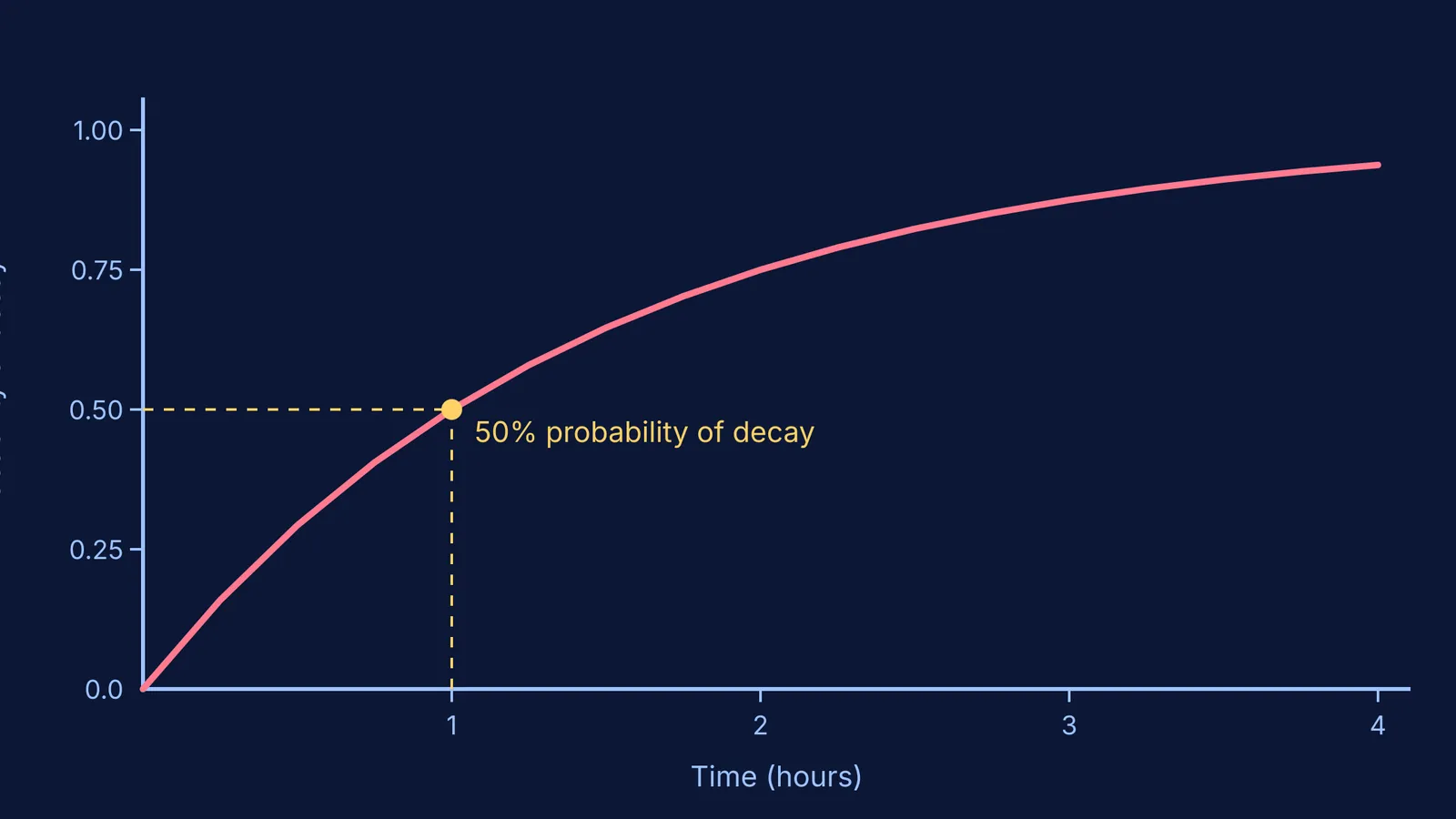
The setup relies on quantum probability: there is an equal probability that one atom will decay within a period of 1 hour, and that no atom will decay. If the Geiger counter detects a decay, it triggers a relay that drops a hammer. The hammer shatters a small flask of hydrocyanic acid, which kills the cat. If no atom decays, the flask remains intact and the cat lives.
According to the Copenhagen interpretation of quantum mechanics (promoted by Niels Bohr and Werner Heisenberg), a quantum particle like an atom exists in a "superposition" of all possible states until it is observed. Because the cat's survival is perfectly tied to the atom, the theory implies that until someone opens the box, the cat itself is in a superposition—smeared out in a state of being simultaneously alive and dead. The mathematical wave function for the entire system contains equal parts of a living cat and a dead cat.
Why did Schrödinger create the cat paradox?
Schrödinger created the paradox to expose a flaw in how physicists were interpreting quantum rules. In his 1935 paper, *Die gegenwärtige Situation in der Quantenmechanik* (The Present Situation in Quantum Mechanics), he called the cat scenario a "burlesque" case, which means an absurd or farcical exaggeration.
His point was simple: while it might make mathematical sense to say an unobserved electron is in a superposition of states—just as Uhlenbeck, Goudsmit and the spin of the electron showed that subatomic properties behave strangely—it is ridiculous to apply those same rules to everyday macroscopic objects. The cat must be either alive or dead before we open the box, not a mathematical blur of both. He used the cat to show that the Copenhagen interpretation was incomplete because it lacked a clear boundary between the quantum world and the classical world.
If you find quantum states hard to picture, you are not alone. The Fermi Concept Library holds every concept in physics, chemistry, biology, mathematics and computing, each with its own lesson and its place in the map. For problems like the recoil of a hydrogen atom when it emits a photon, Fermi's AI tutor can work out what you already know and build a plan for the session, so you sit down to a clear next step.
Is Schrödinger's cat alive or dead?
In reality, the cat is definitively one or the other long before a human opens the box. The Geiger counter itself acts as an "observer." The moment the counter interacts with the radioactive atom, the quantum superposition collapses into a single, definite outcome. The environment inside the box forces the system to choose a state, a process modern physicists call decoherence.
This thought experiment also gave physics a new vocabulary. In the same 1935 paper, Schrödinger coined the term "entanglement" (*Verschränkung*) to describe how the quantum state of the atom becomes permanently linked to the macroscopic state of the cat, meaning you cannot describe one without the other.
Schrödinger's burlesque example was meant to highlight a missing piece in quantum theory. By amplifying a subatomic event to a life-or-death scale, he forced the scientific community to ask hard questions about observation and reality. Today, it stands as the ultimate symbol of how strange the universe becomes when we zoom in on the atom.
What does the cat mean for modern physics?
Despite Schrödinger's intentions, his cat became the mascot for the very strangeness he was trying to critique. Today, the thought experiment is more than a historical footnote; it is a foundational concept in quantum information science.
When physicists build quantum computers, they rely on qubits that exist in a superposition of 0 and 1, much like the atom in the box. The challenge is keeping these qubits isolated from their environment so they do not collapse prematurely—effectively trying to keep the box sealed as long as possible. The paradox of the cat continues to remind us that the boundary between the quantum realm and the everyday world is still one of the deepest mysteries in science.


