On this page
In 1984, Sam Pitroda returned to India from the United States to establish the Centre for Development of Telematics (C-DOT). His mission was to modernise India's telecommunications infrastructure using indigenous technology, earning him the title of the Father of India's Telecom Revolution (Wikipedia).
Who is Sam Pitroda?
Satyanarayan Gangaram Pitroda was born in 1942 (Wikipedia). He became a successful telecommunications engineer and entrepreneur in the United States, filing numerous patents in digital switching. In the 1980s, he returned to India with a vision to upgrade the country's communication network. At the time, India's telephone system was slow; getting a new connection could involve waiting on government lists for several years, and the existing electromechanical switches were unreliable.
In 1984, the Indian government established the Centre for Development of Telematics (C-DOT) with an initial mandate of designing and developing digital exchanges (Wikipedia). Pitroda led this autonomous telecom research and development organisation. He recruited a team of young Indian engineers, fostering a fast-paced culture within the government framework to tackle the large engineering challenge ahead.
What was the C-DOT Rural Automatic Exchange (RAX)?
Before the 1980s, India relied on imported telecom equipment from multinational corporations. These systems often failed because they were designed for Western conditions. They required continuous air conditioning and could not handle India's high heat, heavy dust, or frequent power fluctuations.
Under Pitroda's leadership, C-DOT developed the Rural Automatic Exchange (RAX). This was a small, rugged digital telephone switch designed specifically to work without air conditioning in harsh rural environments. The RAX was built to serve local communities, which made it well scaled for Indian villages where an urban exchange would be wasteful.
By using standard, commercially available microprocessors and a modular software design, C-DOT kept costs low and made the systems easy to maintain. By relying on indigenous engineering, the team bypassed the need for extensive infrastructure and built a network that could survive severe weather and power cuts.
How did the PCO model change communication?
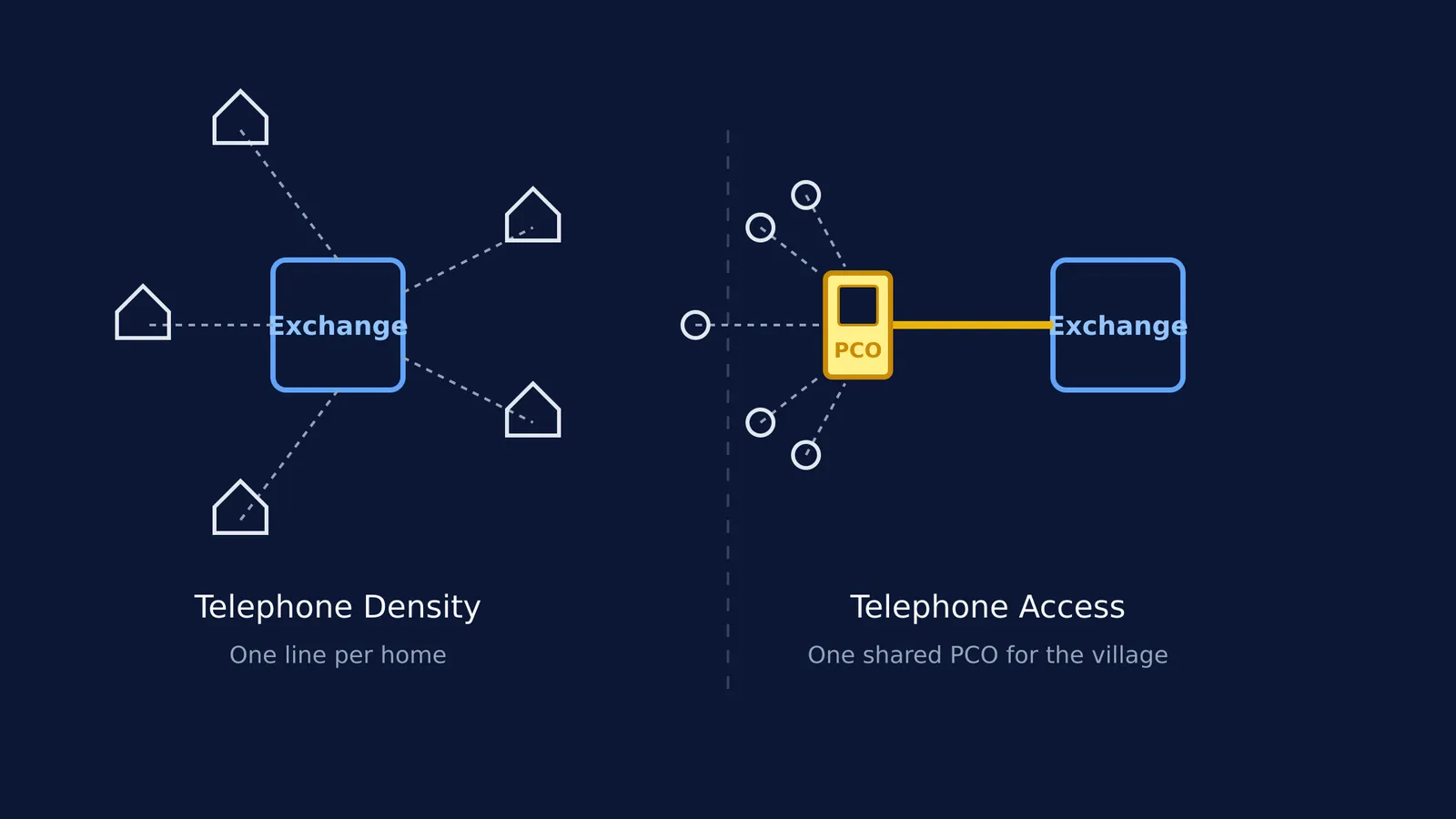
Pitroda recognised early on that installing a private telephone in every Indian home was financially impossible and would take decades to achieve. Instead, he shifted the engineering focus from "telephone density", which measures the number of phones per capita, to "telephone access". The immediate goal was to ensure that a public telephone was within walking distance for most citizens, regardless of where they lived.
This philosophy drove the creation of the Public Call Office (PCO) model. To make shared phones work, C-DOT developed a reliable charge indicator that allowed immediate and transparent billing at the user's end. This technology powered the bright yellow PCO booths that soon became a common sight across the country.
These booths allowed people in small towns and villages to make long-distance (Subscriber Trunk Dialling, or STD) and international (ISD) calls for the first time. It expanded access to communication, removing the need to travel to a major city post office just to make a trunk call. Furthermore, it generated employment, as the booths were run by small-scale entrepreneurs, including physically challenged individuals who were often given priority for booth licenses.
What can students learn from this approach?
The C-DOT story is a clear example of engineering for the real world. Rather than importing a Western solution that did not fit the local environment, Pitroda's team built technology precisely around the constraints of heat, dust and capital. They correctly identified that the true problem was access, not ownership.
For students exploring careers in STEM, this shows that true innovation often lies in deeply understanding the local problem. Identifying what resources you have and what limitations you face is a critical skill used in everything from software design to urban planning. This kind of structured thinking is essential for tackling complex challenges. The Fermi Problem Library has worked problems with a step-by-step solver that explains the reasoning rather than printing an answer. It helps you build this analytical approach as you study.
You can also read about how other pioneers approached indigenous engineering. For example, Vijay Bhatkar and PARAM, C-DAC's first supercomputer explores how India built its own high-performance computing technology when imports were restricted. Similarly, K. Kasturirangan and India's remote sensing satellites details how space technology was adapted for national development needs.