

On this page
In the early twentieth century, embryologists and geneticists worked in complete isolation. Embryologists believed early animal development was governed by physical forces and cytoplasmic gradients, while geneticists assumed genes merely fine-tuned superficial adult traits like eye colour or bristle count. Salome Gluecksohn-Waelsch (1907–2007) shattered that division. By tracking how mouse mutations halt specific embryonic tissues, she proved that individual genes directly govern the cellular inductions and structural movements that build a vertebrate body.
Why were embryology and genetics separate fields?
In 1928, Gluecksohn-Waelsch joined Hans Spemann's laboratory at the University of Freiburg. Spemann showed that transplanting an amphibian dorsal blastopore lip induces a secondary body axis, winning the 1935 Nobel Prize in Physiology or Medicine, as explored in our history of Hans Spemann, Hilde Mangold and the embryo organizer. Yet Spemann dismissed genetics, arguing that embryonic organization was directed entirely by the cytoplasm rather than the nucleus.
Gluecksohn-Waelsch recognized the fundamental flaw in this view. As detailed in Virginia E. Papaioannou's biographical memoir for the Royal Society (Papaioannou, 2019), she realized embryology described what happened, while genetics explained how cells differentiate. Forced to flee Nazi Germany in 1933 due to antisemitic persecution, she moved to New York and joined Leslie C. Dunn's laboratory at Columbia University, where she began analyzing mutant mouse strains.
How did the Brachyury mutation reveal the embryonic organizer?
Because mammalian embryos develop in utero, researchers could not graft tissues as Spemann had done with newts. Gluecksohn-Waelsch turned this obstacle into an advantage. In her landmark 1938 paper (Gluecksohn-Schoenheimer, 1938), she described mutations as "nature's own experiments." By identifying where development halted, she deduced the normal function of the unmutated gene.
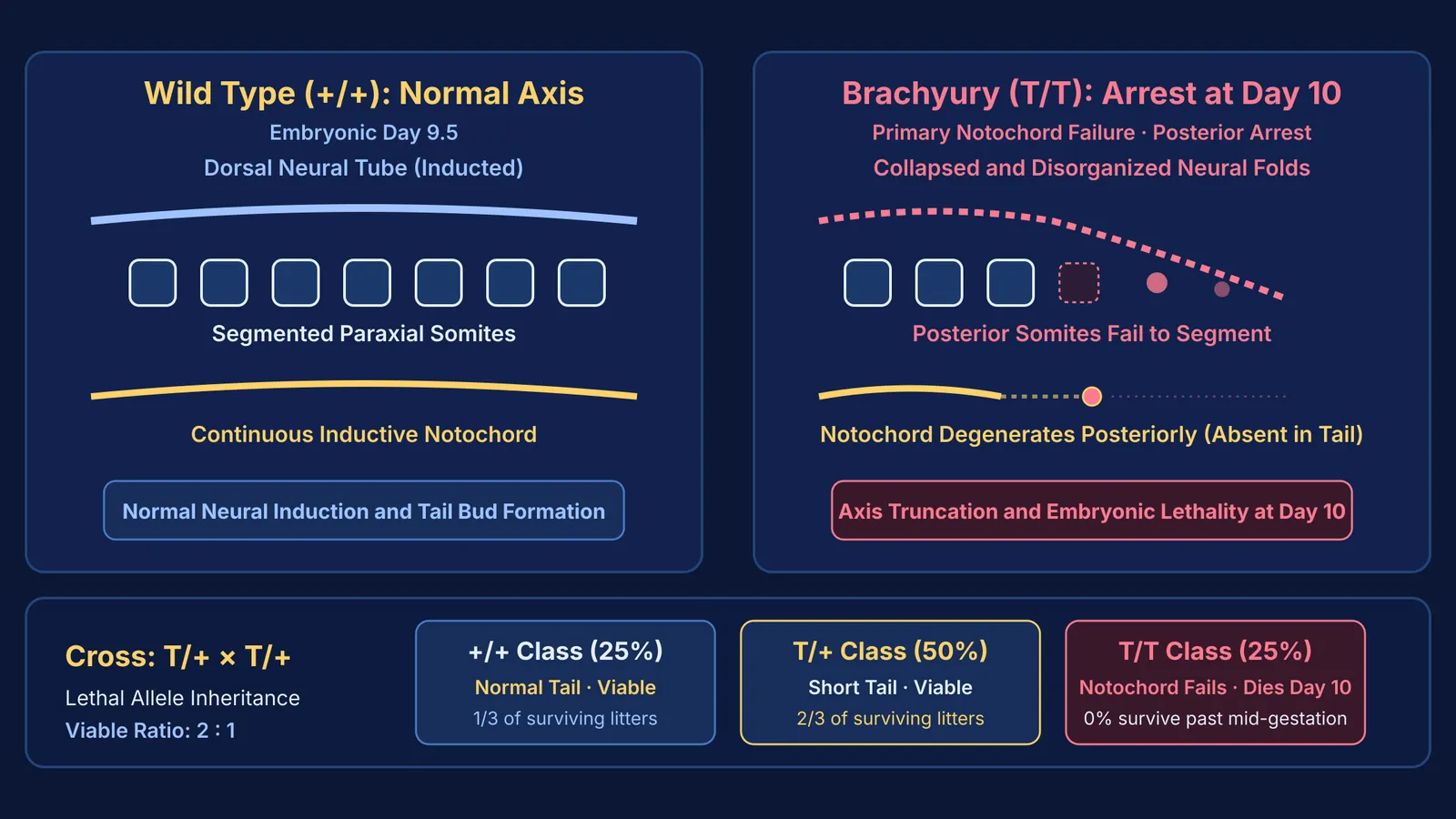
She focused on the Brachyury (*T*) mutation, discovered in mice by Nadine Dobrovolskaïa-Zavadskaïa in 1927. Heterozygotes (*T/+*) survived with short tails, but homozygous embryos (*T/T*) died around embryonic day 10. Analyzing serial histological sections from day 7 to day 11, Gluecksohn-Waelsch discovered that in *T/T* embryos, the notochord failed to differentiate in the posterior half. Without an intact notochord, the overlying neural tube collapsed, somites failed to segment, and posterior axial development halted. This provided the first empirical proof that a specific gene directs embryonic induction in a mammal.
What did the T-locus crosses prove about lethal alleles?
In her breeding records (Gluecksohn-Schoenheimer, 1938), microscopic sections explained non-Mendelian survival ratios. In standard crosses, mating two heterozygotes yields a 3:1 phenotypic ratio, as detailed in our guide to Mendelian genetics for NEET: Punnett squares, ratios and traps. Crossing two short-tailed mice (*T/+*) consistently produces 2 short-tailed offspring for every 1 normal-tailed mouse, verified through test cross vs back cross experiments:
Conception frequency: 25% *T/T*, 50% *T/+*, 25% *+/+* (1:2:1 ratio).
Mid-gestation arrest: 100% of the *T/T* class dies at day 10 from notochord absence and failed umbilical circulation.
Viable birth ratio: 2 *T/+* (short tail) : 1 *+/+* (normal tail).
Gluecksohn-Waelsch proved that the missing 25% did not fail to fertilize; they formed normal early blastocysts and implanted successfully, but perished when their genetic program failed to execute axial induction.
How do you analyze lethal embryonic crosses step by step?
When analyzing developmental mutations and embryonic lethality in genetics problems (Gluecksohn-Schoenheimer, 1938), apply this four-step diagnostic protocol:
Write out conception genotypes: Construct a Punnett square for the cross. For heterozygotes carrying a dominant morphological marker that is homozygous lethal (*T/+* × *T/+*), the conception ratio is 1 *T/T* : 2 *T/+* : 1 *+/+*.
Identify the developmental arrest point: Determine whether lethality occurs pre-implantation, during organogenesis, or post-natally. In *T/T*, arrest occurs during organogenesis at embryonic day 10.
Separate primary defects from secondary cascades: Identify the primary inductive failure (notochord degeneration) before listing secondary consequences (neural tube collapse, absent hindlimbs, failed circulation).
Re-calculate surviving ratios: Remove the lethal class from the denominator. Among viable offspring, the surviving phenotypic ratio is 2/3 mutant phenotype (short tail) to 1/3 wild-type phenotype (normal tail).
What is the lasting legacy of Salome Gluecksohn-Waelsch?
Gluecksohn-Waelsch extended her work to other mutations, including Danforth's short tail (Gluecksohn-Schoenheimer, 1945) and regulatory albino deletions with Carl Cori. In 1955, she joined the newly founded Albert Einstein College of Medicine, helping establish and chair the Department of Genetics.
For uniting embryology and genetics, she received the National Medal of Science in 1993 and the Thomas Hunt Morgan Medal in 1999 (Papaioannou, 1999). She pursued research into her nineties, living to age 100 (Papaioannou, 2019).
Connecting abstract genetic crosses with physical tissue differentiation is often difficult on paper alone. To build an organized conceptual map from Mendelian inheritance to embryonic germ layers, the Fermi Concept Library covers every concept in biology, each with its own lesson and its place in the map. For students working through multi-step inheritance numericals and lethal allele ratios, the Fermi Problem Library provides worked problems with a step-by-step solver that explains the reasoning rather than printing an answer.


