

On this page
In March 1960, mathematician Rudolf Kalman published a paper in the *Journal of Basic Engineering* that solved an old problem in a new way 10.1115/1.3662552. He introduced what is now called the Kalman filter: an algorithm that estimates the true state of a moving object from a series of noisy measurements.
At the time, NASA was struggling with a monumental navigation problem. They needed to send astronauts to the Moon and back, but their measurements of the spacecraft's position and speed would always carry some error. Kalman's elegant mathematics arrived just in time to become the navigation brain of the Apollo missions.
What is the Kalman filter?
Before Kalman, filtering "noise" out of a signal usually meant looking at a long history of past data to smooth out the bumps. This was mathematically heavy and required a lot of memory.
Kalman changed the approach by making the filter recursive. His algorithm only needs two pieces of information to find the best possible answer:
The previous "best guess" of where the object should be (the prediction).
The current measurement from the sensors.
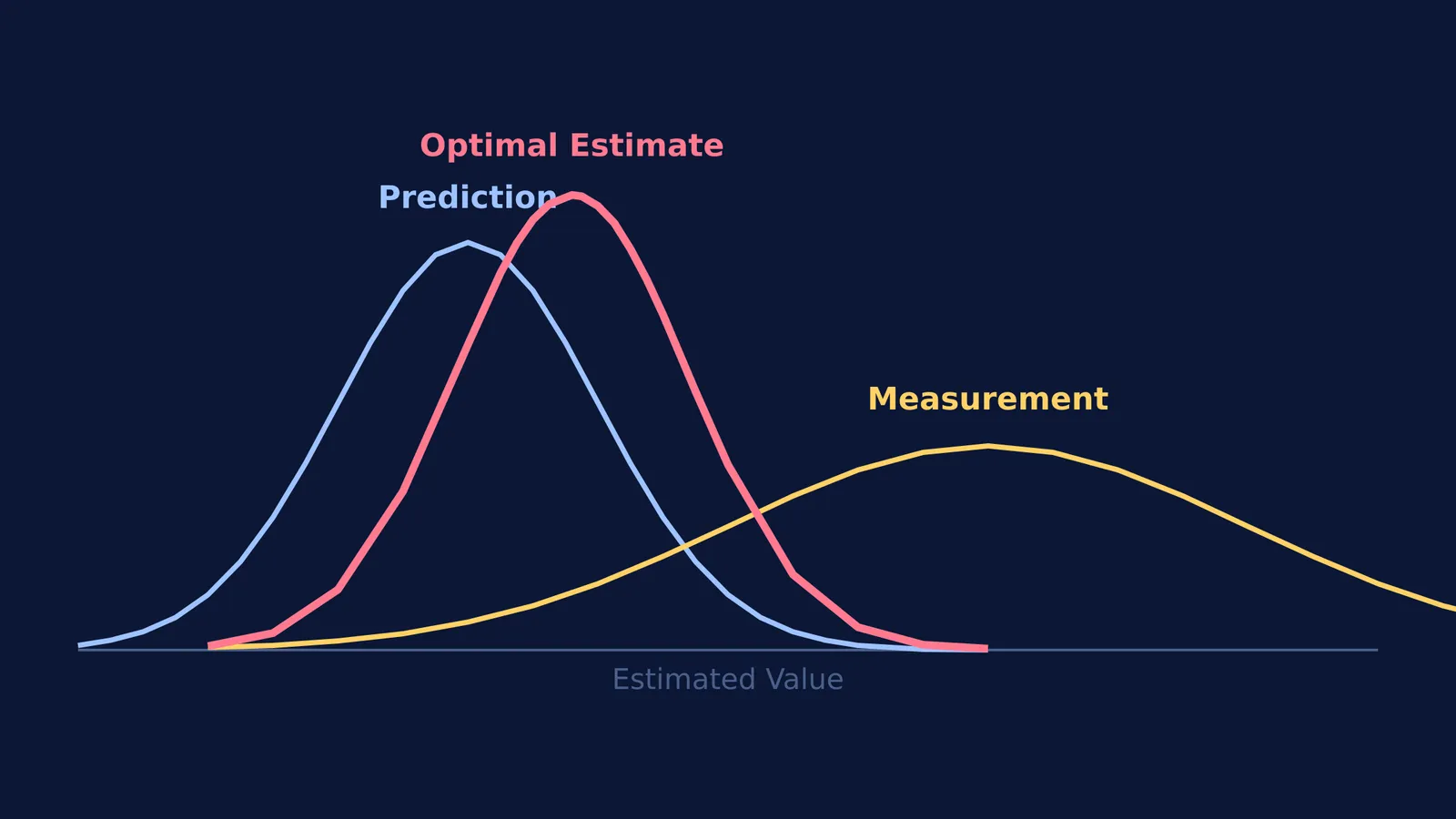
Because no prediction is perfect and no sensor is completely accurate, the filter weights these two inputs based on their uncertainty. If your prediction is very confident but the sensor is known to be noisy, the filter leans on the prediction. If the sensor is highly precise, the filter trusts the measurement more. The result is an optimal estimate that is more accurate than either the prediction or the measurement alone.
Why did Apollo need a new navigation method?
The journey to the Moon is not a straight line. It involves complex, curved paths shaped by gravity, much like the orbital maths behind early spaceflight.
To track the spacecraft across the vast distance to the Moon, the Apollo Guidance Computer used an Inertial Measurement Unit (IMU) to sense motion, alongside star sightings taken by astronauts using a space sextant. However, the IMU drifted over time, and manual optical sightings had human error. Furthermore, the Apollo Guidance Computer had very limited working memory—far too little to store vast tables of past trajectory data NASA TM-86847.
In late 1960, Stanley F. Schmidt at NASA's Ames Research Center learned of Kalman's work. Schmidt realised that Kalman's recursive, memory-efficient filter was exactly what Apollo needed. Because Kalman's original theory was for linear systems, Schmidt's team adapted it for the nonlinear curves of orbital speed, energy and escape speed. This adaptation, known as the Extended Kalman Filter (EKF), allowed the tiny Apollo computer to continually update its state vector—its exact position and velocity—in real time NASA TM-86847.
How does the filter work in practice?
Imagine you are tracking a spacecraft approaching the Moon, applying the principles from Kalman's original work 10.1115/1.3662552.
The Prediction: Based on your last known speed, you predict the spacecraft is moving at 1000 metres per second (m/s). You are fairly confident, so you assign this a standard uncertainty of ±10 m/s.
The Measurement: The radar suddenly pings the speed at 1040 m/s. But you know the radar is noisier, with an uncertainty of ±30 m/s.
Instead of just adopting the radar's noisy reading or stubbornly sticking to the prediction, the Kalman filter calculates a "Kalman gain" to blend them. Because precision scales with the inverse square of uncertainty, the filter weights the prediction nine times more heavily than the measurement. It calculates an optimal estimate of 1004 m/s. This new estimate, complete with a smaller overall uncertainty, then becomes the prediction for the very next radar ping.
How does Fermi's AI tutor use continuous feedback?
Just as the Kalman filter constantly updates its model of reality with every new measurement, effective learning requires a system that adjusts to you.
When you solve problems with Fermi, the system doesn't just check your final answer. Fermi's AI tutor can work out what you already know and build a plan for the session, so you sit down to a clear next step. It notices where you are stuck, decides whether to explain or ask a question, and updates its understanding of your progress—guiding you smoothly to your goal, much like Apollo to the Moon.


