

On this page
Most Class 11 students learn the thyroid as a short list: the gland makes thyroxine (T4) and triiodothyronine (T3), both need iodine, and both raise the body's metabolic rate. The textbook doesn't tell you that T3 was found decades after thyroxine, by two researchers in a London laboratory who chased an unexplained spot on a chromatogram. Knowing that story makes the chapter easier to remember and helps you see why T3, not T4, does most of the work inside cells.
Who were Rosalind Pitt-Rivers and Jack Gross?
Rosalind Pitt-Rivers was a British biochemist, born in London on 4 March 1907. She took a first-class BSc from Bedford College, University of London, in 1930 and a PhD in biochemistry from UCL Medical School in 1939, as her Wikipedia biography records. She joined the National Institute for Medical Research (NIMR) at Mill Hill in 1942, later headed its chemistry division, and was elected a Fellow of the Royal Society in 1954.
Jack Gross (1921-1994) was a Canadian-Israeli endocrinologist who earned his MD and PhD from McGill University in 1949 and then came to her laboratory as a postdoctoral researcher, according to his Wikipedia biography).
By then, thyroxine had been known for decades. Edward Kendall isolated it at the Mayo Clinic in 1914, and Charles Harington and George Barger synthesised it in 1927, as the history of levothyroxine notes.
How did they discover the thyroid hormone T3?
The clue came from Gross's earlier work in Montreal. A history of the discovery, drawing on Jamshed Tata's Royal Society memoir of Pitt-Rivers, describes the steps:
Label the iodine. Radioactive iodine-131 lets you follow iodine through the body, because every compound that contains it gives off a signal.
Separate the compounds. In 1951, Gross and Charles Leblond found that the plasma of rats given iodine-131 held an unknown radioactive compound, which they called "unknown 1". On a two-dimensional paper chromatogram it ran close to thyroxine but not on top of it.
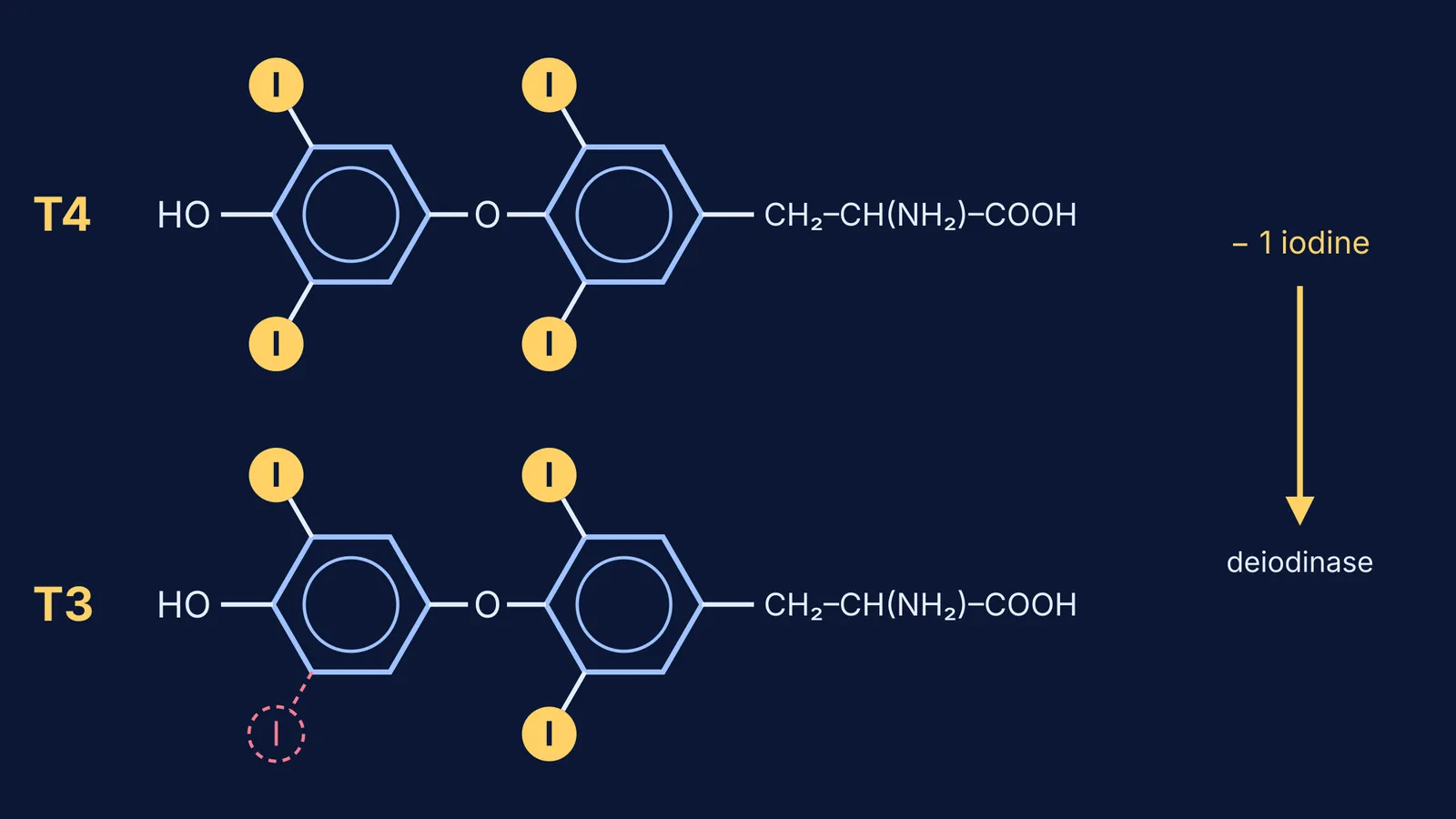
Guess the structure. Work in Paris had shown that thyroid tissue can remove iodine from its compounds. So the unknown might be thyroxine with one iodine missing: triiodothyronine.
Test the guess. At NIMR, Gross and Pitt-Rivers identified the compound as 3,5,3'-triiodothyronine and showed it was present in human plasma.
They published "The identification of 3:5:3'-L-triiodothyronine in human plasma" in The Lancet in March 1952 (volume 259, pages 439-441), as the Crossref record for the paper91952-1) confirms. The same history notes that Jean Roche's group in Paris published on T3 that year too, so the two laboratories confirmed each other's findings.
Why is T3 more active than thyroxine?
The pair followed up with "3:5:3'-Triiodothyronine. 2. Physiological activity" in the Biochemical Journal in 1953 (Crossref record; full text on PMC). According to the Tata-based history, they found T3 was 5 times as potent as thyroxine at suppressing goitre in rats.
Today's picture, summarised in the Wikipedia article on triiodothyronine, fits their result:
About 80% of the hormone the thyroid releases is T4 and about 20% is T3.
Deiodinase enzymes in tissues remove one iodine from T4 to make T3, and roughly 85% of circulating T3 is made this way, outside the thyroid.
T3's effects on target tissues are roughly four times more potent than T4's.
Both bind thyroid hormone receptors inside the cell nucleus, where they change which genes are switched on.
That last point is why thyroid hormones sit with steroids in the "intracellular receptor" group. Our explainer on how hormones act through membrane and intracellular receptors sets out the two routes side by side.
How can you use this story in Class 11 biology?
Turn the discovery into a chain you can rebuild in an exam:
Iodine in: the thyroid needs dietary iodine. For why that matters in India, read about V. Ramalingaswami's iodised salt study in the Kangra valley.
T4 out: the gland releases mostly T4, which has four iodine atoms.
T3 made: tissues remove one iodine to make T3, the more active form.
Action: T3 enters cells and acts on nuclear receptors to raise metabolic rate.
Control: thyroid hormone levels feed back on the pituitary's TSH. See how hormonal feedback loops keep levels steady.
Check yourself with three questions. What does the "3" in T3 count? (Iodine atoms.) Where is most T3 made? (In tissues, from T4.) Why do T3 and T4 act slowly but for a long time? (They change gene expression rather than firing a quick signal at the membrane.)
If a link in the chain feels shaky, such as receptors or negative feedback, the Fermi Concept Library has a lesson for every concept in biology and chemistry, each placed in a map so you can see what it connects to. Then try writing out the chain from memory once more and see which step you still miss.


