

On this page
In 1995, Rosalind Picard published a technical report at the MIT Media Lab titled *Affective Computing*, fundamentally changing the trajectory of artificial intelligence. She argued that emotions are not mere noise that gets in the way of logic. Instead, drawing on neuroscience, she showed that emotions are critical for rational decision-making and learning.
Picard defined the field as "computing that relates to, arises from, or deliberately influences emotions." She posited that "affect-blind" computers—systems that ignore how a person feels—are fundamentally impaired in their ability to interact with humans. By 2001, her team had demonstrated that machines could analyse physiological signals, such as skin conductance and respiration, to recognise human emotional states with 81% accuracy.
What is the "frustrated smile"?
If an educational program is to help a student, it must first understand their emotional state. But reading emotions is surprisingly complex. In a 2011 study, Picard and researcher M. Ehsan Hoque discovered a counter-intuitive phenomenon: the "frustrated smile".
When participants were asked to simply *act* frustrated for a camera, 90% of them did not smile. However, when the researchers intentionally frustrated participants with a badly designed, tedious computer task, 90% of them *did* smile. If a traditional computer program saw that smile, it would wrongly assume the user was delighted. Picard’s work showed that affective systems must look at the timing and context of signals to distinguish genuine delight from a coping mechanism. A student who smiles while struggling with a physics problem might actually be on the verge of giving up.
How does affective computing help students learn?
Learning is rarely a straight line from ignorance to mastery. When you encounter a hard problem in mathematics, confusion is a natural first step. If that confusion is not resolved, it turns into frustration.
A 2007 study by Winslow Burleson and Picard investigated how an "emotionally intelligent learning companion" could help students navigate this cycle. They found that different students need different types of support when they get stuck. For instance, some students benefited most from affective support—empathy and encouragement that validated their struggle—while others responded better to direct task support, such as a concrete hint.
The goal of affective computing in education is not to eliminate frustration entirely, because grappling with hard ideas is how deep learning happens. Instead, the goal is to keep the student from quitting when they hit the "frustration" phase of the cycle.
Fermi's AI tutor is built to manage this cycle. It teaches rather than simply printing an answer. It holds a line of reasoning across a whole session, noticing where a student is stuck. Because it works out what you already know and builds a plan for the session, it decides whether to explain a concept, ask a guiding question, or run a simulation. By adapting to the student's state, it helps push past frustration so you sit down to a clear next step.
The Learning Cycle: A framework for studying
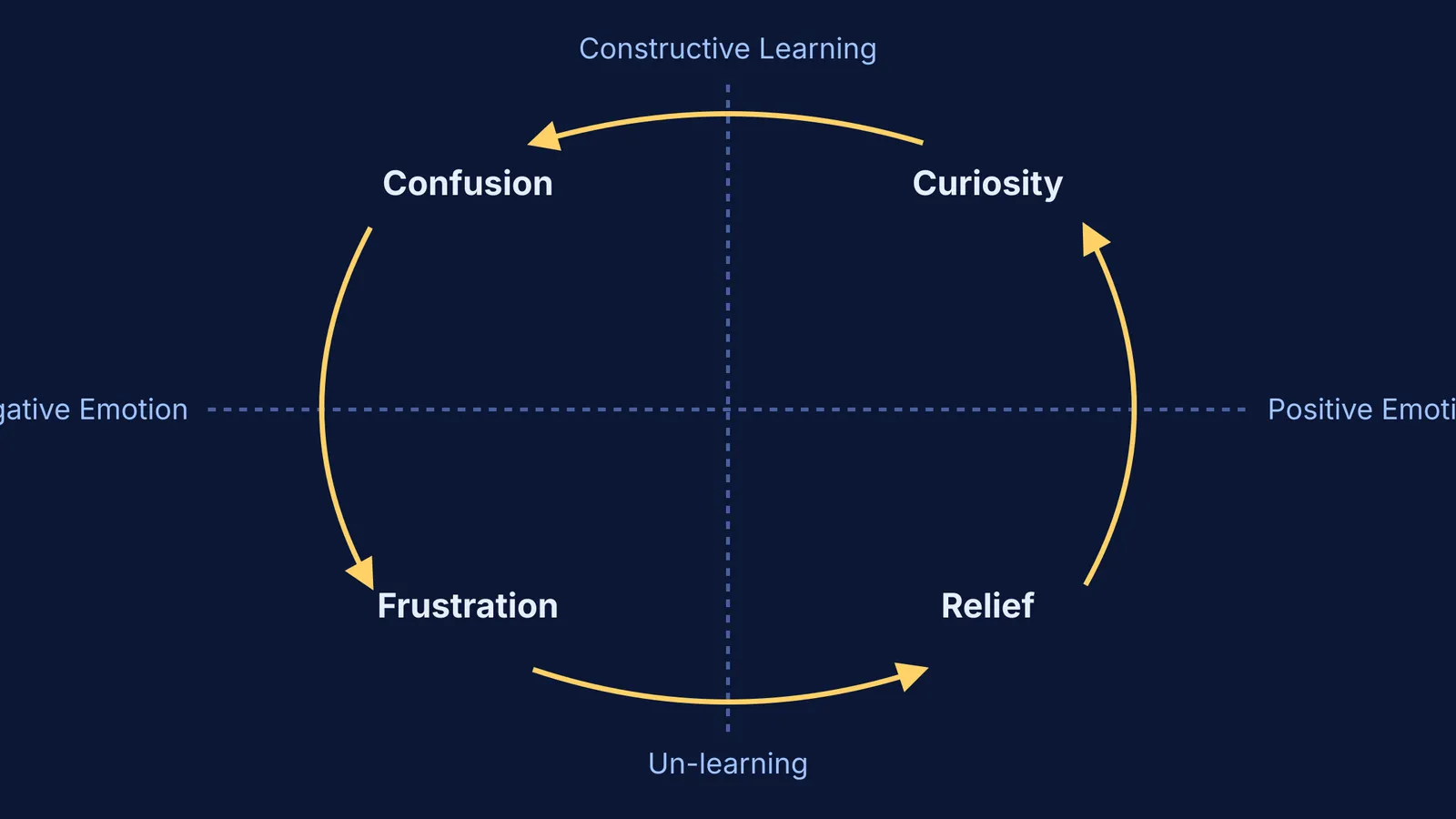
You can apply the lessons of affective computing to your own exam preparation by recognising the four quadrants of the learning cycle, as modelled by Picard and her colleagues:
Curiosity: You start a new topic and it makes sense. You are building knowledge and feeling positive.
Confusion: You hit a JEE Advanced or NEET problem that breaks your mental model. You are still trying to learn, but the emotion turns negative.
Frustration: You feel stuck, un-learn your false assumptions, and want to quit. This is where you must intentionally pause and give yourself the right "support".
Relief: You let go of the misconception, grasp the new idea, and return to curiosity.
The next time you hit Quadrant 3, do what an affective tutor would do: acknowledge the frustration without judging it. Pause for a short break to try a different angle, and if you are still stuck, seek a hint rather than staring at a blank page.
To learn more about how AI can support students, read about why hints are often better than direct answers and how an AI tutor differs from chatbots that just give answers.


