

On this page
Have you ever stopped to look at an equation and wondered where the symbols come from? Before the sixteenth century, reading mathematics was much like reading a paragraph of text. Every relationship between numbers had to be written out in words. That changed when one mathematician decided he was tired of writing "is equal to" over and over again.
Who invented the equals sign?
The equals sign (=) was invented in 1557 by Robert Recorde, a Welsh physician and mathematician. Born in Tenby around 1510, Recorde studied at Oxford and Cambridge and later served as a physician to King Edward VI.
Recorde was passionate about making mathematics accessible to English speakers. At the time, most scholarly texts were written in Latin. Recorde broke this tradition by writing textbooks in English, often phrasing them as dialogues between a master and a student. In his most famous book, *The Whetstone of Witte* (1557), he formally introduced the equals sign to the world, alongside bringing the plus (+) and minus (−) signs into the English mathematical vocabulary.
His work laid the groundwork for modern algebra in Britain, much like how Niccolò Tartaglia advanced the solving of cubic equations in Italy.
Why two parallel lines?
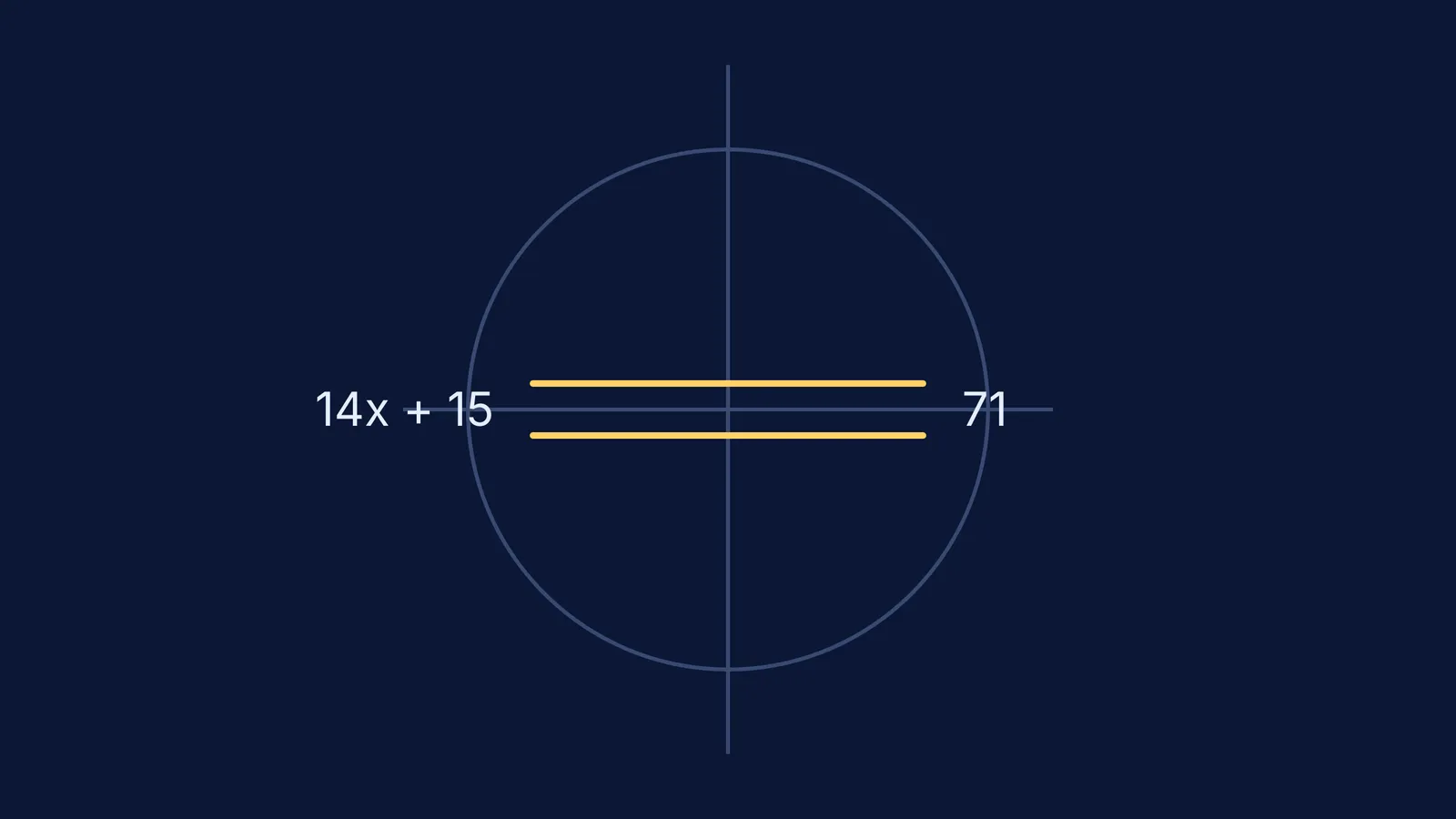
When Recorde introduced his new symbol, he explained exactly why he chose it. To avoid the "tediouse repetition" of writing words like "is equal to," he set down two long, parallel horizontal lines. As he wrote in *The Whetstone of Witte*, he chose this specific design because "noe .2. thynges, can be moare equalle".
Before this invention, mathematicians had to untangle dense blocks of text just to see the underlying relationships. By replacing a phrase with a single, clear symbol, Recorde gave the eye an immediate visual anchor. It separated the left side of a statement from the right, acting as a fulcrum for the mind.
How do symbols reduce cognitive load?
Recorde's invention was not just a matter of saving ink; it was a leap forward in how the human brain processes information. Hundreds of years later, educational psychologists would give a name to what Recorde intuitively understood.
In 1988, John Sweller published a foundational paper on Cognitive Load Theory in the journal *Cognitive Science*. Sweller demonstrated that human working memory is extremely limited in its capacity. He found that instructional design must minimise "extraneous load"—the unnecessary mental effort caused by how information is presented—so that learners can focus on the actual concepts.
Reading a sentence like "fourteen copies of a number and fifteen is equal to seventy-one" forces your working memory to juggle grammar, vocabulary, and mathematical logic simultaneously. This is a high extraneous load. When you read 14x + 15 = 71, the symbol instantly organises the information into a single "schema" or unit.
When you are learning algebra, translating word problems into equations is often where this cognitive load feels heaviest. This is where Fermi's AI tutor can step in: it works out what you already know and builds a plan for the session, helping you step-by-step to turn English words into mathematical symbols without overloading your memory.
How do you read an equation today?
The equals sign transformed algebra from a puzzle of words into a structural diagram. When you approach a new or difficult equation, you can use Recorde's symbol as a tool for active learning. Here is a practical checklist for breaking down complex equations:
Find the fulcrum: Locate the equals sign first. Treat it as the balancing point of a scale. Everything on the left must weigh the same as everything on the right.
Translate to words (just once): If a formula looks intimidating, say it out loud in plain English to ensure you understand the relationship it describes, then return to the symbols for your working steps.
Check your operations: Remember that any operation you perform on one side of the equals sign must be mirrored on the other to maintain that perfect equality Recorde envisioned.
Spot the variables: Identify which symbols are constants and which are changing.
If you need to practise maintaining this balance through a long derivation, the Fermi Problem Library has worked problems with a step-by-step solver that explains the reasoning rather than printing an answer.
Mathematics is a language built for clarity. Just as George Boole would later turn logic into algebra, Robert Recorde gave us the single most important punctuation mark in that language. Every time you balance an equation today, you are relying on a 16th-century physician's brilliant solution to tediouse repetition.


