

On this page
On August 17, 1807, a strange vessel originally named the *North River Steamboat*—but famously known as the *Clermont*—left New York City to travel up the Hudson River. Built by inventor Robert Fulton and his partner Robert R. Livingston, this journey proved that steam power was a reliable way to move goods and people. The voyage marked a turning point in history, transitioning society from sail power to mechanical power.
What was the Robert Fulton steamboat Clermont?
The *Clermont* was a wooden boat designed to carry passengers using the power of boiling water. It measured 150 feet long with two paddle wheels 15 feet in diameter. The boat was powered by a heavy steam engine manufactured in England by the famous firm of Boulton and Watt, who were pioneers of early thermodynamics.
Before this invention, river travel relied completely on the wind and tidal currents. Critics mockingly called the project "Fulton’s Folly," convinced that the heavy engine would sink the narrow hull or explode under pressure. Instead, the turning paddle wheels pushed the water backward, creating a forward reaction force that pushed the boat steadily against the river's natural current.
How fast did the Clermont travel in 1807?
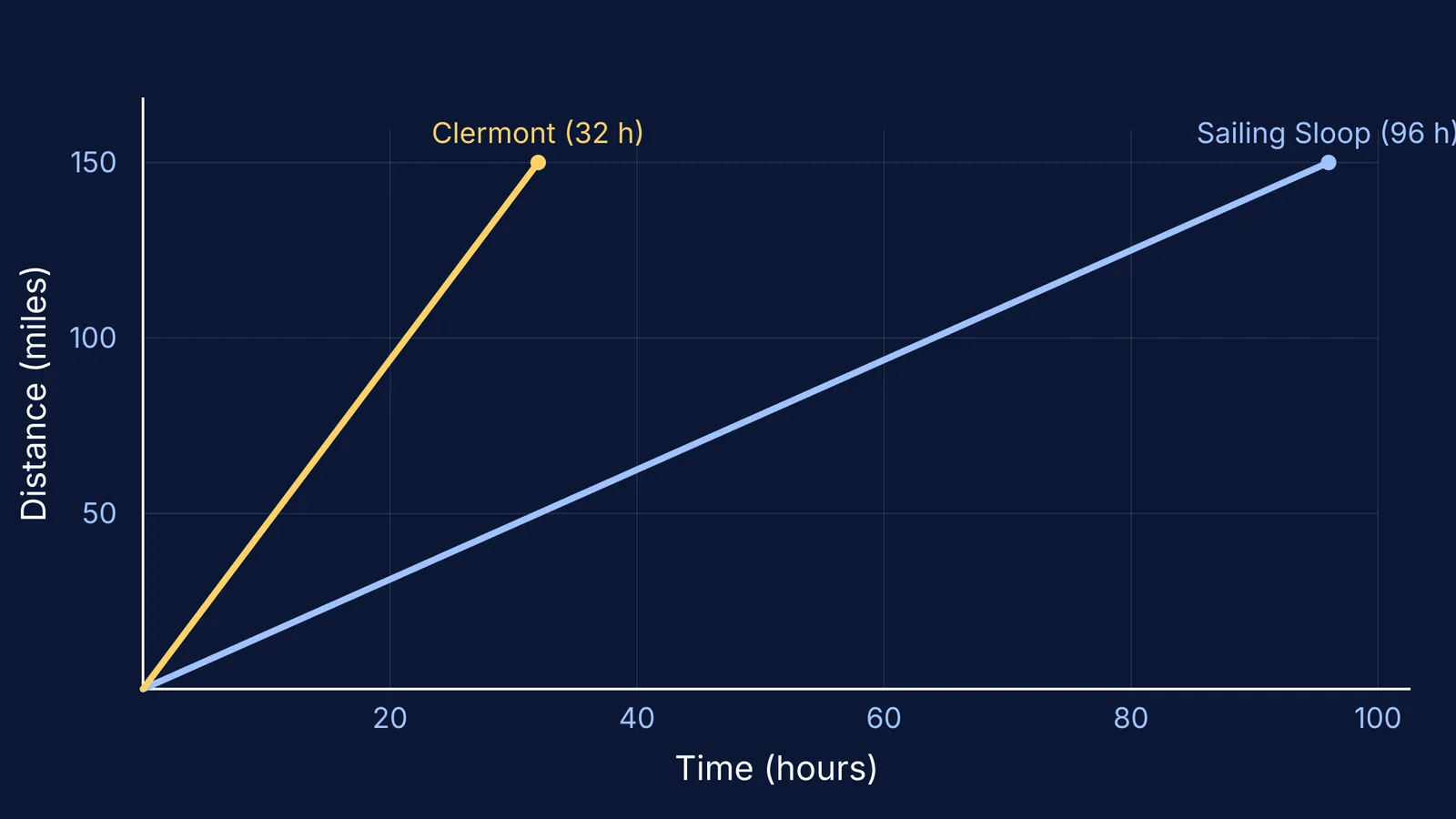
On its maiden voyage, the *Clermont* covered the 150-mile distance from New York to Albany in 32 hours of travel time. This means the steamboat averaged a speed of roughly 4.7 miles per hour. While this sounds like a brisk walking pace today, a traditional sailing sloop took up to four days (or 96 hours) to complete the exact same journey depending on wind conditions.
Calculating average speed is one of the foundational skills physics students learn when studying kinematics. If you are practising these early concepts and get stuck setting up your time and distance equations, Fermi's AI tutor can work out what you already know and build a plan for the session, teaching you by writing on a board.
A worked example: Calculating average speed
You can easily recreate the historical calculation that proved the *Clermont*'s incredible efficiency to the public. Average speed (v) is simply the total distance traveled (d) divided by the total time taken (t).
Identify the variables: The total distance d = 150 miles. The moving time t = 32 hours.
Set up the formula: v = d / t
Calculate the result: v = 150 / 32 = 4.6875
Final Answer: The average speed was approximately 4.7 miles per hour.
This simple math proved to the public that steam engines could offer consistent, calculable travel times—a guarantee that the unpredictable wind could never promise.
Why did the Clermont succeed where others failed?
Fulton was not the first person to build a steamboat, but he was the first to make it a practical and profitable business. His engineering genius was in the design compromises. He combined a reliable British engine with a long, flat hull that created enough thrust to overcome the water's physical drag.
The physics of steam engines changed the world by turning thermal energy into mechanical work. Today, science students study these same thermodynamic principles when calculating work in irreversible expansion. The expansion of steam inside the heated cylinders of the *Clermont* pushed heavy pistons, which then rotated the giant wooden paddle wheels.
What can students learn from Fulton's project?
Fulton's work reminds us that real-world engineering requires balancing many different forces at once. To build the *Clermont*, he had to accurately calculate the weight of the massive engine, the buoyancy of the wooden boat, and the drag forces of the Hudson River.
When you solve complex mechanics problems—such as finding acceleration given as a function of v—it helps to understand the system as a whole. If you are struggling to piece together these physical laws in your homework, the Fermi Problem Library has worked problems with a step-by-step solver that explains the reasoning rather than printing an answer.
Fulton's success ultimately proved that with the right application of physics and mathematics, transport no longer had to rely on the unpredictable weather.


