

On this page
The story of weather forecasting begins not with supercomputers, but with a tragic shipwreck and the electric telegraph. Before 1861, weather was widely thought to be impossible to predict with certainty. In October 1859, the *Royal Charter* steam clipper was wrecked in a severe storm off the coast of Anglesey, killing at least 450 people (Wikipedia). Robert FitzRoy, who was the Meteorological Statist to the Board of Trade and former captain of Charles Darwin's HMS *Beagle*, was convinced that storms could be tracked and sailors warned.
What was the first weather forecast in The Times?
FitzRoy knew that to predict the weather, he needed to know what the weather was doing across the whole country at the same moment. He set up a network of 15 coastal stations around Britain (Wikipedia). Local observers read their instruments—recording temperature, atmospheric pressure, and wind direction—and used the newly invented electric telegraph to send the data to London in near real-time. FitzRoy called his daily predictions "forecasts", a term of his own invention. He also actively debunked the pseudoscientific forecasting methods of his time.
On August 1, 1861, he published his first daily forecast in *The Times* (Wikipedia). It provided simple daily predictions based on the telegraph data. It was the first time the public could read a scientific prediction of tomorrow's weather over their breakfast.
How did the storm warning service work?
Before launching his public forecasts, FitzRoy's immediate goal was preventing shipwrecks. In February 1861, he initiated a warning service for shipping. When his telegraph data indicated a severe gale was approaching, FitzRoy sent a message back to the port towns. The local officials would then hoist a system of large black cones on a mast in the harbour.
The shape and arrangement of these cones told ships in the harbour which direction the storm was coming from, warning them not to set sail. This simple, visual communication system was an immediate success with sailors and saved countless lives, even though the broader scientific forecasts in the newspapers faced skepticism.
How does a FitzRoy barometer measure pressure?
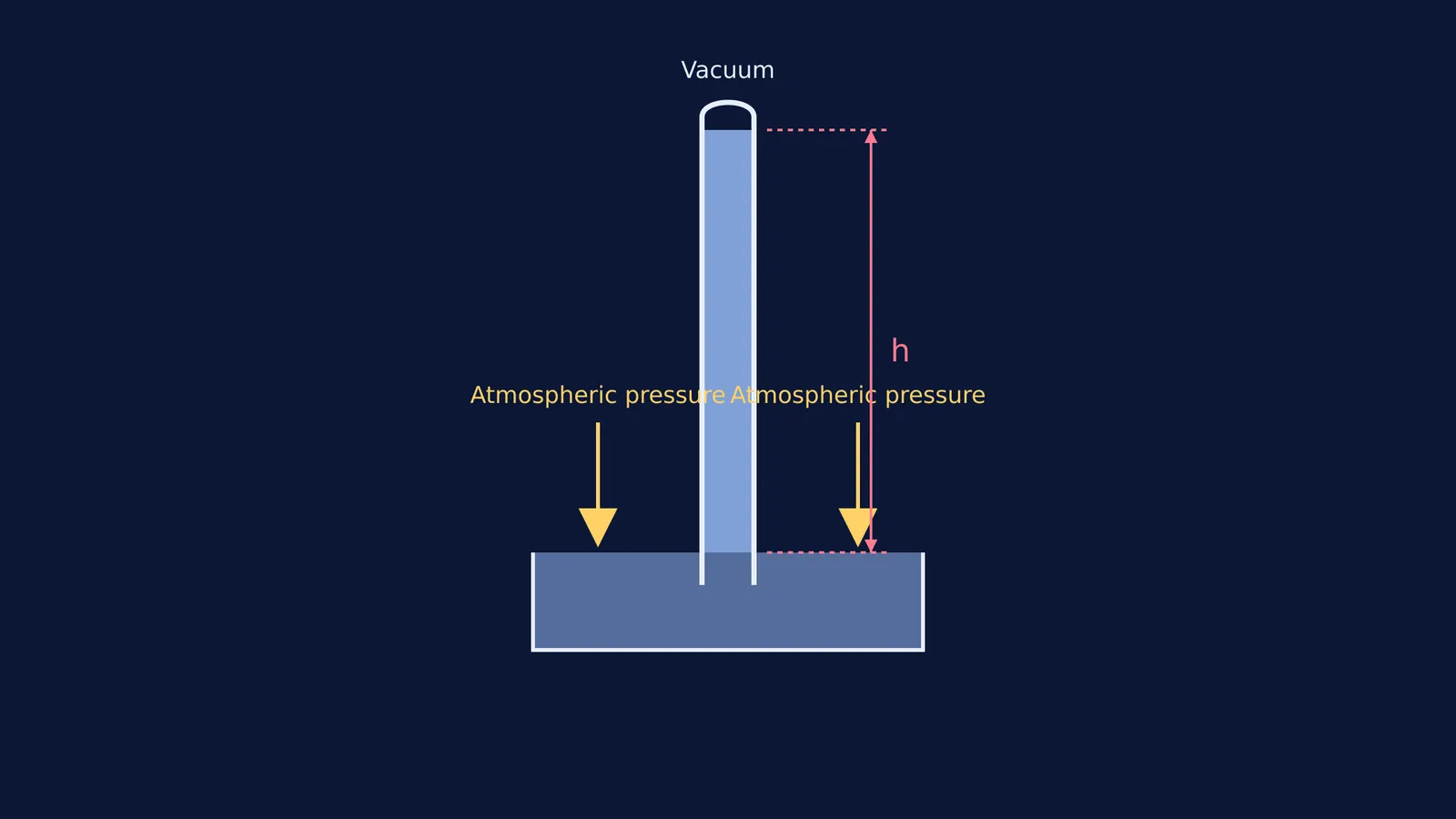
To help fishing communities gather this data themselves, FitzRoy designed a robust, affordable barometer that could be mounted in local ports. A barometer works by balancing the weight of the atmosphere against a column of liquid.
To find the atmospheric pressure (P) from the height of the mercury column (h), you use the basic hydrostatic pressure equation:
P = ρgh
where ρ is the density of mercury (13,600 kg/m³) and g is the acceleration due to gravity (9.81 m/s²) (Wikipedia). If the barometer reads 760 mm (0.76 m) of mercury, the pressure is 13,600 × 9.81 × 0.76 = 101,396 Pa, or about 1.01 × 10⁵ Pa (which is 1 standard atmosphere).
FitzRoy knew that a sudden drop in this column meant the air above was lighter, a sign of an incoming low-pressure storm system. If you are practising these calculations for your exams, Pressure at depth and gauge pressure: hydrostatics problems covers the math and underlying theory in detail.
For more complex scenarios where multiple fluids are involved, the Fermi Problem Library has worked problems on barometers and manometers, with a step-by-step solver that explains the reasoning rather than printing an answer.
Why was FitzRoy ridiculed for his forecasts?
Predicting a chaotic system like the Earth's atmosphere with so few data points is incredibly difficult. When FitzRoy's early forecasts were occasionally wrong, he was ridiculed in the press. More significantly, the scientific establishment of the time thought his methods were empirical guesswork rather than true science, and they openly criticized his work. Struggling with depression and having exhausted his personal fortune on the weather service, FitzRoy took his own life in 1865.
Today, the Met Office he founded uses supercomputers and satellite data, but they still rely on the exact basic principle FitzRoy proved: gather the initial conditions, apply the laws of physics, and run the model forward in time. If you are learning how these physical laws apply in different fluid contexts, you might find our guide on Fluid mechanics: pressure, buoyancy and Bernoulli mistakes to avoid helpful as a next step.


